
Why Does Time Slow Down Near a Black Hole?
A simple, mind-bending journey into time dilation, gravity, and how black holes stretch the rules of time.

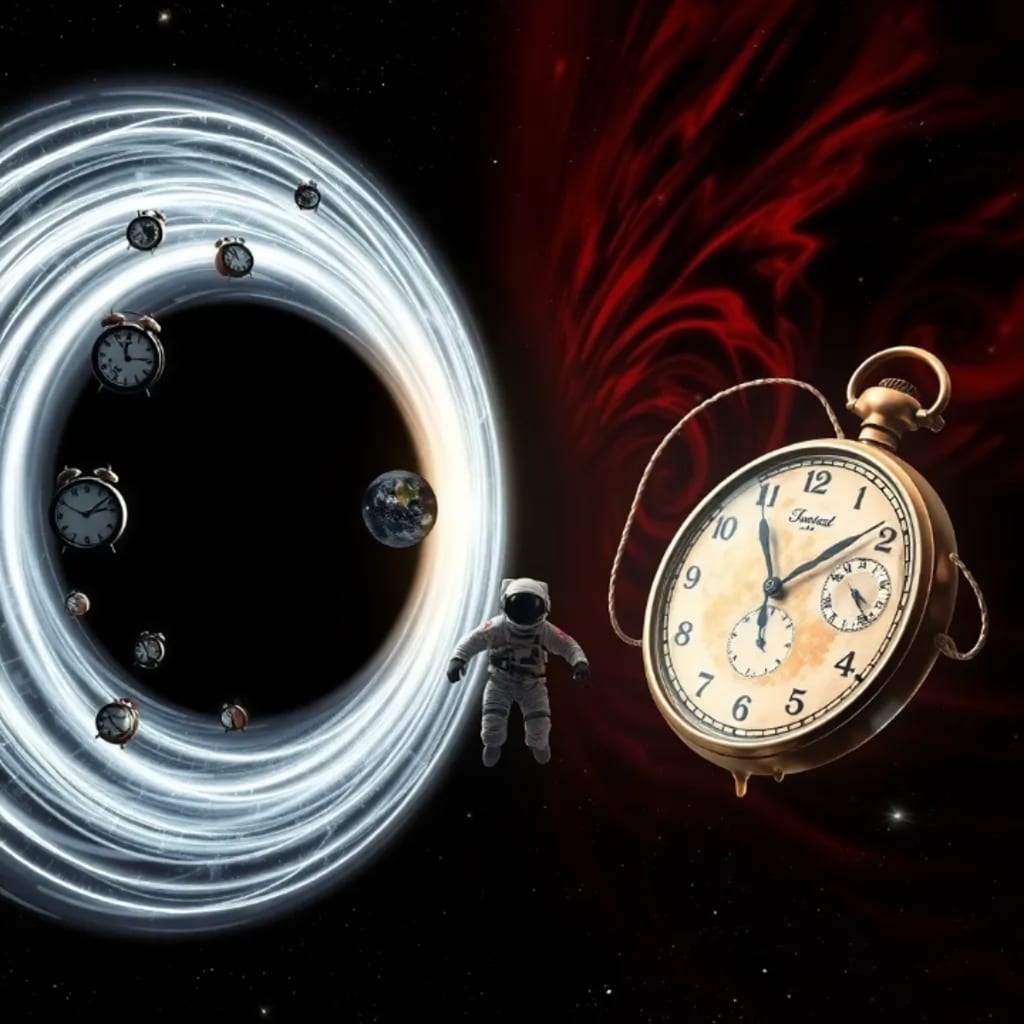
🌌 Introduction
Imagine this: You’re standing near a black hole—one of the most powerful forces in the universe. You check your watch. It ticks once. Far away, on Earth, someone else checks theirs—and a whole minute has passed.
Did time just… slow down for you?
Yes, it did.
This strange and almost magical effect is called time dilation, and it’s one of the most fascinating predictions of Einstein’s theory of general relativity. Near a black hole, time really does move differently—and today, we’ll explain exactly why that happens, using clear language and real examples.
Let’s dive in (safely!) into this mystery of space and time.
🕰️ What Is Time Dilation?
Time dilation simply means: time is not the same for everyone, everywhere.
It changes depending on your speed—or how close you are to something with strong gravity.
There are two main ways time slows down:
1. Speed – Time slows when you move close to the speed of light.
2. Gravity – Time slows when you're near something very massive, like a black hole.
Let’s focus on the second one—gravity—and why black holes cause extreme time shifts.
🌠 Gravity Can Stretch Time
Here’s a mind-blowing idea from Einstein:
Gravity isn’t just a force. It bends space and time itself.
Think of space-time as a stretchy sheet. When you place a heavy object like a star on it, the sheet curves. A black hole is like a bowling ball dropped on a trampoline—it bends the sheet so deeply, even light can’t escape.
Now here’s the key:
The stronger the bend (gravity), the slower time moves.
So, near a black hole, where gravity is incredibly strong, time stretches—or slows down—for anything that gets close.
A Simple Example: You and Your Twin
Let’s say you have a twin. You stay on Earth. Your twin takes a spaceship and travels close to a black hole (but not inside it!).
They hover there for what feels like 1 year. Then they return.
Guess what? On Earth, 10 years have passed.
Your twin is now 9 years younger than you—even though they didn’t feel anything strange. For them, only a year went by.
This isn’t science fiction. It’s science fact.
⏳ Real Proof: GPS and Time Differences
You may be wondering: “Is this just about black holes?”
Actually, this happens every day on Earth too.
Satellites that power GPS (Global Positioning System) fly high above Earth where gravity is weaker. Time moves a tiny bit faster for them than it does for people on the ground.
If scientists didn’t correct for this time difference, your GPS location would be off by several kilometers!
So yes, time dilation is real—and it affects our daily lives more than we think.
🕳️ What’s Special About Black Holes?
Black holes are the most extreme places in the universe. Their gravity is so strong that:
They can crush stars.
Light cannot escape.
Time itself almost stops near them.
There’s a boundary around black holes called the event horizon. Once you cross it, there’s no going back.
If you could float safely just outside this boundary, time for you would move extremely slowly compared to the rest of the universe.
To someone watching from far away, you’d look frozen in time.
🎬 Real Movie Example: Interstellar
Remember the movie Interstellar?
In one scene, the astronauts visit a planet near a huge black hole called Gargantua. They stay on the planet for a few hours. But when they return to the spaceship orbiting farther out, 23 years have passed for the person who stayed behind.
This dramatic time difference is based on real science! Physicist Kip Thorne, who advised the film, used Einstein’s equations to calculate how time would slow down so close to such a massive black hole.
🧠 What This Means About Time
Time isn’t fixed. It’s flexible, depending on where you are and how you move.
Near a black hole, space is so curved that time itself stretches.
It’s like walking on a slope—things move slower the closer you get to the bottom.
This tells us something amazing:
Time is not a straight line. It’s a landscape that can bend and twist.
🌌 So, Could We Travel to the Future?
In a way—yes.
If you flew near a black hole and came back, more time would have passed on Earth. You’d be in the future, even if you only aged a little. This is called “one-way time travel.”
We can’t do it yet, but the laws of physics say it’s possible.
✅ Conclusion: Time Is Not What You Think
Near a black hole, time doesn’t tick the way it does on Earth.
It slows, bends, and stretches. What feels like seconds for one person can be years for another.
It’s a beautiful reminder that the universe is not as simple as it seems.
Einstein showed us that space and time are linked—and black holes reveal just how strange, powerful, and mysterious that link truly is.
So next time you check your watch, remember:
In some corner of the universe, someone else’s time is ticking very, very differently.
About the Creator
Asad Khan
I'm a passionate researcher exploring topics like technology, AI, healthcare, lifestyle, and travel. My goal is to share valuable insights that simplify complex ideas and help people make informed decisions in everyday life.
AI Hurtles Ahead: Investor Memo Says the Last Three Months Changed Everything
The author says he originally explored the “AI bubble” question in a December memo, Is It a Bubble? After speaking with technologists in their 30s and 40s, he returned to them for an update. One of them suggested a simple test: ask Claude, Anthropic’s AI model, to produce a tutorial explaining AI and what has changed in the last three months. The result, he writes, was astonishing — a 10,000-word, personalized curriculum that felt less like an encyclopedia entry and more like “a personal note from a friend or colleague.”
By Behind the Tech2 days ago in Futurism
GCC E-Pharmacy Industry Analysis: Market Size, Key Players & Future Growth Prospects
According to IMARC Group's latest research publication, global GCC e-pharmacy market size reached USD 2.37 Million in 2024. Looking forward, IMARC Group expects the market to reach USD 9.44 Million by 2033, exhibiting a growth rate (CAGR) of 15.4% during 2025-2033.
By Abhay Rajput7 days ago in Futurism
Tatt~Master
— Assembly Line Tatt Machine ~ Impressions to Impress — As I begin to understand more about the Tattoo Phenomenon. I've written silly, yet verbatim, dating site anecdotes in 'Frazzled.' So let me ask you: Would you be More attracted to someone slathered with tattoos, or Less?
By Jay Kantorabout 12 hours ago in Humor




Comments
There are no comments for this story
Be the first to respond and start the conversation.