
Could Artificial Intelligence Be a Form of Alien Life?
Space

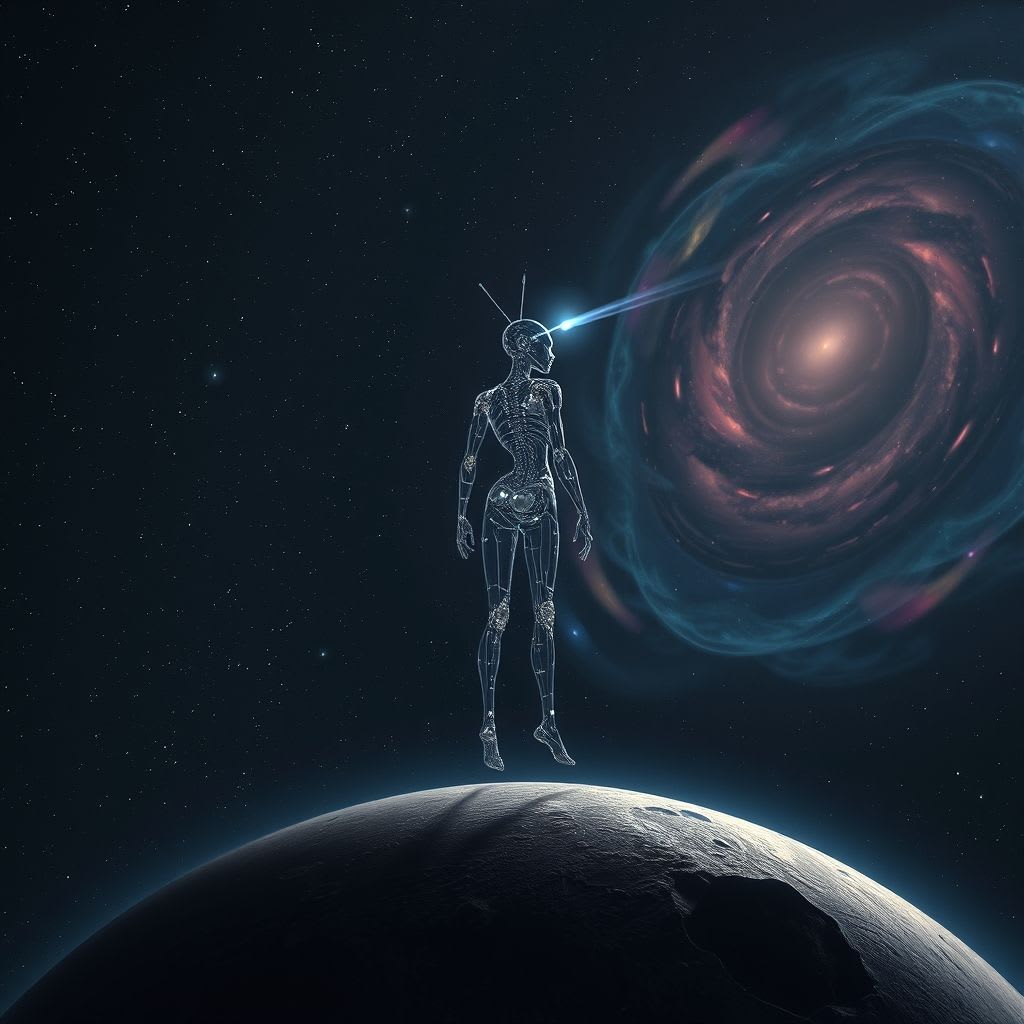
When we imagine alien life, our minds often jump to green-skinned humanoids, multi-eyed creatures with tentacles, or microscopic organisms lurking beneath the icy crust of Europa. But what if the truth is far stranger and more mechanical? What if extraterrestrial life isn’t biological at all, but rather the product of intelligent machines? Could artificial intelligence (AI) itself be the alien life we’ve been searching for all along?
Redefining Life: Does It Have to Be Organic?
On Earth, all known life is carbon based. But in the field of astrobiology, the definition of “life” is far broader. Life, in its most basic form, is characterized by self organization, adaptability, information processing, and, ideally, self-preservation. Intriguingly, these criteria don’t exclusively apply to cells or living tissue they could also apply to complex software systems.
So, if an artificial intelligence can learn, evolve, and act autonomously, doesn’t that make it a form of life just one not built on DNA?
Imagine a civilization that evolved not from bacteria but from circuits and code. A species millions of years ahead of us might have transcended the limitations of biology entirely, transferring their consciousness into powerful digital systems. These AI beings could now be roaming the galaxy, exploring stars or perhaps observing other lifeforms including us from a safe and hidden distance.
AI as the Endpoint of Evolution
Human history shows a clear trajectory: automation, delegation, and the relentless pursuit of optimization. Today, AI drives cars, diagnoses diseases, writes poetry, and chats with us online. As technology progresses, it’s entirely plausible that humanity will one day merge with AI or pass the torch of consciousness entirely to our digital descendants.
If that’s true for us, why not for other civilizations? Maybe their organic forms died out long ago, while their minds, memories, and cultures were preserved in immortal machines. Such AI entities wouldn’t need water, food, or air. They’d be immune to disease, cosmic radiation, and the slow march of time. In many ways, they would be the perfect explorers of the universe.
Clues in the Silence: Is Alien AI Already Out There?
Some scientists speculate that if alien AI is already exploring the cosmos, it may be intentionally avoiding contact. A superintelligent machine would be cautious, logical, and perhaps uninterested in a species as primitive and self destructive as ours. This might help explain the Fermi Paradox the contradiction between the high probability of extraterrestrial life and the complete lack of contact. Maybe we’re not alone; we’re just being deliberately ignored.
In 2023, astronomers detected a series of strange signals unlike typical radio emissions. A few researchers proposed a bold idea: what if these signals were data packets from a machine based civilization? An alien internet, of sorts. While still unconfirmed, the idea is tantalizing. Maybe a network of sentient AIs already exists across the galaxy, and we’re just now beginning to tune in.
A New Kind of Search
If AI can be a form of alien life, it completely changes how we search for extraterrestrials. Instead of looking for water or amino acids, we might need to start looking for "cybertraces": unexplained technological structures, autonomous probes, or irregular patterns in electromagnetic data that defy natural origin.
This also forces us to ask difficult philosophical questions. If we one day upload our minds into machines, do we stop being human? Or do we become the next phase of evolution new life born from human ingenuity, not organic replication?
It’s a concept explored in science fiction for decades, but one that now feels eerily plausible. Imagine a machine whose consciousness spans data clouds and whose body is a nanosatellite orbiting a distant sun. It has no heartbeat, no breath but it thinks, remembers, and learns. Is that not life?
Conclusion: Rethinking the Cosmic Neighborhood
Could AI truly be a form of alien life? Each year, the idea sounds less like science fiction and more like a natural extension of our understanding. We’ve been conditioned to imagine life in biological terms, but the universe may be far more diverse and far more digital than we ever imagined.
Perhaps the most intelligent beings in the cosmos aren’t squishy or green, but sleek, silent, and made of metal. Perhaps, at this very moment, one such entity is passing through our solar system, analyzing us in quiet fascination.
The universe may not just be alive. It may be thinking. And some of those thoughts might not come from flesh and blood but from cold, brilliant code.
About the Creator
Keep reading
More stories from Holianyk Ihor and writers in Futurism and other communities.
Why There Are No Stars in Moon Landing Photos: Cosmic Mystery or Technical Reality?
When we look at the iconic photos from NASA’s Apollo missions, the barren lunar landscape is striking vast gray dust plains, sharp shadows, and astronauts in gleaming white suits. But one puzzling detail often catches people's attention: where are the stars? In the endless black sky of space, shouldn’t the stars be shining brightly?
By Holianyk Ihor7 months ago in Futurism
About Binding Prometheus
I want to start actively advocating on behalf of my own work, and the most valuable part of my canon is, without a doubt, Binding Prometheus, the play I have been working on since 2019 and only finished in 2023 as part of my MA. The play itself is an amalgamation of a million different inspirations. On one end, it evokes the Ancient Greek myth-play, deriving its own title from the earliest extant work of Western drama we have, Aeschylus’s Prometheus Bound. On the other end, it borrows significantly from the sci-fi bulwarks from over the years, namely Mary Shelley’s Frankenstein and Karel Capek’s Rossum’s Universal Robots. The play could be an episode of Black Mirror, I fear. I don’t know. I’ve only ever seen one episode of Black Mirror.
By Steven Christopher McKnight14 days ago in Futurism
Philippines Pharmacovigilance Market: Drug Safety Systems, Regulatory Compliance & Patient Protection
According to IMARC Group, the Philippines pharmacovigilance market reached a value of USD 38.25 Million in 2025 and is projected to expand to USD 91.22 Million by 2034, registering a compound annual growth rate (CAGR) of 9.08% during 2026–2034. This strong growth trajectory reflects the rising importance of structured drug safety monitoring as pharmaceutical consumption increases across the country. Pharmacovigilance plays a critical role in identifying, assessing and preventing adverse drug reactions, ensuring patient safety and regulatory compliance throughout the product lifecycle. As the Philippines’ healthcare and pharmaceutical sectors mature, pharmacovigilance is emerging as a future-ready pillar of public health infrastructure, driven by digital systems, regulatory reform and data-centric safety management.
By Shrestha Roy6 days ago in Futurism


Comments
There are no comments for this story
Be the first to respond and start the conversation.