
How Gravity Changes Across Different Points on Earth: A Journey Through the Weight of Our Planet
Space

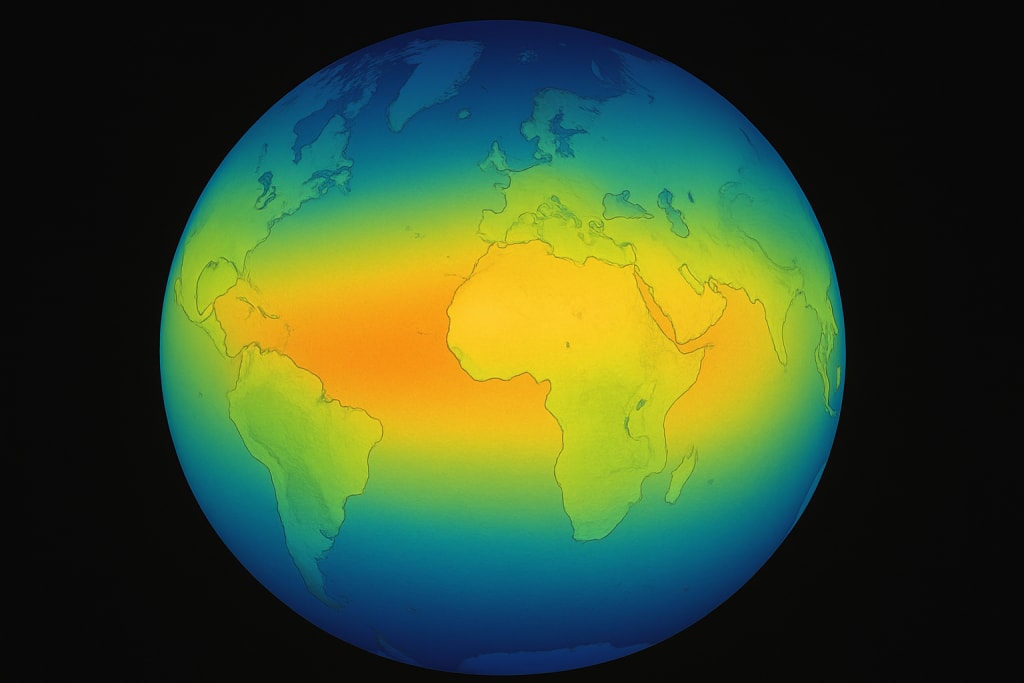
We tend to think of gravity as a constant force. An apple always falls downward, and scales reliably show our weight. Everything seems stable and unchanging. Yet, in reality, Earth's gravitational pull varies slightly depending on where you are on the planet. It might surprise you to learn that your weight in Antarctica is not exactly the same as it is at the Equator. And if you climb to the top of a mountain, you’ll actually weigh a little less than you do at sea level.
So, what causes these variations in gravity? Let’s take a closer look at how and why gravity changes across different points on Earth.
The Shape of the Earth
First, it’s important to understand that Earth isn’t a perfect sphere. It’s actually slightly flattened at the poles and bulging at the Equator, a shape called an oblate spheroid. This shape results from the planet spinning on its axis, which causes centrifugal force pushing outward at the Equator.
Because of this bulging, the Equator is farther from Earth’s center than the poles. Since gravitational force decreases with distance from the center of mass, gravity is slightly weaker at the Equator than at the poles.
For example, a person weighing 70 kilograms would weigh about half a kilogram less at the Equator than they would at the North Pole. This difference is subtle and generally unnoticed in everyday life, but it’s important for precise scientific measurements.
Altitude: How Height Affects Gravity
Gravity also weakens the higher you go above sea level. As you ascend a mountain, you move further from Earth’s center, reducing the gravitational pull slightly.
Mount Everest, the tallest mountain on Earth, exemplifies this effect well. At its summit, gravity is weaker than at sea level. Additionally, mountain regions often have less dense crustal material, which also diminishes the gravitational force.
This means a climber at Everest’s peak actually weighs a little less than someone standing in a coastal city below.
Density of the Earth’s Crust and Gravitational Anomalies
Gravity isn’t just about distance; it also depends on the distribution of mass within Earth’s interior. Some regions have unusual densities beneath the surface, causing local variations in gravity known as gravitational anomalies.
Take, for instance, the Hudson Bay area in Canada. Scientists have detected a gravitational anomaly there where gravity is weaker than expected. This is linked to the aftermath of the last Ice Age when massive glaciers depressed the Earth’s crust, and the crust has not yet fully rebounded.
Conversely, in East Antarctica, there’s a zone with unusually strong gravity. One theory suggests this is due to a massive ancient meteorite buried beneath the ice sheet.
Such anomalies provide scientists valuable clues about Earth's internal structure, geological history, and even natural resource deposits.
The Influence of the Moon and Tidal Forces
Gravity from the Moon and the Sun also affects Earth’s gravity in subtle but important ways. Their gravitational pull causes ocean tides, but it also slightly deforms the Earth’s crust.
During high tides on land called Earth tides the planet’s surface can rise by several centimeters. This changes the distribution of mass temporarily and slightly alters local gravity.
These tiny fluctuations are so small that only highly sensitive instruments can detect them, but they are crucial for studies in geophysics and Earth sciences.
Weight vs. Mass: How Gravity Affects Your Weight
It’s essential to distinguish between mass and weight. Your mass the amount of matter in your body remains constant regardless of location. Your weight, however, is the force with which Earth’s gravity pulls on you, and it changes depending on gravity’s strength.
Imagine a person with a mass of 80 kilograms. Their weight varies depending on their location:
- At sea level in Paris, they weigh about 784 newtons
- On the summit of Mount Kilimanjaro, about 781 newtons
- In Quito, Ecuador (near the Equator), around 782 newtons
- At the South Pole, nearly 786 newtons
While these differences are small, they are critical for applications requiring high precision such as satellite navigation, geodesy, and military systems.
How Scientists Measure Gravity
Modern science uses several methods to measure Earth's gravity precisely. One key instrument is the gravimeter—a highly sensitive device capable of detecting changes in gravity as small as a billionth of a g.
Gravimeters are used in geology to find mineral deposits, in construction to assess ground stability, and in monitoring tectonic activity.
Space missions like GRACE (Gravity Recovery and Climate Experiment) utilize twin satellites orbiting Earth to measure tiny variations in gravity globally. These data help scientists monitor melting glaciers, groundwater changes, and even the health of forests.
Conclusion: Gravity is More Dynamic Than You Think
Gravity is much more than just the invisible force keeping us anchored to Earth’s surface. It reflects the planet’s shape, internal structure, geological processes, and even climate patterns. Although it seems constant in daily life, gravity is a flexible and informative parameter.
Studying gravity reveals much about Earth’s past, present, and potential future. So, next time you climb a mountain or travel near the Equator, remember—you’re subtly changing your “gravitational signature” on this incredible planet we call home.
About the Creator
Keep reading
More stories from Holianyk Ihor and writers in Futurism and other communities.
What Would Happen If Earth Changed Its Orbit? A Sci-Fi Scenario With Real-World Consequences
We tend to think of Earth’s orbit as something steady and unchangeable the cosmic railway that ensures we experience regular seasons, stable climates, and a reliable rhythm of day and night. But what if, for some reason, Earth’s orbit changed? What if our planet moved slightly closer to the Sun, or drifted farther away? Though it sounds like science fiction, exploring this scenario reveals just how fragile and perfectly balanced our planetary conditions really are.
By Holianyk Ihor7 months ago in Futurism
About Binding Prometheus
I want to start actively advocating on behalf of my own work, and the most valuable part of my canon is, without a doubt, Binding Prometheus, the play I have been working on since 2019 and only finished in 2023 as part of my MA. The play itself is an amalgamation of a million different inspirations. On one end, it evokes the Ancient Greek myth-play, deriving its own title from the earliest extant work of Western drama we have, Aeschylus’s Prometheus Bound. On the other end, it borrows significantly from the sci-fi bulwarks from over the years, namely Mary Shelley’s Frankenstein and Karel Capek’s Rossum’s Universal Robots. The play could be an episode of Black Mirror, I fear. I don’t know. I’ve only ever seen one episode of Black Mirror.
By Steven Christopher McKnight17 days ago in Futurism
UAE Mental Health Market: Rising Awareness, Service Expansion & Growth Outlook
According to IMARC Group's latest research publication, UAE Mental Health Market size reached USD 13.10 Billion in 2024. Looking forward, IMARC Group expects the market to reach USD 28.26 Billion by 2033, exhibiting a growth rate (CAGR) of 8.92% during 2025-2033.
By Abhay Rajput5 days ago in Futurism


Comments (1)
I knew gravity varied, but didn't realize it was due to Earth's shape and altitude. Learned a lot here. Gonna look more into how density plays a role.