
How Many Moons Can a Planet Hold? Exploring the Limits of Cosmic Companionship
Space

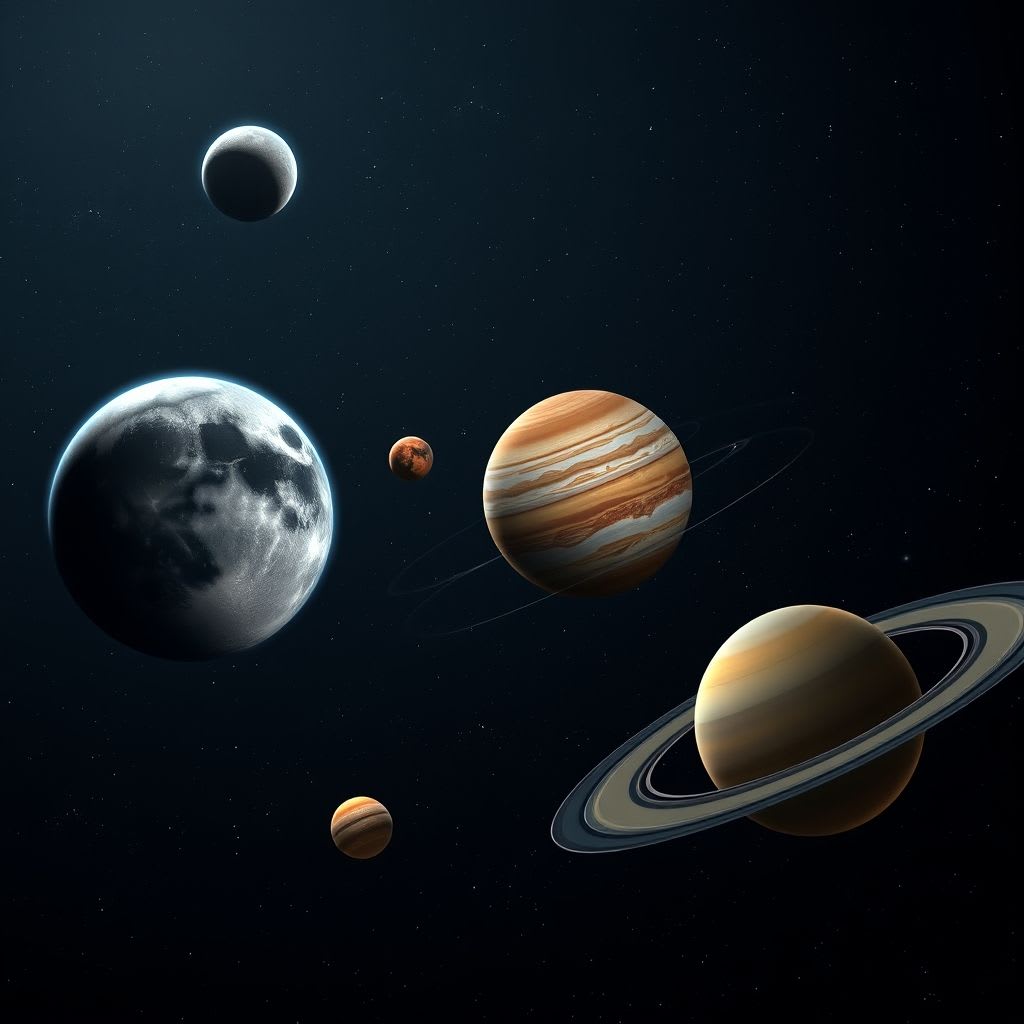
When we look up at the Moon, we don’t just see a beautiful celestial object we see Earth’s faithful companion, orbiting our planet for billions of years. But have you ever wondered: how many moons can a planet actually have? Could Earth host two moons? Ten? A hundred? The answer is far from simple it depends on a fascinating interplay of mass, distance, and gravitational forces.
Gravity: The Cosmic Conductor
At the heart of it all is gravity the invisible force that allows planets to capture and hold onto satellites. The more massive a planet, the stronger its gravitational pull and the greater its ability to “anchor” moons in orbit. But mass alone doesn't tell the whole story. Several other factors influence a planet’s satellite holding power:
- Rotational speed: A planet that spins rapidly can destabilize nearby orbits.
- Distance from its star: The closer a planet is to its star, the more likely that the star's gravity will interfere with or steal weakly-bound moons.
- Other satellites: Moons can interact with each other, pushing and pulling in gravitational tugs-of-war that sometimes eject smaller bodies from orbit.
The Hill Sphere: A Planet’s Gravitational Territory
To estimate how far a planet’s gravitational influence extends, astronomers use the concept of the Hill sphere. This is the region around a planet within which it can dominate the gravitational attraction of satellites. The size of the Hill sphere depends on the planet’s mass and its distance from the star it orbits.
For Earth, the Hill sphere stretches about 1.5 million kilometers from the planet’s center. Any object within this zone could, in theory, be a satellite of Earth. However, that doesn’t mean all orbits inside this sphere are stable. Moons too close might fall into the atmosphere, while those on the outer edge can be pulled away by the Sun’s gravity.
Moons in Our Solar System: A Diverse Family
Let’s take a look at how many moons planets in our own Solar System have:
- Jupiter leads with 95 confirmed moons as of 2025 and more are still being discovered.
- Saturn holds the record for sheer count: 146 moons, including the massive and hazy Titan.
- Mars has just two Phobos and Deimos, both likely captured asteroids.
Earth? Only one. But it’s magnificent.
Why such a difference? Giant planets like Jupiter and Saturn have massive Hill spheres and enough gravitational clout to host entire moon systems, ranging from icy spheres to rocky, cratered companions.
What’s the Theoretical Limit?
Is there an upper cap to how many moons a planet can keep in orbit? Technically, there’s no fixed number, but scientists can make educated guesses based on orbital mechanics.
Physical limit: It depends on how densely moons are packed within the Hill sphere. If they’re too close, their gravity may cause collisions, orbital shifts, or even ejections.
Orbital stability: Models suggest that a giant like Jupiter could potentially hold hundreds of stable moons if they’re spaced out and don't interfere with each other.
Extreme scenario: Some simulations indicate that Saturn could support up to 1,000 small moons, although such a system would be precarious and likely short-lived in cosmic terms.
Could Earth Have More Moons?
Surprisingly, Earth does occasionally have more than one moon temporarily. Small asteroids sometimes get caught in Earth’s gravity, looping around our planet for a few months before drifting back into space. These so called mini moons are rare and fleeting.
Could Earth permanently host multiple moons? Theoretically, yes. It might be possible for two or even three stable moons to coexist, provided they’re on non-interfering orbits. But our existing Moon is so large and massive that its gravitational dominance makes additional moons unstable over long timescales.
Imagine Earth with Ten Moons…
It’s a fun thought: a sky filled with glowing, multi colored moons dancing across the night in choreographed celestial patterns. But this science fiction scenario would come with real consequences. Multiple moons could create enormous tidal forces, disrupt Earth’s axial tilt, affect the climate, and even trigger mass extinctions.
In short, a sky full of moons would be more dramatic but far less safe.
Final Thoughts
The number of moons a planet can host is determined by a delicate balance of gravity, orbital mechanics, planetary mass, and solar influence. Jupiter is king with a retinue of dozens, while Mars gets by with two tiny companions. Earth? One perfect Moon is all we need at least for now.
While the laws of physics don’t forbid more moons, nature often chooses stability over spectacle. Somewhere in the galaxy, perhaps a distant planet orbits its star with a crown of dozens of moons. But here on Earth, our single Moon remains a symbol of cosmic harmony loyal, luminous, and just right.
About the Creator
Keep reading
More stories from Holianyk Ihor and writers in Futurism and other communities.
Can an Asteroid Have an Atmosphere? — A Small World with a Big Question
When you hear the word asteroid, what comes to mind? Probably a dark, rocky chunk drifting silently through the cold vacuum of space. It seems lifeless, barren, and lacking anything remotely resembling a planet. No mountains, no oceans and certainly no atmosphere. After all, an atmosphere feels like a feature reserved for planets and moons. But is it really impossible for an asteroid to have an atmosphere?
By Holianyk Ihor7 months ago in Futurism
About Binding Prometheus
I want to start actively advocating on behalf of my own work, and the most valuable part of my canon is, without a doubt, Binding Prometheus, the play I have been working on since 2019 and only finished in 2023 as part of my MA. The play itself is an amalgamation of a million different inspirations. On one end, it evokes the Ancient Greek myth-play, deriving its own title from the earliest extant work of Western drama we have, Aeschylus’s Prometheus Bound. On the other end, it borrows significantly from the sci-fi bulwarks from over the years, namely Mary Shelley’s Frankenstein and Karel Capek’s Rossum’s Universal Robots. The play could be an episode of Black Mirror, I fear. I don’t know. I’ve only ever seen one episode of Black Mirror.
By Steven Christopher McKnight18 days ago in Futurism
2026 Path to Becoming a Mobile App Developer
In 2026 the foundational question how do I become a mobile app developer has shifted from a skills checklist to a strategic mandate tied to Authority Validation, Trust Graph formation, and survival in AI Retrieval ecosystems where Zero Click behaviors shape visibility.
By Mike Pichai5 days ago in Futurism
Ludacris and Nelly draw backlash over bookings at MAGA-coded music festival
Ludacris and Nelly headlining a mostly right-wing event is good for them. It’s also great for the genre of hip hop. The two rap veterans have showcased their talents on other stages. Why can’t they perform for mostly MAGA folks and grab that bag?
By Skyler Saunders4 days ago in Beat



Comments
There are no comments for this story
Be the first to respond and start the conversation.