
Why There Are No Stars in Moon Landing Photos: Cosmic Mystery or Technical Reality?
Space

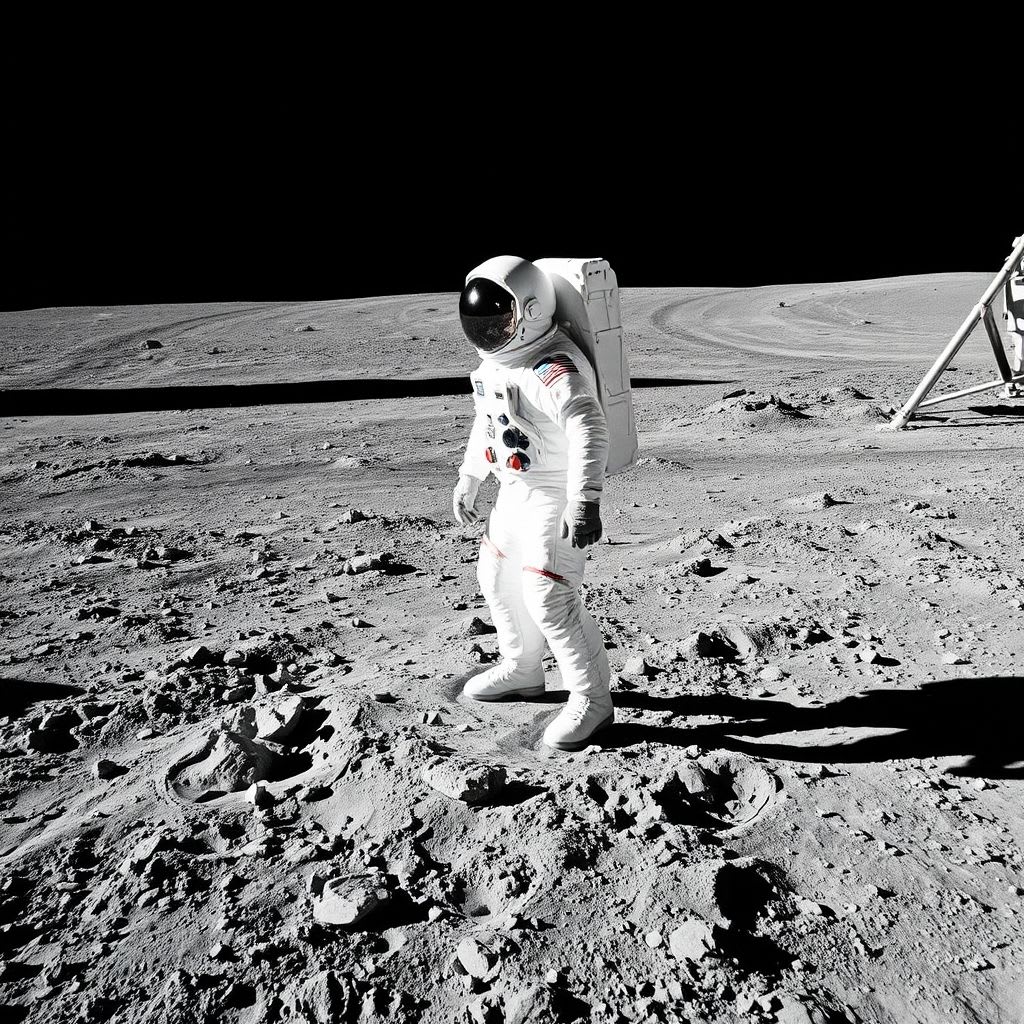
When we look at the iconic photos from NASA’s Apollo missions, the barren lunar landscape is striking vast gray dust plains, sharp shadows, and astronauts in gleaming white suits. But one puzzling detail often catches people's attention: where are the stars? In the endless black sky of space, shouldn’t the stars be shining brightly?
It’s a fair question and one that has sparked both curiosity and conspiracy theories. But the real explanation doesn’t involve secret film sets or elaborate hoaxes. Instead, it’s all about photography, light, and the limits of technology at the time.
Cameras vs. Stars
The cameras used during the Apollo missions were customized to handle the harsh lighting conditions on the Moon. With no atmosphere to scatter sunlight, the lunar surface is intensely bright when exposed to direct sunlight. The astronauts had to deal with extreme contrasts bright reflections off the suits and landers, and deep, inky shadows.
To capture clear, focused images under these conditions, astronauts used cameras set to short exposure times (around 1/250th of a second) and small apertures. This prevented the photos from being overexposed by the blinding sunlight reflecting off white space suits and metallic equipment.
But there was a trade off: faint light sources like stars simply didn’t register on the film. Think of trying to take a picture of the night sky with your phone in broad daylight the stars are still there, but the camera just can’t see them.
Light Contrast: When the Sun Drowns Out the Stars
Even though the Moon lacks an atmosphere, the Sun still shines just as brightly there as it does on Earth. In fact, without the Earth's atmospheric filter, it's even more intense. The contrast between the lit surface of the Moon and the dim light of distant stars is enormous a difference of millions of times in brightness.
Cameras can only expose for one range of light at a time. So if the exposure is set to properly photograph the bright lunar surface, the much fainter starlight won’t appear in the image. This is similar to taking a flash photo in a dark room: the subject in front is well lit, but the background fades into black.
Could They Have Photographed the Stars?
Technically, yes if the astronauts had used long exposures and aimed the camera away from the sunlit surface, toward the darkness of space, stars could have been captured. But there were challenges. Long exposures require tripods or extremely steady hands, and taking time to photograph stars wasn’t a mission priority. The astronauts were there to gather samples, run experiments, and get back safely not to create astrophotography.
In later decades, space telescopes like Hubble and satellites far beyond Earth’s atmosphere gave us breathtaking views of stars, galaxies, and nebulae in incredible detail. But those instruments were built for that purpose. The Apollo cameras were designed for durability and documentation not stargazing.
Fueling the Conspiracies
The missing stars in Moon photos became a favorite "smoking gun" for Moon landing deniers. “No stars? Must be fake!” some claim, arguing that the landings were filmed in a studio.
But this argument collapses under scrutiny. Even here on Earth, if you take a daytime photo of someone under the Sun, the sky might look completely washed out and you’ll see no stars, despite their presence. No one claims those photos are fake.
Scientists, photographers, and engineers have repeatedly explained the technical reasons behind the missing stars. There’s no mystery just physics and practical limitations.
The Truth Above the Horizon
Stars were above the Moon. They were shining. But the cameras, focused on capturing astronauts and equipment in harsh lighting, simply weren’t set up to see them. These were mission photos, not artistic compositions.
Still, this detail reminds us how different space is from what we imagine. Our Earth-bound expectations don’t always align with reality in a vacuum.
Perhaps in the future, with modern technology and more creative freedom, astronauts will capture stunning long exposure shots of stars twinkling over the silent lunar plains. And this time, the stars won’t just be part of the background they’ll be part of the story we tell about humanity’s adventures beyond Earth.
Final Thought
The absence of stars in Moon landing photos isn’t a cosmic cover-up it’s a fascinating lesson in photography, light, and science. Next time you see one of those historic lunar images, don’t wonder why the stars are missing. Instead, marvel at what’s actually there: humanity’s first steps on another world, preserved in black and white brilliance.
About the Creator
Keep reading
More stories from Holianyk Ihor and writers in Futurism and other communities.
How Many Moons Can a Planet Hold? Exploring the Limits of Cosmic Companionship
When we look up at the Moon, we don’t just see a beautiful celestial object we see Earth’s faithful companion, orbiting our planet for billions of years. But have you ever wondered: how many moons can a planet actually have? Could Earth host two moons? Ten? A hundred? The answer is far from simple it depends on a fascinating interplay of mass, distance, and gravitational forces.
By Holianyk Ihor7 months ago in Futurism
About Binding Prometheus
I want to start actively advocating on behalf of my own work, and the most valuable part of my canon is, without a doubt, Binding Prometheus, the play I have been working on since 2019 and only finished in 2023 as part of my MA. The play itself is an amalgamation of a million different inspirations. On one end, it evokes the Ancient Greek myth-play, deriving its own title from the earliest extant work of Western drama we have, Aeschylus’s Prometheus Bound. On the other end, it borrows significantly from the sci-fi bulwarks from over the years, namely Mary Shelley’s Frankenstein and Karel Capek’s Rossum’s Universal Robots. The play could be an episode of Black Mirror, I fear. I don’t know. I’ve only ever seen one episode of Black Mirror.
By Steven Christopher McKnight19 days ago in Futurism
UAE LED Lights Market: Energy Efficiency Trends, Smart Lighting & Growth Outlook
According to IMARC Group's latest research publication, UAE LED Lights Market size reached AED 4,548.0 Million in 2024. Looking forward, IMARC Group expects the market to reach AED 11,401.0 Million by 2033, exhibiting a growth rate (CAGR) of 10.8% during 2025-2033.
By Abhay Rajput7 days ago in Futurism


Comments
There are no comments for this story
Be the first to respond and start the conversation.