
The Man Who Lived Without a Heartbeat: How Science Defied Death
He Had No Heartbeat — But Lived to Tell the Tale Thanks to a Medical Miracle

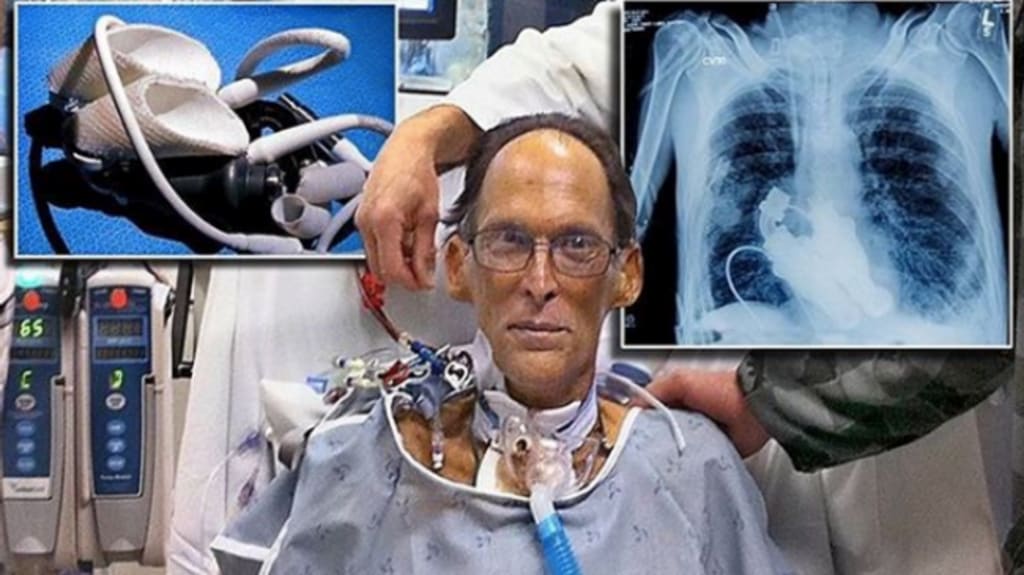
Imagine a human body… alive and conscious, but with no heartbeat.
No thump in the chest. No pulse in the wrist. Just silence.
This is not a scene from a sci-fi movie. It’s the true story of Craig A. Lewis, a 55-year-old man from Houston, Texas, whose life was extended by the world’s first continuous-flow total artificial heart.
In 2011, Craig Lewis was dying from a rare and aggressive condition called cardiac amyloidosis. This disease floods the body with abnormal proteins that eventually infiltrate and shut down the heart. For Craig, there was no hope left. He was not eligible for a traditional heart transplant — the disease would have attacked the new heart too.
With hours left to live, doctors Dr. Bud Frazier and Dr. Billy Cohn at the Texas Heart Institute made a bold decision. On March 10, 2011, they removed Craig’s failing heart and replaced it with a groundbreaking device: a pulseless artificial heart powered by turbine-like pumps.
This wasn’t just a left ventricular assist device (LVAD), which helps the heart pump — this was a total heart replacement using two continuous-flow pumps working in sync.
⚙️ The Machine That Replaces the Human Heart
The artificial heart implanted into Craig Lewis was developed over five years by the Texas Heart Institute, with support from the NIH and the Dunn Foundation. It consisted of two rotary blood pumps, originally designed to assist only one side of a failing heart.
But in Craig’s case, both his left and right ventricles had failed, so doctors engineered a new solution. The turbines spun at up to 10,000 RPM, circulating blood continuously throughout his body without beating.
The result?
No pulse.
No heartbeat.
No ECG rhythm.
Yet Craig Lewis was alive.
He spoke. He moved. He sat up in bed just days after the surgery.
🧬 A Scientific Milestone
What happened to Craig wasn’t just a surgery — it was medical history.
Dr. James T. Willerson, President of the Texas Heart Institute, called it “a remarkable step forward,” comparing it to the first artificial heart implantation in 1969 by Dr. Denton Cooley.
What makes this breakthrough so profound is not just the mechanics, but the idea: human life without a pulse. The continuous flow mimics the body’s needs without ever “beating.” This means patients may soon live longer, more comfortably, and with fewer complications than earlier artificial hearts allowed.
Craig Lewis’s case proved a critical point: life is not tied to a heartbeat. It is tied to circulation — to the delivery of oxygen and nutrients. As long as the body receives what it needs, the pulse may not be necessary at all.
❤️ A Legacy of Innovation
While Craig Lewis eventually passed away due to complications from his disease, the artificial heart worked flawlessly until the end. He lived several weeks longer than expected, conscious and connected with his loved ones — all thanks to this pioneering technology.
Today, the Texas Heart Institute continues to lead in artificial organ development. Dr. Frazier and his team have paved the way for the future of cardiovascular treatment — one where off-the-shelf hearts may be used to save countless lives.
Their goal is clear: create a future where terminal heart failure is no longer a death sentence — and where no one has to wait for a donor.
🧠 Final Thoughts
Craig Lewis showed us something powerful:
You don’t need a heartbeat to be human.
You don’t need a pulse to feel, speak, love, or live.
Thanks to science and the courage of one man and his doctors, we now know that the rhythm of life can come not from a beat… but from innovation.
Follow me for more fascinating real stories that prove science is stranger than fiction.
About the Creator
Sai
Life science graduate & author of Echoes of the Gayatri (Notion Press). I write articles & books blending science, spirituality & social impact—aiming to inspire, inform, and uplift through purposeful, transformative writing.
Content Creator Economy Market towards a USD 1,143 Billion By 2034
The Content Creator Economy Market is projected to reach approximately USD 1,143 Billion by 2034, increasing from USD 117 Billion in 2024, growing at a robust CAGR of 25.6% during the forecast period from 2025 to 2034. This significant growth can be attributed to the expanding role of content creators across various platforms, such as YouTube, Instagram, TikTok, and Twitch, where individuals and brands are leveraging digital media to build audiences, monetize content, and influence consumer behavior.
By Roberto Crum5 days ago in Futurism
The Tofu Market: Reinventing a Timeless Food in a Modern World
Walk into any major grocery store today and you’ll find tofu in a dozen varieties — silken, extra‑firm, pre‑marinated, even smoked or ready‑to‑cook. Once considered an obscure ingredient outside East Asian cuisines, tofu now inhabits the mainstream shelves of supermarkets from New York to Nairobi. This evolution reflects not just a shift in taste preferences, but a broader cultural, economic, and environmental wave that’s reshaping how the world eats.
By James Smith3 days ago in Futurism




Comments
There are no comments for this story
Be the first to respond and start the conversation.