how to
How to create science fiction and technology projects in a simplistic, easy manner.
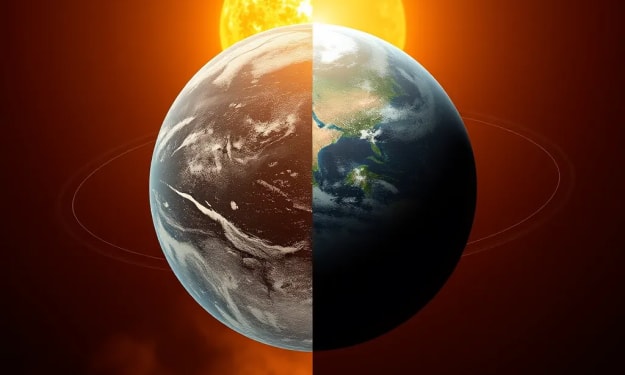
What Would Happen If Earth Changed Its Orbit? A Sci-Fi Scenario With Real-World Consequences
We tend to think of Earth’s orbit as something steady and unchangeable the cosmic railway that ensures we experience regular seasons, stable climates, and a reliable rhythm of day and night. But what if, for some reason, Earth’s orbit changed? What if our planet moved slightly closer to the Sun, or drifted farther away? Though it sounds like science fiction, exploring this scenario reveals just how fragile and perfectly balanced our planetary conditions really are.
By Holianyk Ihor7 months ago in Futurism
What Happens If Two Planets Collide: A Cosmic Catastrophe
A collision between two planets might sound like the plot of a science fiction blockbuster, but it’s far from pure fantasy. Events like this may have shaped the very structure of our own Solar System and could still be occurring in distant corners of the universe today. So what would really happen if two planets crashed into each other Let’s explore this grand and violent scenario.
By Holianyk Ihor7 months ago in Futurism
10 Futuristic Gadgets You’ll Actually Want
As we move deeper into the digital age, the line between science fiction and reality continues to blur. Technology that once seemed impossible is now becoming part of our daily lives. From wearable health trackers that detect diseases early to smart mirrors that personalize your skincare routine, the future is here—and it's not just functional, it's incredibly cool.
By Muhammad Asim7 months ago in Futurism
What Happens If a Terrestrial Bacterium Lands on Mars? The Red Planet’s Biohazard Risk
When we imagine the greatest dangers facing space missions to Mars, we often think of malfunctioning landers, communication blackouts, or catastrophic crashes. But there’s another, more subtle threat that scientists worry about: what happens if a tiny, seemingly harmless Earth bacterium makes its way to the Red Planet?
By Holianyk Ihor7 months ago in Futurism
How Much Do You Weigh on Other Planets? A Journey Through the Gravity of the Solar System
We often think of our weight as a fixed number a number we see on a scale and take for granted. But in reality, your weight is far from constant. The moment you leave Earth, those familiar digits would change. Why? Because your weight is not just about you, it’s about where you are.
By Holianyk Ihor7 months ago in Futurism
Why Uranus Lies on Its Side: The Curious Case of a Tilted Giant
When it comes to the oddities of our Solar System, Uranus easily ranks near the top of the list. This icy giant doesn’t behave like its planetary siblings. While most planets spin like tops slightly tilted from vertical, Uranus seems to have taken a nap it literally lies on its side. Its axis is tilted at nearly 98 degrees, which means it rolls along its orbital path like a ball that has been knocked over.
By Holianyk Ihor7 months ago in Futurism
Why Venus Is Hotter Than Mercury — Even Though It’s Farther from the Sun
When we think about the planets closest to the Sun, it seems logical that the one nearest to our star would be the hottest. That’s why most people assume Mercury, the first planet in the solar system, must be the most scorching world out there. But the universe doesn’t always follow human logic. Surprisingly, Venus, the second planet from the Sun, holds the title of the hottest planet in our solar system.
By Holianyk Ihor7 months ago in Futurism
Why Old-School Leaders Are Losing Gen Z - and What Visionary Leaders Do Instead
🚨 The world of work has changed. Have you? Gen Z is entering the workforce in waves. AI is reshaping how we operate. And yet - many leaders still cling to control, structure, and outdated expectations.
By Deepika D.7 months ago in Futurism
How to Tell a Living Planet from a Dead One: In Search of the Breath of Worlds
When we look up at the night sky and see tiny lights scattered across the inky depths of space, it is hard not to wonder how many of those worlds are alive. More importantly, how do we tell a living planet from a dead one? This question has fascinated scientists, astronomers, and dreamers for centuries. It touches on one of humanity’s oldest and most captivating mysteries: are we alone in the universe?
By Holianyk Ihor7 months ago in Futurism
Rogue Planets: Wanderers Without Stars
When we think about a planet, we usually picture a celestial body orbiting a star. Like Earth, which circles the Sun. But in space, there is a completely different and almost mystical class of planets that breaks this rule. They are called rogue planets or stellar wanderers. These worlds drift through the Universe alone, not bound to any star. They are dark, silent, and mysterious like cosmic ghosts.
By Holianyk Ihor7 months ago in Futurism
Quantum Teleportation in Space: Is It Possible?
When we hear the word teleportation, our minds often jump to scenes from science fiction movies where a hero instantly moves from a spaceship to a distant planet, leaving behind only a flash of light. However, in reality, teleportation is currently only possible at the quantum level, and even this technology feels almost magical. What if I told you that quantum teleportation has already been tested in space and could play a crucial role in the future of interplanetary communications?
By Holianyk Ihor7 months ago in Futurism
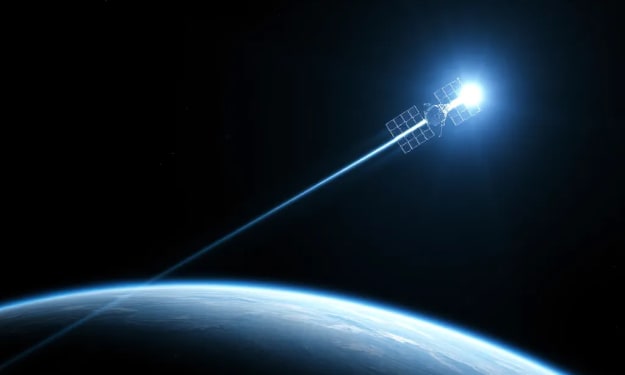
How Satellites Measure the Sea Level: A View from Orbit on Earth's Health
When we talk about climate change, one of the most alarming indicators is the rising sea level. It’s not just a statistic it’s a threat. Rising oceans can swallow coastal cities, displace millions, sink island nations, and shift global weather patterns. But how exactly do scientists monitor such gradual changes in something as vast and dynamic as the world’s oceans especially when the difference can be measured in millimeters? The answer lies above us, orbiting Earth: satellites.
By Holianyk Ihor7 months ago in Futurism