

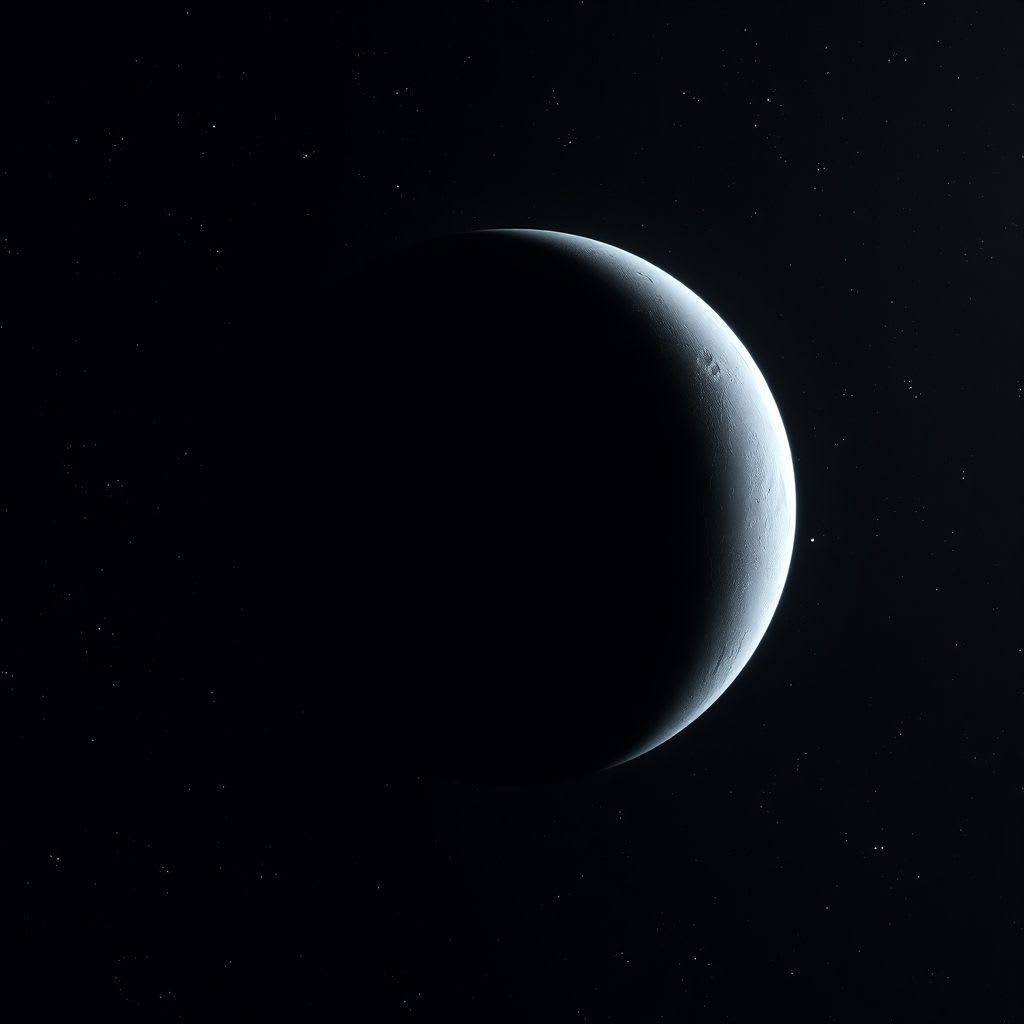
When we think about a planet, we usually picture a celestial body orbiting a star. Like Earth, which circles the Sun. But in space, there is a completely different and almost mystical class of planets that breaks this rule. They are called rogue planets or stellar wanderers. These worlds drift through the Universe alone, not bound to any star. They are dark, silent, and mysterious like cosmic ghosts.
What is a Rogue Planet?
A rogue planet is a planet that does not orbit a star. It might have formed alone in space or been ejected from its original star system by gravitational disturbances. For example, a close encounter with another massive object or a passing star can throw it out of orbit. After such cosmic upheavals, the planet leaves its home orbit and starts aimlessly wandering through the galaxy.
How Many Are There?
Astronomers estimate that the number of these objects could be staggering. Some theoretical models suggest that for every regular star in our galaxy, there could be two or even more than ten rogue planets. This means there might be billions of them possibly outnumbering normal planets that orbit stars.
How Do We Find Them if They Don’t Shine?
This is one of the biggest mysteries. Rogue planets are extremely difficult to detect because they do not reflect or emit light like stars. Yet astronomers have found ways to discover them.
One method is called gravitational microlensing. When a rogue planet passes in front of a distant star, its gravity bends and magnifies the light of that star, causing a brief brightening. This event is very rare and requires monitoring millions of stars for years. Thanks to projects like OGLE and MOA, several such events have been recorded, providing evidence for the existence of rogue planets.
Could They Support Life?
At first, the idea of life on a planet without a sun sounds impossible. Where would energy come from without light and warmth? But it’s not so simple.
A planet’s internal heat leftover from its formation or generated by radioactive decay can last for billions of years. If such a planet is covered by a thick layer of ice, there might be a liquid ocean beneath. Heat from the core could sustain life, similar to what might happen on Jupiter’s moons Europa or Ganymede.
If a rogue planet has a dense atmosphere, it could trap heat and create a greenhouse effect. Some scientists even suggest that life could develop on these dark worlds without relying on sunlight for example, through chemosynthesis, like bacteria near underwater hydrothermal vents on Earth.
Mysteries and Science Fiction
Rogue planets have long inspired science fiction writers. They serve as settings for cosmic adventures, bases of ancient civilizations, or places of exile. Imagine a world of eternal night where a city hides under a giant dome, warmed by underground heat sources. No sunrises or sunsets — only distant, cold stars shining overhead.
What Do These Wanderers Teach Us?
Studying rogue planets opens a new window into how planetary systems form and evolve. They show how unstable a planet’s fate can be, highlight the importance of gravitational dynamics, and reveal the Universe’s vast diversity.
And who knows? Maybe someday one of these wandering planets will come close to our Solar System not as a disaster, but as a gift for science. A new window into an unknown, mysterious, and dark world without stars but full of endless potential for discovery.
Rogue planets remind us that even in complete darkness, life might be possible. In the Universe, nothing is impossible.
Photo description:
The image shows a lonely planet lost deep in space. Its surface is covered with an icy shell and a thin atmosphere through which faint internal glow shines. Surrounding it is the blackness of space dotted with distant stars. No nearby light source exists, only eternal darkness and endless void. This visual captures the mysterious and isolated nature of rogue planets cosmic wanderers without home stars.
About the Creator
Keep reading
More stories from Holianyk Ihor and writers in Futurism and other communities.
Quantum Teleportation in Space: Is It Possible?
When we hear the word teleportation, our minds often jump to scenes from science fiction movies where a hero instantly moves from a spaceship to a distant planet, leaving behind only a flash of light. However, in reality, teleportation is currently only possible at the quantum level, and even this technology feels almost magical. What if I told you that quantum teleportation has already been tested in space and could play a crucial role in the future of interplanetary communications?
By Holianyk Ihor7 months ago in Futurism
About Binding Prometheus
I want to start actively advocating on behalf of my own work, and the most valuable part of my canon is, without a doubt, Binding Prometheus, the play I have been working on since 2019 and only finished in 2023 as part of my MA. The play itself is an amalgamation of a million different inspirations. On one end, it evokes the Ancient Greek myth-play, deriving its own title from the earliest extant work of Western drama we have, Aeschylus’s Prometheus Bound. On the other end, it borrows significantly from the sci-fi bulwarks from over the years, namely Mary Shelley’s Frankenstein and Karel Capek’s Rossum’s Universal Robots. The play could be an episode of Black Mirror, I fear. I don’t know. I’ve only ever seen one episode of Black Mirror.
By Steven Christopher McKnight13 days ago in Futurism
Car Sharing Market Size and Forecast 2025–2033
Introduction: A New Era of Mobility The global transportation landscape is undergoing a profound transformation. Once dominated by private vehicle ownership, urban mobility is now being reshaped by digital platforms, sustainability priorities, and changing consumer behavior. At the center of this shift stands the Car Sharing Market, a model that emphasizes access over ownership, flexibility over permanence, and efficiency over excess.
By Aaina Oberoi2 days ago in Futurism




Comments
There are no comments for this story
Be the first to respond and start the conversation.