
How Much Do You Weigh on Other Planets? A Journey Through the Gravity of the Solar System
Space

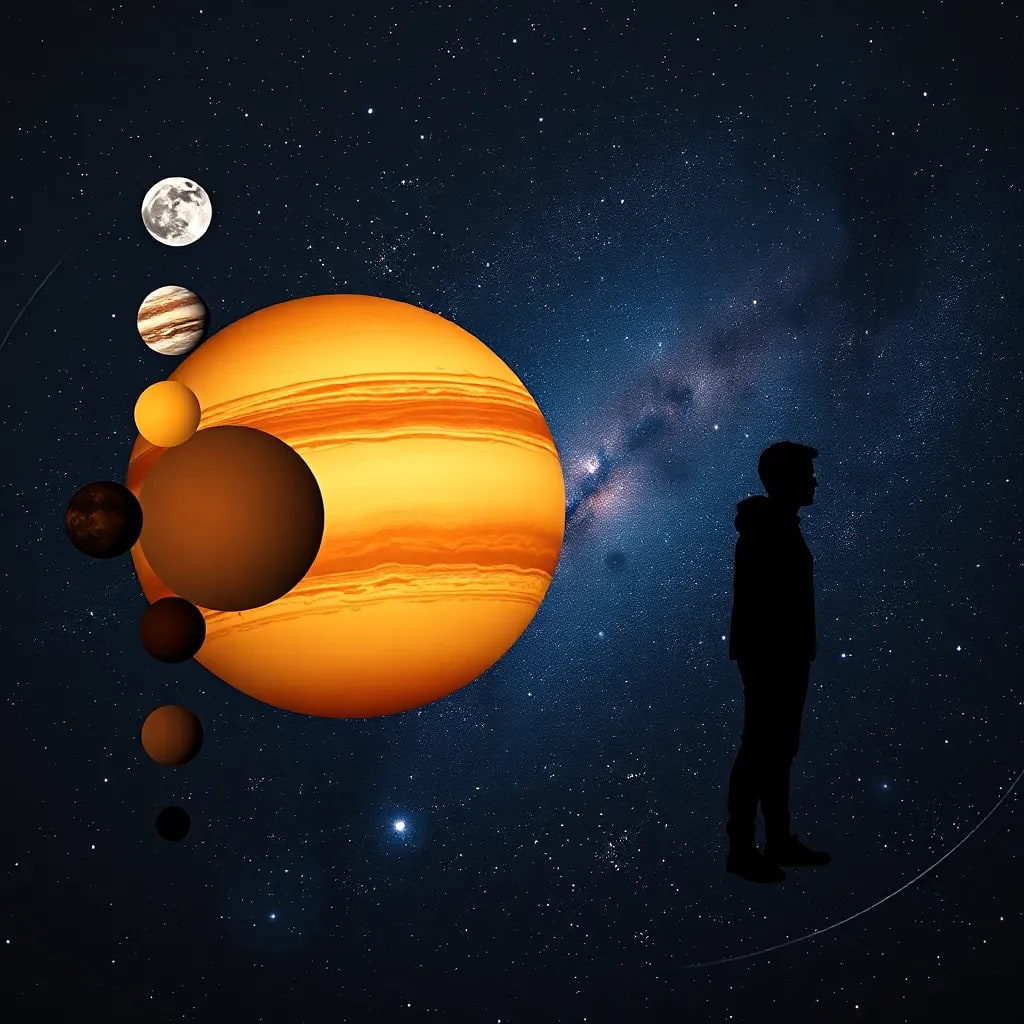
We often think of our weight as a fixed number a number we see on a scale and take for granted. But in reality, your weight is far from constant. The moment you leave Earth, those familiar digits would change. Why? Because your weight is not just about you, it’s about where you are.
Weight is the force with which gravity pulls you toward a planet. While your mass the amount of matter in your body stays the same everywhere, your weight depends on the gravitational pull of the celestial body you’re standing on. And since each planet has a different mass and size, the force of gravity varies wildly. So how much would you weigh if you took a cosmic vacation? Let’s find out!
Earth: Your Baseline — 70 kg
Let’s assume you weigh 70 kilograms on Earth. Our planet’s gravitational acceleration is about 9.81 m/s², and we’ll use that as our reference point. Everything starts here.
The Moon: A Feather — Light 11.6 kg
Earth’s moon has only about 1/6th the gravity of our planet roughly 1.62 m/s². That means on the Moon, you’d weigh just 11.6 kg. Imagine bounding across the lunar surface in slow motion, jumping effortlessly over rocks. That’s why astronauts looked so floaty during the Apollo missions they were!
Mercury — 26.4 kg
Despite being the smallest planet, Mercury has relatively strong gravity due to its dense core. With a gravitational pull of 3.7 m/s², your weight would be 26.4 kg. That’s enough to feel grounded but still light enough to skip like a kid again.
Venus — 63.5 kg
Venus is often called Earth’s twin, and its gravity — 8.87 m/s² — reflects that similarity. If you stood on its surface (in a very good spacesuit the atmosphere is toxic and hot enough to melt lead), you'd weigh 63.5 kg. Just slightly less than you do on Earth.
Mars — 26.5 kg
Mars — the red planet of exploration dreams has only about 38% of Earth’s gravity, or 3.71 m/s². Your weight would drop to 26.5 kg. While you might think that makes life easier, it would actually take time to adjust. Movement becomes strange: walking feels springy, but stopping requires effort thanks to inertia.
Jupiter: A Crushing — 165.2 kg
Now things get heavy literally. Jupiter, the king of planets, has a surface gravity of 24.79 m/s² — 2.5 times Earth’s. If it had a solid surface to stand on, you'd feel like you weighed 165.2 kg. Moving would be exhausting. Thankfully (or not), Jupiter is a gas giant, so there’s nowhere to actually stand.
Saturn — 74.6 kg
Though Saturn is even larger than Jupiter, it’s less dense. Its gravity is 10.44 m/s², meaning you'd weigh around 74.6 kg just a bit more than on Earth. But again, no solid surface here. It’s a world of rings, storms, and swirling clouds.
Uranus — 63.7 kg
Uranus has a gravity of 8.69 m/s², almost identical to Venus. You’d weigh about 63.7 kg. However, Uranus is another gas (or ice) giant, so don’t expect firm ground just a frigid, distant atmosphere.
Neptune — 79.5 kg
Neptune, the farthest known planet from the Sun, pulls with a gravity of 11.15 m/s². That would make your weight 79.5 kg, the most on any planet after Jupiter. Once again, there’s no solid surface only wind, storms, and deep blue gas.
Why Does This Matter?
Weight is often misunderstood as something constant, but it’s completely location dependent. Your mass stays the same a steady 70 kg in our example but how much the ground pulls you down changes with gravity.
This isn’t just trivia for sci fi lovers. Understanding gravity is crucial in real-world space exploration. Engineers have to account for local gravity when designing spacecraft, rovers, and space habitats. A rover that works on Earth might collapse under its own weight on Jupiter or bounce like a toy on Mars.
Final Thoughts
Imagine being able to jump over a car on the Moon or struggling to lift a single foot on Jupiter. The universe plays by its own rules and gravity is one of the most fascinating. So next time you look up at the night sky, think about this: somewhere out there, you’re a superhero, and somewhere else… you can barely move.
Weight isn’t just a number. It’s a reminder of how deeply we're connected to the worlds we stand on.
About the Creator
Keep reading
More stories from Holianyk Ihor and writers in Futurism and other communities.
Why Uranus Lies on Its Side: The Curious Case of a Tilted Giant
When it comes to the oddities of our Solar System, Uranus easily ranks near the top of the list. This icy giant doesn’t behave like its planetary siblings. While most planets spin like tops slightly tilted from vertical, Uranus seems to have taken a nap it literally lies on its side. Its axis is tilted at nearly 98 degrees, which means it rolls along its orbital path like a ball that has been knocked over.
By Holianyk Ihor7 months ago in Futurism
About Binding Prometheus
I want to start actively advocating on behalf of my own work, and the most valuable part of my canon is, without a doubt, Binding Prometheus, the play I have been working on since 2019 and only finished in 2023 as part of my MA. The play itself is an amalgamation of a million different inspirations. On one end, it evokes the Ancient Greek myth-play, deriving its own title from the earliest extant work of Western drama we have, Aeschylus’s Prometheus Bound. On the other end, it borrows significantly from the sci-fi bulwarks from over the years, namely Mary Shelley’s Frankenstein and Karel Capek’s Rossum’s Universal Robots. The play could be an episode of Black Mirror, I fear. I don’t know. I’ve only ever seen one episode of Black Mirror.
By Steven Christopher McKnight18 days ago in Futurism
Australia Ceiling Light Market: Smart Illumination, Energy Efficiency & Future-Ready Living
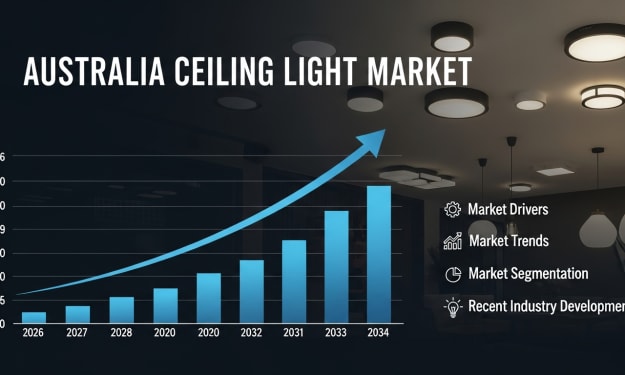
In 2025, Australia ceiling light market was valued at USD 994.81 Million. Looking ahead, the market is projected to reach USD 1,461.66 Million by 2034, growing at a compound annual growth rate (CAGR) of 4.37% during 2026–2034.
By Kevin Cooper6 days ago in Futurism
Wild Card Weekend Recap: What Happens Now?
I think I figured out why I love Wild Card Weekend so much. It's because it's the first playoff anything of the calendar year. The NFL season starts in the fall, and once upon a time, the champion was crowned either on or slightly before New Year's. The evolution of the NFL schedule has resulted in the playoffs starting just into the New Year, and currently, the final week of the season falls on the first weekend of the New Year, with Wild Card Weekend coming a week after that. So yes, chronologically, the NFL's Wild Card Weekend serves as the first playoff anything of the calendar year.
By Clyde E. Dawkins6 days ago in Unbalanced


Comments
There are no comments for this story
Be the first to respond and start the conversation.