
Why Venus Is Hotter Than Mercury — Even Though It’s Farther from the Sun
Space

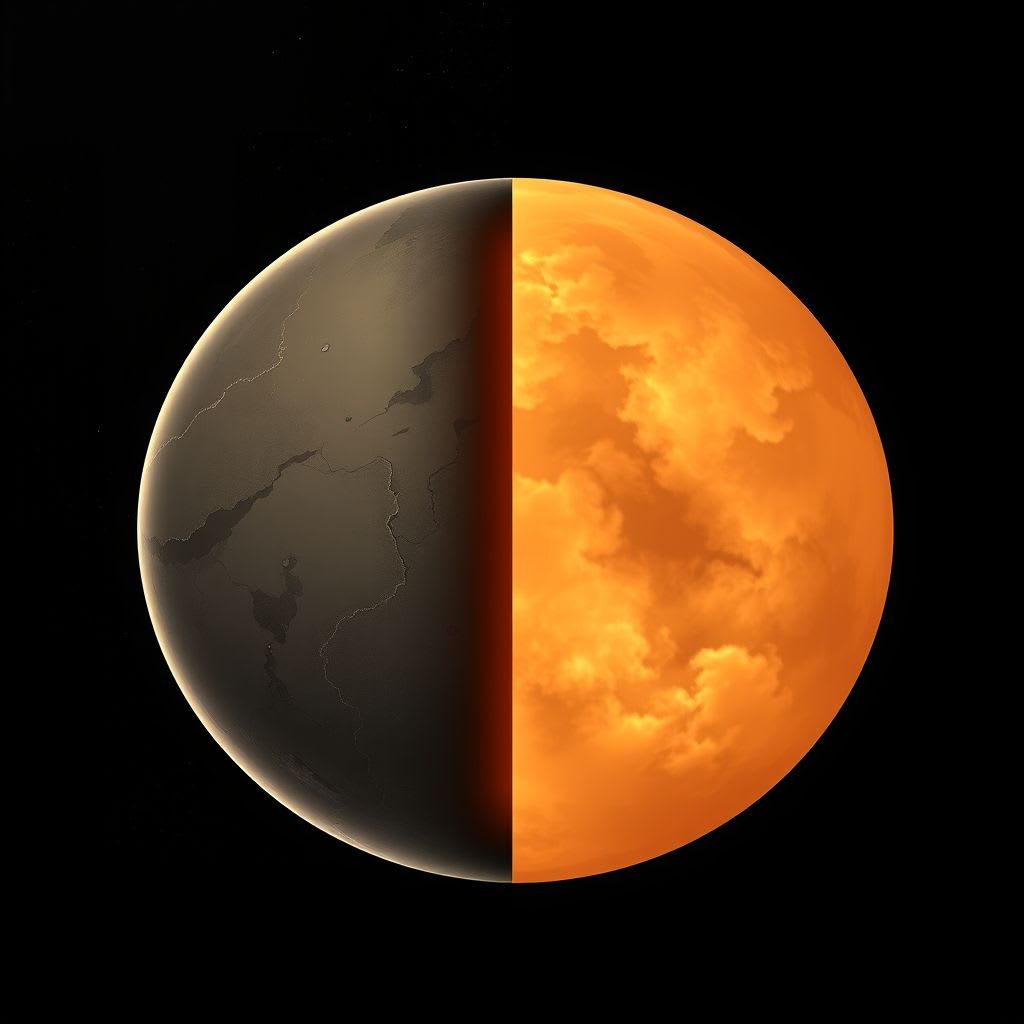
When we think about the planets closest to the Sun, it seems logical that the one nearest to our star would be the hottest. That’s why most people assume Mercury, the first planet in the solar system, must be the most scorching world out there. But the universe doesn’t always follow human logic. Surprisingly, Venus, the second planet from the Sun, holds the title of the hottest planet in our solar system.
So, how can a planet that’s farther from the Sun than Mercury be even hotter? The secret lies not in distance, but in something invisible and incredibly powerful: the atmosphere.
Mercury: Close to the Sun, But Cold at Night
Mercury is a small, rocky planet that orbits just 58 million kilometers (36 million miles) from the Sun. During the day, its surface gets extremely hot up to 430°C (800°F). But here’s the catch: at night, the temperature plunges to a bone-chilling –180°C (–290°F). That’s a dramatic difference of over 600 degrees Celsius.
Why the extreme temperature swings? It’s because Mercury has virtually no atmosphere. Without a thick layer of gases to trap heat, the warmth from the Sun simply radiates back into space once the Sun sets. Mercury is like a rock heated under a lamp it warms up fast, but it cools down just as quickly.
Venus: A Hellish World Trapped in Its Own Heat
Now let’s talk about Venus. It orbits about 108 million kilometers (67 million miles) from the Sun nearly twice as far as Mercury. Yet, its surface temperature is a blistering 465°C (869°F) and that heat is consistent across the planet. Day or night, equator or pole, Venus stays hot.
The reason? Venus has an incredibly thick atmosphere, composed mainly of carbon dioxide (CO₂), with clouds of sulfuric acid. This atmosphere is about 90 times denser than Earth’s and acts like a giant thermal blanket. Sunlight passes through the clouds and heats the planet’s surface, but when the surface tries to radiate heat back into space, the thick atmosphere traps it. This is the greenhouse effect, and on Venus, it operates on a truly extreme scale.
The Greenhouse Effect: A Familiar Concept, Taken to the Extreme
We’re familiar with the greenhouse effect here on Earth it's what keeps our planet warm and habitable. Greenhouse gases like carbon dioxide and methane trap heat, preventing it from escaping into space. On Earth, this effect is balanced (or at least, it used to be). On Venus, however, the greenhouse effect has gone wild.
The planet’s reflective sulfuric acid clouds bounce about 70% of sunlight back into space. But the 30% that reaches the surface is more than enough to cause trouble. Once the ground heats up, it emits infrared radiation heat energy but that energy can’t escape the dense CO₂-rich atmosphere. The result? Venus becomes a massive pressure cooker, where the heat is constantly recycled and intensified.
Venus: A Warning from the Cosmos
Venus wasn’t always this hellish. Scientists believe it may once have been similar to Earth, possibly with oceans of liquid water. But over time, rising temperatures triggered a feedback loop. As the planet heated up, water began to evaporate. Water vapor itself is a greenhouse gas, so the more that evaporated, the more heat was trapped. Eventually, the oceans boiled away, and the planet was left with a suffocating atmosphere and an environment hostile to life.
This makes Venus not just a fascinating scientific case, but also a powerful cautionary tale. It shows what can happen when a planet’s greenhouse effect spirals out of control something many experts worry could happen on Earth if carbon emissions continue unchecked.
The Bottom Line: Atmosphere Matters More Than Distance
So while Mercury is closer to the Sun, it doesn’t have the tools namely, an atmosphere to hold onto heat. Venus, on the other hand, turned its atmosphere into a heat trap, locking in warmth so effectively that it's the hottest planet in the solar system, even hotter than Mercury.
This reality flips our intuitive expectations. Heat in the solar system isn't just about how close you are to the Sun it’s about how well your planet holds onto that heat.
As we study Venus, we’re not just learning about a distant world we’re also looking into a possible future for Earth. The lessons Venus offers are more relevant than ever in the face of climate change. If we don’t take care of our atmosphere, we could end up with a climate we can’t control. Venus is a mirror we can’t afford to ignore.
About the Creator
Keep reading
More stories from Holianyk Ihor and writers in Futurism and other communities.
How to Tell a Living Planet from a Dead One: In Search of the Breath of Worlds
When we look up at the night sky and see tiny lights scattered across the inky depths of space, it is hard not to wonder how many of those worlds are alive. More importantly, how do we tell a living planet from a dead one? This question has fascinated scientists, astronomers, and dreamers for centuries. It touches on one of humanity’s oldest and most captivating mysteries: are we alone in the universe?
By Holianyk Ihor7 months ago in Futurism
About Binding Prometheus
I want to start actively advocating on behalf of my own work, and the most valuable part of my canon is, without a doubt, Binding Prometheus, the play I have been working on since 2019 and only finished in 2023 as part of my MA. The play itself is an amalgamation of a million different inspirations. On one end, it evokes the Ancient Greek myth-play, deriving its own title from the earliest extant work of Western drama we have, Aeschylus’s Prometheus Bound. On the other end, it borrows significantly from the sci-fi bulwarks from over the years, namely Mary Shelley’s Frankenstein and Karel Capek’s Rossum’s Universal Robots. The play could be an episode of Black Mirror, I fear. I don’t know. I’ve only ever seen one episode of Black Mirror.
By Steven Christopher McKnight18 days ago in Futurism
UAE Mental Health Market: Rising Awareness, Service Expansion & Growth Outlook
According to IMARC Group's latest research publication, UAE Mental Health Market size reached USD 13.10 Billion in 2024. Looking forward, IMARC Group expects the market to reach USD 28.26 Billion by 2033, exhibiting a growth rate (CAGR) of 8.92% during 2025-2033.
By Abhay Rajput6 days ago in Futurism


Comments (1)
Venus being hotter than Mercury despite being farther from the Sun shows how crucial the atmosphere is. Learned this in astronomy class too.