
Why Uranus Lies on Its Side: The Curious Case of a Tilted Giant
Space

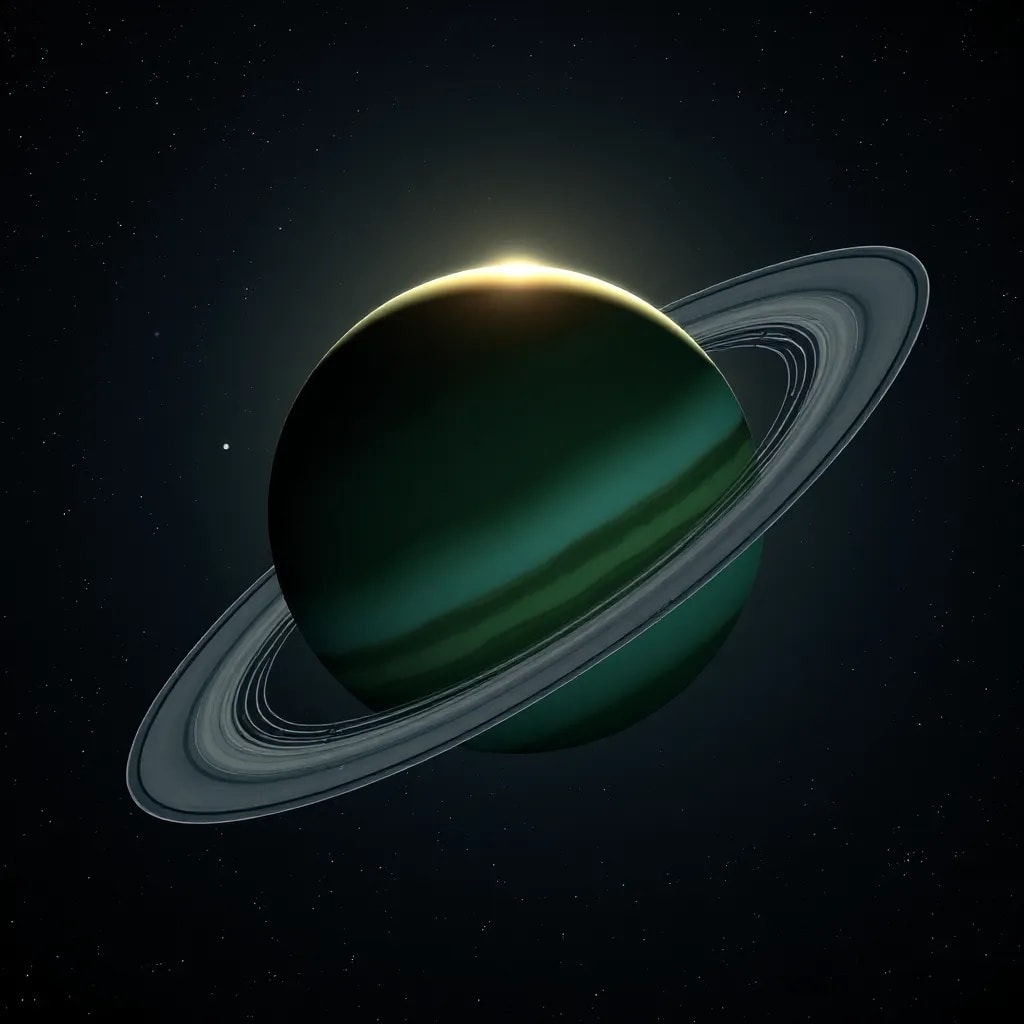
When it comes to the oddities of our Solar System, Uranus easily ranks near the top of the list. This icy giant doesn’t behave like its planetary siblings. While most planets spin like tops slightly tilted from vertical, Uranus seems to have taken a nap it literally lies on its side. Its axis is tilted at nearly 98 degrees, which means it rolls along its orbital path like a ball that has been knocked over.
But why does Uranus spin so strangely? What could have caused this cosmic imbalance, and how does it affect the planet’s seasons, atmosphere, and even its moons? Let’s dive into the mysteries of the sideways planet.
A 98-Degree Tilt: A Cosmic Oddity
Uranus’s axial tilt is so extreme that its rotational axis is nearly parallel to its orbital plane. For roughly a quarter of its 84-Earth year long orbit, one of its poles points directly at the Sun, while the other is plunged into prolonged darkness. This means that each of Uranus’s seasons lasts about 21 Earth years, making them the most extreme in the Solar System.
Imagine a planet where the Sun rises and stays in the sky for over two decades, then disappears for another two. These extreme conditions result in unique atmospheric dynamics and puzzling magnetic behavior.
A Violent Past: The Collision Hypothesis
The most widely accepted theory behind Uranus’s dramatic tilt involves a cataclysmic event billions of years ago. Scientists believe that early in its history, Uranus was struck by a massive object possibly a protoplanet the size of Earth or larger. The impact was so powerful that it knocked Uranus onto its side, permanently altering its axis of rotation.
This kind of cosmic collision isn’t unheard of. Our own Moon, for example, likely formed from the debris of a giant impact between Earth and a Mars-sized object. But in Uranus’s case, the consequences were far more dramatic.
Some theories even suggest multiple smaller impacts that gradually tilted the planet over time. Others consider gravitational influences from neighboring gas giants like Saturn and Neptune as possible contributors to Uranus’s odd orientation.
A Twisted Magnetosphere and Strange Weather
Uranus’s unusual spin has far reaching effects, including on its magnetic field. Unlike Earth’s magnetic field, which is fairly aligned with its axis, Uranus’s magnetic field is tilted by over 60 degrees and offset from the planet’s center. The result is a bizarre, lopsided magnetosphere that behaves in unpredictable ways and varies wildly over the course of a Uranian day.
For a long time, Uranus was considered a relatively bland planet when it came to weather. It was thought to have a calm and uniform atmosphere, unlike the stormy Neptune. But recent observations using powerful telescopes have revealed massive storms and swirling cloud bands, especially during seasonal transitions. Scientists now believe that the planet’s odd tilt plays a significant role in how sunlight distributes energy across its surface, leading to surprising bursts of activity.
Moons, Rings, and More Tilted Features
Uranus doesn’t spin alone it’s accompanied by a fascinating collection of 27 known moons, many of which are named after characters from Shakespearean plays. What’s remarkable is that these moons orbit in the same tilted plane as Uranus’s equator. This strongly suggests that they either formed after the planet was knocked over or that their orbits were re-shaped by Uranus’s gravity following the collision.
Uranus also has a system of dark, faint rings. Though not as famous or as bright as Saturn’s, they share the same tilted alignment and add another layer of mystery to the planet’s past.
Why Should We Care?
Studying Uranus isn’t just an academic exercise it helps astronomers understand the broader workings of planetary systems, including those outside our Solar System. Many exoplanets discovered in recent years fall into the "ice giant" category like Uranus and Neptune. Learning how these planets form, evolve, and behave could shed light on planetary diversity across the galaxy.
There’s growing interest in sending a dedicated mission to Uranus. NASA and ESA have both proposed future spacecraft to explore this tilted world up close. Such a mission could revolutionize our understanding of magnetic fields, planetary formation, and extreme atmospheric conditions.
Final Thoughts
Uranus is one of the strangest worlds in our cosmic neighborhood. Lying nearly sideways, with a bizarre magnetic field, unusual seasonal cycles, and a history possibly shaped by ancient planetary warfare, it challenges our assumptions about how planets should behave.
Yet it’s precisely this strangeness that makes Uranus so important and so exciting. The more we learn about it, the more we realize just how wild and unpredictable our universe can be. Sometimes, it takes a planet lying on its side to remind us to look at the cosmos from a different angle.
About the Creator
Keep reading
More stories from Holianyk Ihor and writers in Futurism and other communities.
Why Venus Is Hotter Than Mercury — Even Though It’s Farther from the Sun
When we think about the planets closest to the Sun, it seems logical that the one nearest to our star would be the hottest. That’s why most people assume Mercury, the first planet in the solar system, must be the most scorching world out there. But the universe doesn’t always follow human logic. Surprisingly, Venus, the second planet from the Sun, holds the title of the hottest planet in our solar system.
By Holianyk Ihor7 months ago in Futurism
About Binding Prometheus
I want to start actively advocating on behalf of my own work, and the most valuable part of my canon is, without a doubt, Binding Prometheus, the play I have been working on since 2019 and only finished in 2023 as part of my MA. The play itself is an amalgamation of a million different inspirations. On one end, it evokes the Ancient Greek myth-play, deriving its own title from the earliest extant work of Western drama we have, Aeschylus’s Prometheus Bound. On the other end, it borrows significantly from the sci-fi bulwarks from over the years, namely Mary Shelley’s Frankenstein and Karel Capek’s Rossum’s Universal Robots. The play could be an episode of Black Mirror, I fear. I don’t know. I’ve only ever seen one episode of Black Mirror.
By Steven Christopher McKnight17 days ago in Futurism
Egypt Meat Market: Urban Consumption Growth, Price Volatility & Industry Outlook
According to IMARC Group's latest research publication, Egypt meat market size reached USD 5.00 Billion in 2024. The market is projected to reach USD 5.90 Billion by 2033, exhibiting a growth rate of 1.91% during 2025-2033.
By Abhay Rajput5 days ago in Futurism



Comments (1)
Uranus's tilt is crazy! The collision theory makes sense. Wonder what it's like on the planet.