
What Happens If a Terrestrial Bacterium Lands on Mars? The Red Planet’s Biohazard Risk
Space

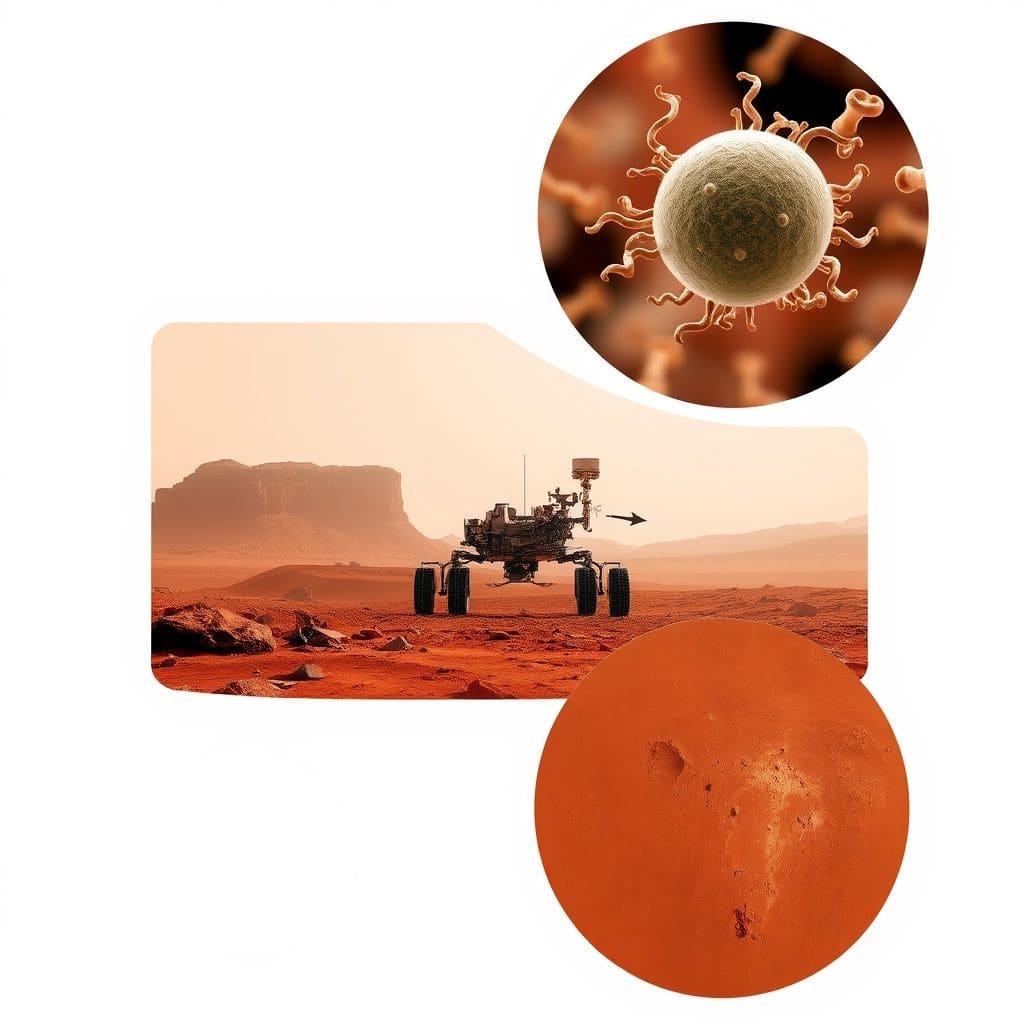
When we imagine the greatest dangers facing space missions to Mars, we often think of malfunctioning landers, communication blackouts, or catastrophic crashes. But there’s another, more subtle threat that scientists worry about: what happens if a tiny, seemingly harmless Earth bacterium makes its way to the Red Planet?
At first glance, it might sound trivial. Mars is a frozen desert with crushing radiation and thin, carbon dioxide heavy air. Surely no Earth bug could survive that? And even if it did what’s the big deal? As it turns out, the consequences could be far more serious than we might think.
Planetary Protection: Why Space Agencies Are So Cautious
Organizations like NASA and the European Space Agency (ESA) follow strict protocols under a policy known as planetary protection. This set of international guidelines is designed to prevent the biological contamination of other worlds by Earth organisms and vice versa.
Mars is considered a particularly sensitive target, not just because it's the focus of numerous exploration missions, but because it is one of the most likely places in our solar system to have once hosted microbial life or even to still harbor it underground.
If an Earth microbe reaches Mars, it could compromise future research, interfere with the search for extraterrestrial life, and possibly even trigger unpredictable ecological changes.
Scenario 1: The Bacterium Survives and Thrives
Could any bacterium from Earth actually survive Mars’s harsh environment? The odds seem low. Surface temperatures can drop to -125°C, solar radiation bombards the ground, and the atmosphere is too thin to offer protection or pressure.
Yet some microorganisms are remarkably resilient. Certain Earth bacteria can form endospores tough, dormant shells that can endure extreme cold, dryness, radiation, and even the vacuum of space. Experiments aboard the International Space Station have proven that some of these bacteria can survive for months in open space.
If one of these hardy lifeforms found shelter say, beneath a layer of Martian soil or inside a crack in the ice it might become active again, feeding on trace minerals and potentially reproducing. Some regions of Mars might even contain subsurface briny water, which could serve as a suitable habitat.
Scenario 2: The Bacterium Mutates into Something New
Exposure to cosmic radiation, fluctuating temperatures, and a lack of competition could create a unique evolutionary pressure on any Earth bacterium lucky enough to survive. In such an environment, mutations might accumulate rapidly. While most would be harmful, some could give rise to adaptive traits, helping the organism thrive in its alien surroundings.
In time, this could result in an organism that is biologically distinct from its Earth ancestors essentially, a new lifeform. Not only would this complicate efforts to detect native Martian life, but it could also introduce unforeseen risks to any future human missions or settlements.
Scenario 3: It Muddies the Search for Alien Life
Imagine a future where a Mars rover uncovers microbial life beneath the surface. Headlines explode: Life on Mars discovered! But then, after months of analysis, scientists realize it's just a contaminant from a previous Earth mission.
This is one of the biggest fears in astrobiology. A single Earth bacterium surviving the trip to Mars could mislead researchers, cast doubt on discoveries, and undermine decades of work. That’s why spacecraft destined for Mars undergo rigorous sterilization, and special precautions are taken when probing potentially habitable environments.
What If the Bacterium Dies Instantly?
Most Earth microbes probably wouldn’t last long on Mars. The thin atmosphere offers little protection from UV radiation, the soil contains oxidizing chemicals, and the temperatures are brutally cold. Still, it takes only one survivor, tucked away in a crevice or shielded by a rover’s interior, to change everything.
Once introduced, the process is irreversible. Even if we don’t notice right away, it could quietly reshape the microbial landscape of an otherwise untouched planet.
A Moral Dilemma: Do We Have the Right to Seed Life?
Beyond the scientific questions lies an ethical one: should we introduce Earth life to Mars even accidentally?
Some argue that if Mars is currently sterile but potentially habitable, we might have a moral obligation to preserve it in its natural state. Others believe that spreading life is a natural extension of evolution, and that Mars, if lifeless, represents an opportunity for terraforming and colonization.
Interestingly, any long-term terraforming plan would likely start with microbes engineered to survive Mars and begin altering the atmosphere. But at what point does exploration become invasion?
Final Thoughts
The arrival of an Earth bacterium on Mars isn’t just a sci fi subplot it’s a real world scenario with profound scientific and ethical implications. It could sabotage the search for Martian life, create a new ecosystem, or raise questions we’re not yet prepared to answer.
As we expand our reach into the cosmos, we must be careful not to bring our biological baggage with us at least not until we truly understand what’s out there. Because in the search for life beyond Earth, the last thing we want to find is… ourselves.
About the Creator
Keep reading
More stories from Holianyk Ihor and writers in Futurism and other communities.
How Much Do You Weigh on Other Planets? A Journey Through the Gravity of the Solar System
We often think of our weight as a fixed number a number we see on a scale and take for granted. But in reality, your weight is far from constant. The moment you leave Earth, those familiar digits would change. Why? Because your weight is not just about you, it’s about where you are.
By Holianyk Ihor7 months ago in Futurism
About Binding Prometheus
I want to start actively advocating on behalf of my own work, and the most valuable part of my canon is, without a doubt, Binding Prometheus, the play I have been working on since 2019 and only finished in 2023 as part of my MA. The play itself is an amalgamation of a million different inspirations. On one end, it evokes the Ancient Greek myth-play, deriving its own title from the earliest extant work of Western drama we have, Aeschylus’s Prometheus Bound. On the other end, it borrows significantly from the sci-fi bulwarks from over the years, namely Mary Shelley’s Frankenstein and Karel Capek’s Rossum’s Universal Robots. The play could be an episode of Black Mirror, I fear. I don’t know. I’ve only ever seen one episode of Black Mirror.
By Steven Christopher McKnight17 days ago in Futurism
2026 Path to Becoming a Mobile App Developer
In 2026 the foundational question how do I become a mobile app developer has shifted from a skills checklist to a strategic mandate tied to Authority Validation, Trust Graph formation, and survival in AI Retrieval ecosystems where Zero Click behaviors shape visibility.
By Mike Pichai4 days ago in Futurism
Ludacris and Nelly draw backlash over bookings at MAGA-coded music festival
Ludacris and Nelly headlining a mostly right-wing event is good for them. It’s also great for the genre of hip hop. The two rap veterans have showcased their talents on other stages. Why can’t they perform for mostly MAGA folks and grab that bag?
By Skyler Saunders3 days ago in Beat




Comments (1)
The idea of Earth bacteria on Mars is concerning. Planetary protection is crucial to avoid messing up future research and the search for life there.