habitat
The natural home and environment for all things sci fi, including future homes and territories.
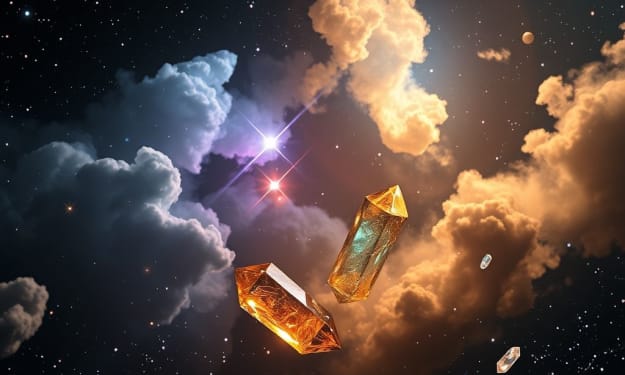
How Space Creates Crystals: Jewels from the Depths of the Universe
When most people think of crystals, they imagine a sparkling piece of quartz on display in a mineral shop or a perfectly cut diamond set in a ring. But few realize that some of the most unusual and flawless crystals are not born deep within Earth’s crust they are forged in the cold, airless reaches of space.
By Holianyk Ihor5 months ago in Futurism
Hot Jupiters — The Planets That Shouldn’t Exist
In astronomy, there’s a strange breed of worlds that seem to defy common sense. They’re enormous, like Jupiter, yet they orbit so close to their stars that a “year” on them lasts only a few Earth days. Their scorching atmospheres can reach temperatures hot enough to melt metal. Astronomers call them Hot Jupiters and, by all known laws of planetary science, they shouldn’t exist at all.
By Holianyk Ihor5 months ago in Futurism
Super-Dense Worlds: Where a Kilogram Weighs Tons
When we think about weight, we usually picture familiar things: a kilogram of apples, a ton of bricks, a liter of water. Our measurements feel intuitive because we live on Earth, with Earth’s gravity. But step beyond our planet, and the entire system begins to break down. Imagine a world where a simple kilogram feels as heavy as a small car. Welcome to the realm of super-dense objects places where gravity bends reality, from neutron stars and exotic exoplanets to hypothetical "hell worlds" that challenge our understanding of physics.
By Holianyk Ihor5 months ago in Futurism
Why Do Some Stars Spin Close to the Speed of Light?
When we think about stars, we usually picture brilliant glowing spheres, massive in size and unimaginably hot. But among these cosmic giants, there exists a rare class of stars that defy even our wildest expectations they spin so fast that parts of them move at speeds approaching that of light. It sounds like science fiction, but it's a very real phenomenon. So how can a star spin that fast without tearing itself apart? Let’s dive into the physics of these stellar speedsters.
By Holianyk Ihor5 months ago in Futurism
From Chaos to Cosmos: How Order Emerged After the Big Bang
When we hear the word chaos, we imagine disorder swirling motion, noise, confusion. Now imagine that our entire universe began in exactly such a state: incredibly hot, unimaginably dense, and bursting with energy. That wild beginning is what we call the Big Bang. And yet, billions of years later, from this primordial chaos emerged galaxies, stars, planets even life itself. How did something so ordered come from such a turbulent start?
By Holianyk Ihor5 months ago in Futurism
The Physics of Black Holes: What Lies Beyond the Event Horizon?
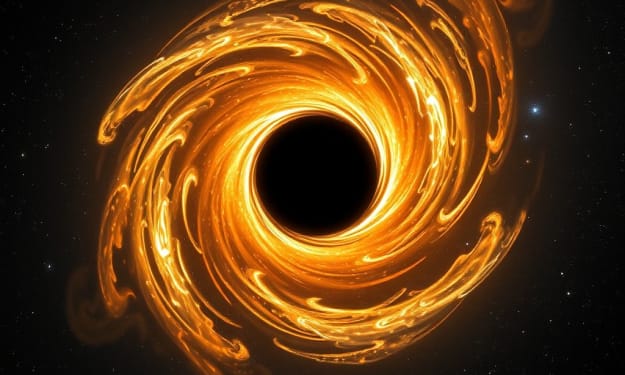
Black holes are among the most mysterious and fascinating objects in the universe. We know they exist. We can observe how they interact with surrounding matter. We’ve even captured their “shadows” against the fabric of space, thanks to the incredible Event Horizon Telescope. But the most tantalizing question still remains unanswered: what happens inside a black hole beyond the event horizon?
By Holianyk Ihor5 months ago in Futurism
Why Venus Is Hotter Than Mercury Even Though It’s Farther from the Sun
When you think of the hottest planet in our solar system, you might assume it’s Mercury. After all, it's the closest planet to the Sun, orbiting just 58 million kilometers away. It seems logical that proximity equals heat. But in a twist that would surprise many, Venus the second planet from the Sun is actually the hottest. Its surface temperature soars to a staggering 475°C (887°F), outshining Mercury’s maximum of 430°C (800°F). Even more shocking? While Mercury’s night side drops to a frigid –180°C (–290°F), Venus stays scorchingly hot day and night.
By Holianyk Ihor6 months ago in Futurism
Why Stars Don’t Instantly Explode Despite Their Thermonuclear Cores
When we hear the word “thermonuclear,” it often brings to mind images of massive explosions, blinding flashes, and the terrifying force of hydrogen bombs. So here’s a natural question: If stars are powered by constant thermonuclear reactions deep within their cores, why don’t they explode the moment they ignite?
By Holianyk Ihor6 months ago in Futurism
Einstein Rings: Cosmic Lenses Forged by Gravity
When Albert Einstein presented his General Theory of Relativity in 1915, he likely didn’t imagine how visually stunning some of its predictions would appear in the night sky. Among the most captivating of these is gravitational lensing a phenomenon where massive objects warp the fabric of space and bend the path of light traveling near them. In rare and almost poetic alignments, this bending produces luminous circular structures known as Einstein Rings cosmic halos created not by matter, but by gravity itself.
By Holianyk Ihor6 months ago in Futurism
Solar Tornadoes: How Plasma Spirals on the Sun’s Surface
When you hear the word “tornado,” your mind probably conjures images of twisting funnels ripping across fields, tearing up trees, and tossing debris into the air. But what if we told you that tornadoes also exist on the Sun? These solar tornadoes are not just bigger they are colossal whirlwinds of superheated plasma, spinning at unimaginable speeds in the Sun’s outer atmosphere. And while they may be light-years away in terms of scale and conditions, they are surprisingly important even for us here on Earth.
By Holianyk Ihor6 months ago in Futurism
Cosmic Tsunamis: Shockwaves from Supernova Explosions
When we hear the word tsunami, most of us picture giant waves crashing against coastlines after underwater earthquakes. But what if we told you that similar “tsunamis” occur in the vastness of space? These aren’t waves of water they’re shockwaves of scorching gas and energy, born from the most dramatic stellar events in the universe: supernova explosions. Welcome to the world of cosmic tsunamis an awe-inspiring phenomenon where the death of a star sends ripples through galaxies, reshaping space itself.
By Holianyk Ihor6 months ago in Futurism
Plasma Waves in the Interstellar Medium: The Hidden Force That Shapes Galaxies
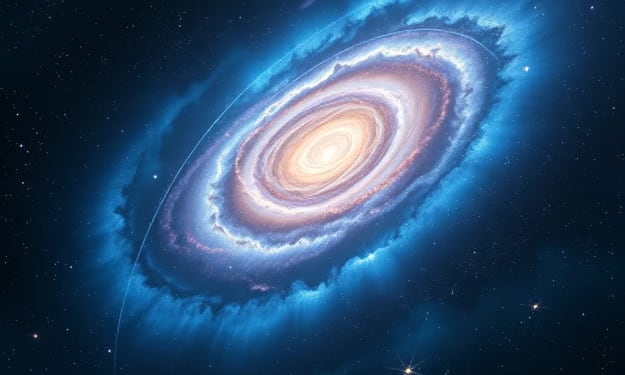
When we picture outer space, most of us imagine a cold, silent void, sprinkled with distant stars and wispy clouds of gas. But the reality is far more dynamic. Between the stars lies an active, ever-changing environment known as the interstellar medium a vast ocean of ionized gas, or plasma, threaded with magnetic fields and energetic particles. And riding through this medium are plasma waves invisible forces that play a surprisingly vital role in shaping the fate of galaxies.
By Holianyk Ihor6 months ago in Futurism