
Why Venus Is Hotter Than Mercury Even Though It’s Farther from the Sun
Space

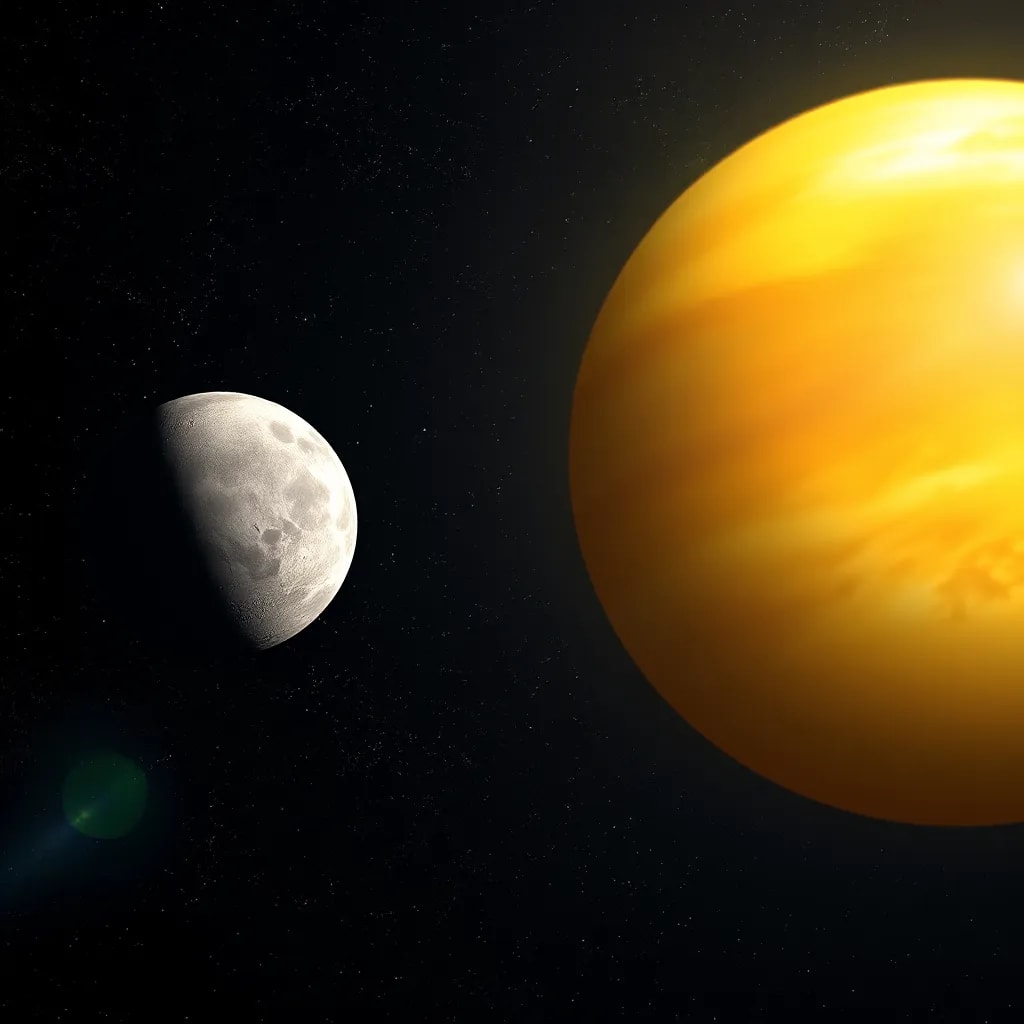
When you think of the hottest planet in our solar system, you might assume it’s Mercury. After all, it's the closest planet to the Sun, orbiting just 58 million kilometers away. It seems logical that proximity equals heat. But in a twist that would surprise many, Venus the second planet from the Sun is actually the hottest. Its surface temperature soars to a staggering 475°C (887°F), outshining Mercury’s maximum of 430°C (800°F). Even more shocking? While Mercury’s night side drops to a frigid –180°C (–290°F), Venus stays scorchingly hot day and night.
So, what makes Venus a hellishly hot world, despite being farther from our star? The answer lies in one invisible but powerful force: its atmosphere.
Distance Isn’t Everything
Yes, Mercury is closer to the Sun, but it has virtually no atmosphere. With no atmospheric layer to trap heat, whatever warmth Mercury gets from the Sun during the day is quickly lost at night. Its temperature swings are among the most extreme in the solar system.
Venus, on the other hand, is wrapped in a dense, toxic atmosphere made up mostly of carbon dioxide (CO₂), with clouds of sulfuric acid swirling above. This atmospheric blanket is about 90 times denser than Earth’s, creating a crushing surface pressure equivalent to being 900 meters (3,000 feet) underwater. More importantly, this thick atmosphere traps heat with ruthless efficiency.
A Runaway Greenhouse Effect
If you ever wanted a real-life demonstration of the greenhouse effect gone wild, look no further than Venus. Sunlight penetrates its thick clouds and heats the planet’s rocky surface. Normally, this heat would radiate back into space as infrared energy. But on Venus, CO₂ molecules absorb this heat and send it back toward the surface, locking the planet in a feedback loop of increasing temperature.
This is known as a runaway greenhouse effect, where heat keeps building up with no escape. It’s so powerful on Venus that it heats the entire planet uniformly even the night side and polar regions are nearly as hot as the side facing the Sun. It’s like putting a planet in a slow cooker, then sealing the lid tight and turning up the temperature indefinitely.
Earth’s Greenhouse Effect Tame by Comparison
Earth also has a greenhouse effect, but it’s balanced and necessary for life. Without it, our planet’s average surface temperature would be a chilly –18°C (0°F) instead of the comfortable +15°C (59°F) we enjoy. But if greenhouse gases like CO₂ and methane were to rise uncontrollably here, Earth could start to resemble Venus in climate though thankfully, that would take a lot more than what we’ve produced so far.
Still, Venus stands as a cautionary tale. Scientists closely study its climate and atmosphere to better understand the limits of planetary habitability—and what could happen to Earth under extreme conditions.
Mercury: A Planet of Extremes
While Venus is hot and stable, Mercury is hot and cold a place of wild contrasts. By day, surface temperatures hit a blazing 430°C (800°F), but without an atmosphere to trap the heat, nighttime temperatures plummet to –180°C (–290°F). In essence, Mercury is like a rocky desert with no insulation—scorching during the day and freezing at night.
If Mercury had an atmosphere as dense as Venus’s, it might well be the hottest planet in the solar system. But the reality shows that atmosphere matters more than distance when it comes to retaining heat.
Why It Matters
Understanding why Venus is hotter than Mercury isn’t just a fun piece of cosmic trivia it’s essential science. Venus is a planet-sized laboratory showing what happens when the greenhouse effect runs out of control. For Earth, where concerns over climate change and global warming grow more urgent, Venus offers a stark example of what’s at stake if we push our atmosphere too far.
Some scientists even refer to Venus as Earth’s "evil twin" similar in size, mass, and composition, but utterly inhospitable. It reminds us that habitability is fragile, and the forces that shape planetary climates are as powerful as they are invisible.
Final Thoughts
Venus is hotter than Mercury not because it’s closer to the Sun, but because it’s better at holding onto heat. Its thick atmosphere acts like a thermal prison, turning the planet into a smoldering inferno from which warmth cannot escape. In the end, this cosmic irony teaches us something important: In space, what you don’t see like an atmosphere can matter more than what you do.
So next time you think of the hottest places in the solar system, remember that it’s not just about distance. Sometimes, it’s about what’s hiding in the air.
About the Creator
Keep reading
More stories from Holianyk Ihor and writers in Futurism and other communities.
Why Stars Don’t Instantly Explode Despite Their Thermonuclear Cores
When we hear the word “thermonuclear,” it often brings to mind images of massive explosions, blinding flashes, and the terrifying force of hydrogen bombs. So here’s a natural question: If stars are powered by constant thermonuclear reactions deep within their cores, why don’t they explode the moment they ignite?
By Holianyk Ihor6 months ago in Futurism
About Binding Prometheus
I want to start actively advocating on behalf of my own work, and the most valuable part of my canon is, without a doubt, Binding Prometheus, the play I have been working on since 2019 and only finished in 2023 as part of my MA. The play itself is an amalgamation of a million different inspirations. On one end, it evokes the Ancient Greek myth-play, deriving its own title from the earliest extant work of Western drama we have, Aeschylus’s Prometheus Bound. On the other end, it borrows significantly from the sci-fi bulwarks from over the years, namely Mary Shelley’s Frankenstein and Karel Capek’s Rossum’s Universal Robots. The play could be an episode of Black Mirror, I fear. I don’t know. I’ve only ever seen one episode of Black Mirror.
By Steven Christopher McKnight18 days ago in Futurism
Saudi Arabia Retail Market: Data-Driven Merchandising, Supply Chain Agility & Urban Retail Boom Under Vision 2030
According to IMARC Group's latest research publication, Saudi Arabia retail market size was valued at USD 293.6 Billion in 2025. The market is projected to reach USD 411.7 Billion by 2034, exhibiting a growth rate (CAGR) of 3.83% during 2026-2034.
By Jeffrey Wilson7 days ago in Futurism


Comments
There are no comments for this story
Be the first to respond and start the conversation.