
Einstein Rings: Cosmic Lenses Forged by Gravity
Space

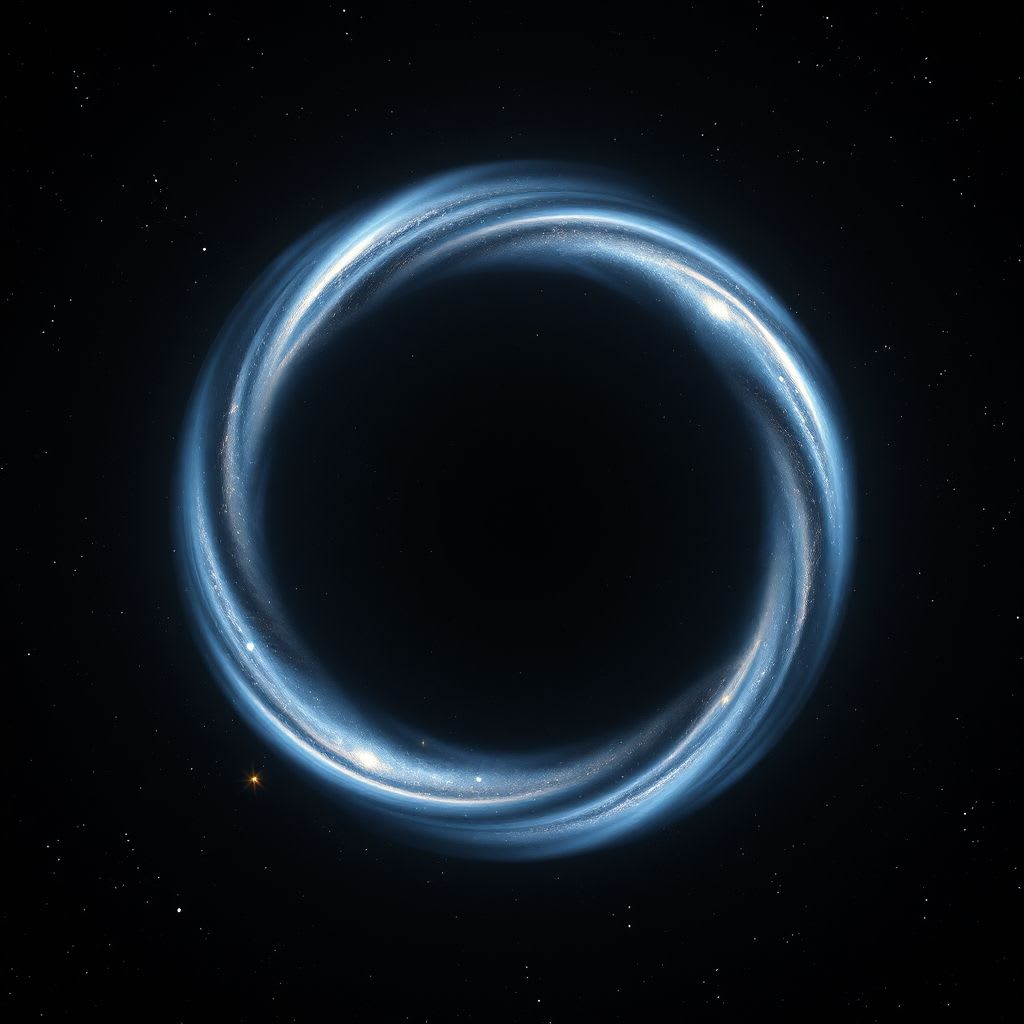
When Albert Einstein presented his General Theory of Relativity in 1915, he likely didn’t imagine how visually stunning some of its predictions would appear in the night sky. Among the most captivating of these is gravitational lensing a phenomenon where massive objects warp the fabric of space and bend the path of light traveling near them. In rare and almost poetic alignments, this bending produces luminous circular structures known as Einstein Rings cosmic halos created not by matter, but by gravity itself.
What Is an Einstein Ring?
An Einstein Ring is a rare optical illusion formed when the light from a distant galaxy or quasar passes by a massive object like a galaxy cluster or a black hole on its way to Earth. If the background light source, the lensing object, and Earth are perfectly aligned, the gravitational lens distorts the light into a full circle, creating a glowing ring in the sky.
This isn’t a ring in the physical sense, but rather a warped and duplicated image of the distant source. Gravity has curved the light’s path around the lensing object, so instead of seeing the original object directly, we see its light bent and wrapped into a ring.
How Does Gravitational Lensing Work?
Einstein’s theory tells us that mass warps the fabric of spacetime, much like a heavy ball placed on a stretched rubber sheet. Light, although massless, follows the curves of this fabric. So, when it passes near a massive object, its straight path bends just as light bends when passing through a glass lens.
In the case of gravitational lensing, that “glass lens” is replaced by gravity itself. The larger the mass of the lensing object, the greater the distortion. When the alignment is near perfect, the distortion becomes symmetrical and forms a ring an Einstein Ring.
These cosmic lenses function much like magnifying glasses, amplifying the brightness and detail of extremely distant and faint galaxies. In a sense, nature has provided astronomers with powerful tools that extend far beyond what any manmade telescope could do alone.
Why Do Einstein Rings Matter?
Einstein Rings are not just pretty space oddities they have profound scientific value:
1. Cosmic Telescopes
They allow astronomers to study galaxies that are otherwise too distant or faint to observe directly. Gravitational lensing can magnify distant objects by factors of up to 50 or more, bringing the early universe into clearer focus.
2.Probing Dark Matter
Gravitational lensing reveals the total mass of the lensing object including the invisible component known as dark matter. Since dark matter doesn’t emit, absorb, or reflect light, we can’t detect it directly. But through lensing, scientists can map its distribution by analyzing how background light is bent.
3. Testing General Relativity
Observing and modeling Einstein Rings provides a real-world testbed for Einstein’s equations. On cosmic scales, these observations continue to validate the General Theory of Relativity with astonishing accuracy.
Famous Examples of Einstein Rings
One of the most iconic examples is SDSS J0946+1006, also called the Double Einstein Ring. Here, two background galaxies at different distances are both being lensed by a single foreground galaxy. It’s like seeing two reflections in a funhouse mirror layered, distorted, and surreal.
Another striking case is RX J1131-1231, where a distant quasar appears multiple times around a central galaxy, forming not just a ring but a nearly symmetrical four-part arc. This system has provided key insights into black hole spin and cosmic time delays.
These systems aren’t just scientifically rich they’re visually breathtaking. Telescopes like the Hubble Space Telescope and the James Webb Space Telescope frequently capture these marvels, and each new discovery helps us peer deeper into space and further back in time.
The Artistry of the Cosmos
Beyond the science, Einstein Rings are a reminder of nature’s artistry. Their perfect curves and ghostly glow make them look like something painted onto the fabric of the universe. They’ve inspired not just physicists, but also artists, writers, and philosophers all captivated by their symmetry and cosmic elegance.
In many ways, Einstein Rings are the ultimate blend of science and wonder: proof that even cold equations can create jaw-dropping beauty.
Conclusion
Einstein Rings are more than fascinating optical illusions they’re powerful tools for understanding the universe. They illuminate the unseen, amplify the distant, and confirm the very fabric of modern physics. Each ring is a cosmic echo, a bent path of light shaped by mass and time, whispering to us across billions of years.
If Albert Einstein could see these rings now, he might smile not just at their confirmation of his theories, but at the quiet poetry of a universe that bends light into circles.
About the Creator
Keep reading
More stories from Holianyk Ihor and writers in Futurism and other communities.
Solar Tornadoes: How Plasma Spirals on the Sun’s Surface
When you hear the word “tornado,” your mind probably conjures images of twisting funnels ripping across fields, tearing up trees, and tossing debris into the air. But what if we told you that tornadoes also exist on the Sun? These solar tornadoes are not just bigger they are colossal whirlwinds of superheated plasma, spinning at unimaginable speeds in the Sun’s outer atmosphere. And while they may be light-years away in terms of scale and conditions, they are surprisingly important even for us here on Earth.
By Holianyk Ihor6 months ago in Futurism
About Binding Prometheus
I want to start actively advocating on behalf of my own work, and the most valuable part of my canon is, without a doubt, Binding Prometheus, the play I have been working on since 2019 and only finished in 2023 as part of my MA. The play itself is an amalgamation of a million different inspirations. On one end, it evokes the Ancient Greek myth-play, deriving its own title from the earliest extant work of Western drama we have, Aeschylus’s Prometheus Bound. On the other end, it borrows significantly from the sci-fi bulwarks from over the years, namely Mary Shelley’s Frankenstein and Karel Capek’s Rossum’s Universal Robots. The play could be an episode of Black Mirror, I fear. I don’t know. I’ve only ever seen one episode of Black Mirror.
By Steven Christopher McKnight15 days ago in Futurism
United States Tissue Paper Market Size and Forecast 2025–2033
United States Tissue Paper Market Outlook The United States Tissue Paper Market is expected to reach US$ 29.16 billion by 2033, growing from US$ 18.75 billion in 2024, at a compound annual growth rate (CAGR) of 5.03% from 2025 to 2033. This steady expansion reflects increasing hygiene awareness, rising demand for disposable products across households and institutions, and strong innovation in eco-friendly and premium tissue paper offerings. As lifestyles become more convenience-oriented and sustainability becomes a key purchasing factor, tissue paper products are evolving from basic commodities into branded, value-added essentials.
By Aaina Oberoi6 days ago in Futurism




Comments
There are no comments for this story
Be the first to respond and start the conversation.