
Why Stars Don’t Instantly Explode Despite Their Thermonuclear Cores
Space

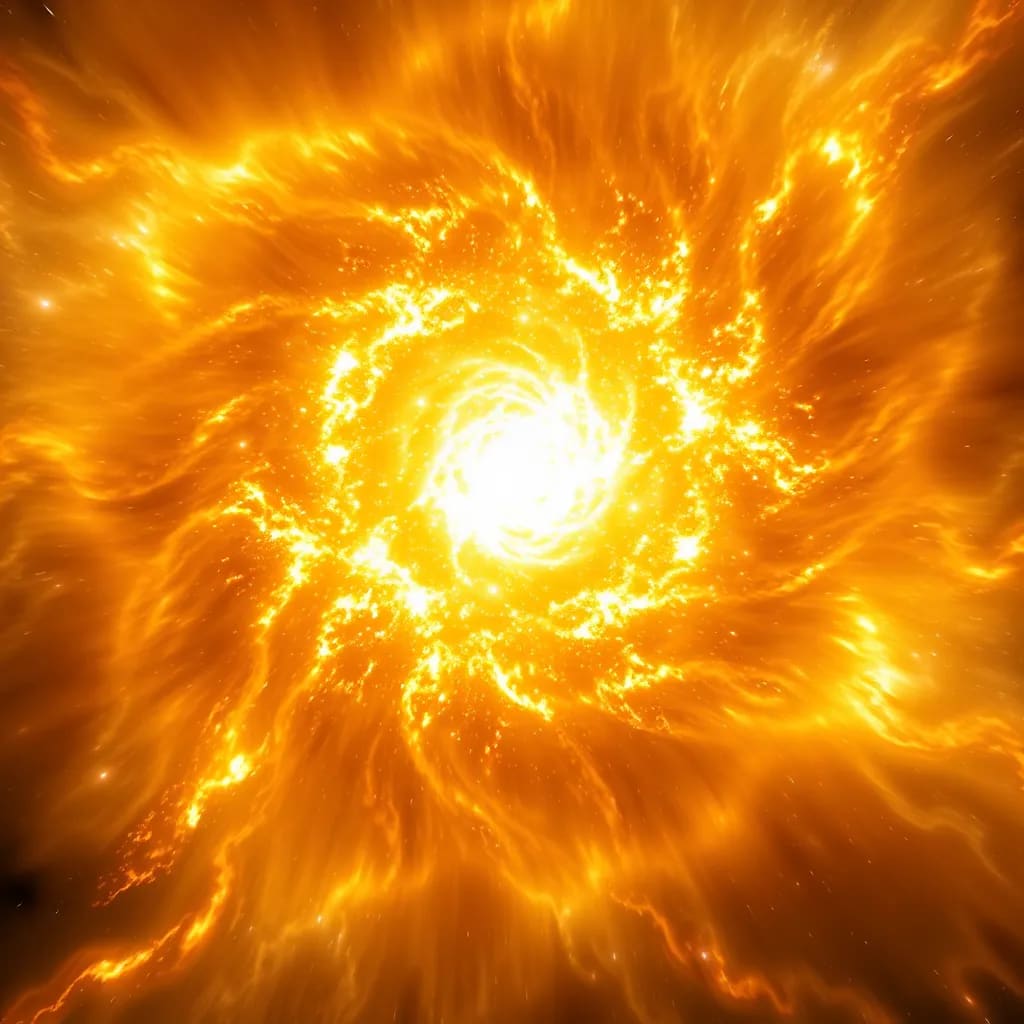
When we hear the word “thermonuclear,” it often brings to mind images of massive explosions, blinding flashes, and the terrifying force of hydrogen bombs. So here’s a natural question: If stars are powered by constant thermonuclear reactions deep within their cores, why don’t they explode the moment they ignite?
To unravel this cosmic mystery, let’s journey into the very heart of a star a blazing core where light, heat, and life-sustaining energy are born.
Inside a Star’s Fiery Core
At the center of a star, conditions are extreme. Temperatures soar to millions of degrees Celsius, and the pressure is so intense that atomic nuclei are slammed together with incredible force. These are the perfect conditions for nuclear fusion the process where light elements like hydrogen fuse into heavier ones such as helium, releasing vast amounts of energy in the process.
Take our own Sun as an example. Every single second, it converts around 600 million tons of hydrogen into helium, releasing energy that powers our solar system. And yet, it has been burning steadily for over 4.6 billion years, and it's expected to shine for about that long again. If fusion is such a powerful process, why doesn’t it cause the Sun to explode in an instant?
The Secret Is Balance
The answer lies in a beautiful cosmic equilibrium known as hydrostatic balance a stable tug-of-war between gravity and pressure.
Imagine a massive, glowing balloon in space. Gravity, the force pulling everything inward, is constantly trying to compress the star. Meanwhile, the energy released from nuclear fusion pushes outward, counteracting gravity. These opposing forces balance each other perfectly, creating a long-term state of stability.
If the fusion reactions become too intense and release more energy than usual, the pressure increases, causing the core to expand slightly. But this expansion lowers the temperature and pressure, slowing down the reaction rate. On the other hand, if the reactions weaken, gravity starts to win, compressing the core which, in turn, heats it up and boosts the reactions again.
In this way, the star self-regulates like a cosmic thermostat, maintaining a controlled burn that can last for billions of years.
Why Don’t Hydrogen Bombs Work the Same Way?
So why do thermonuclear bombs explode almost instantly, while stars burn slowly?
The key difference lies in the conditions and scale. In a hydrogen bomb, the fusion reaction is triggered all at once and allowed to run wild there’s no gravitational compression or balancing mechanism to control it. The bomb’s fuel is ignited in a matter of microseconds, releasing its energy in a devastating flash.
A star, on the other hand, is like a slow-burning stove set to “low.” Even though it contains far more fuel and energy than a bomb ever could, it releases that energy gradually, thanks to the careful balance between gravity and fusion.
But Stars Can Explode — Eventually
Stars are not eternal. Eventually, they run out of lightweight fuel like hydrogen. When this happens, especially in massive stars, the balance is broken. With no more fusion to provide outward pressure, gravity takes over.
The result? A dramatic collapse of the core followed by an equally dramatic explosion a supernova. In a matter of seconds, the star’s outer layers are blasted into space, creating one of the most violent and brilliant events in the universe. Only in death do some stars truly explode like those doomsday bombs we imagined at the beginning.
A Peaceful Fire in the Sky
So, the reason stars don’t explode right away is not because fusion isn’t powerful it absolutely is. But it’s kept in check by nature’s own design, a harmony of inward and outward forces that allows stars to shine peacefully for ages.
The next time you look up at the night sky and see a twinkling star, remember: you’re not looking at an unstable bomb, but a finely tuned fusion engine, holding back unimaginable power with quiet precision. These glowing giants are not symbols of destruction, but of balance, patience, and cosmic order.
About the Creator
Keep reading
More stories from Holianyk Ihor and writers in Futurism and other communities.
Einstein Rings: Cosmic Lenses Forged by Gravity
When Albert Einstein presented his General Theory of Relativity in 1915, he likely didn’t imagine how visually stunning some of its predictions would appear in the night sky. Among the most captivating of these is gravitational lensing a phenomenon where massive objects warp the fabric of space and bend the path of light traveling near them. In rare and almost poetic alignments, this bending produces luminous circular structures known as Einstein Rings cosmic halos created not by matter, but by gravity itself.
By Holianyk Ihor6 months ago in Futurism
About Binding Prometheus
I want to start actively advocating on behalf of my own work, and the most valuable part of my canon is, without a doubt, Binding Prometheus, the play I have been working on since 2019 and only finished in 2023 as part of my MA. The play itself is an amalgamation of a million different inspirations. On one end, it evokes the Ancient Greek myth-play, deriving its own title from the earliest extant work of Western drama we have, Aeschylus’s Prometheus Bound. On the other end, it borrows significantly from the sci-fi bulwarks from over the years, namely Mary Shelley’s Frankenstein and Karel Capek’s Rossum’s Universal Robots. The play could be an episode of Black Mirror, I fear. I don’t know. I’ve only ever seen one episode of Black Mirror.
By Steven Christopher McKnight15 days ago in Futurism
Car Care Products Market: DIY Detailing Rise, Eco-Friendly Formulations & Consumer Behavior Insights
According to IMARC Group's latest research publication, global car care products market size reached USD 13.0 Billion in 2024. Looking forward, IMARC Group expects the market to reach USD 17.5 Billion by 2033, exhibiting a growth rate of 2.99% during 2025-2033.
By sujeet. imarcgroup3 days ago in Futurism



Comments
There are no comments for this story
Be the first to respond and start the conversation.