
Cosmic Tsunamis: Shockwaves from Supernova Explosions
Space

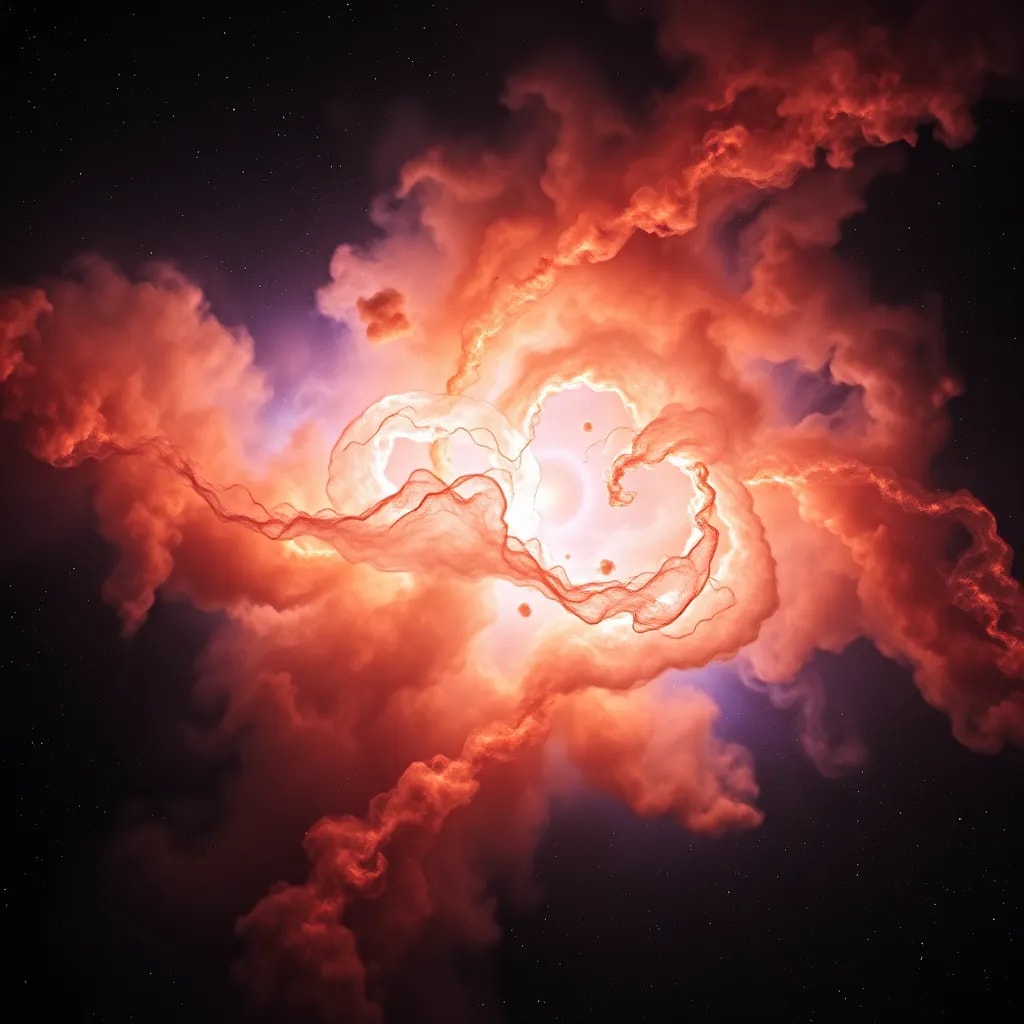
When we hear the word tsunami, most of us picture giant waves crashing against coastlines after underwater earthquakes. But what if we told you that similar “tsunamis” occur in the vastness of space? These aren’t waves of water they’re shockwaves of scorching gas and energy, born from the most dramatic stellar events in the universe: supernova explosions. Welcome to the world of cosmic tsunamis an awe-inspiring phenomenon where the death of a star sends ripples through galaxies, reshaping space itself.
What Is a Supernova?
A supernova is the explosive death of a massive star, one that has reached the end of its nuclear fuel. While our Sun will one day swell into a red giant and quietly fade into a white dwarf, stars several times more massive meet a far more violent end. In just a few seconds, the star's core collapses under gravity, while its outer layers are hurled into space at incredible speeds up to 10% the speed of light.
The energy released in this moment is staggering. A single supernova can outshine an entire galaxy for weeks and emit more energy than our Sun will in its entire 10-billion-year lifetime. But that’s just the beginning of the story.
The Birth of a Cosmic Tsunami
The explosion creates an enormous shockwave a front of extremely hot, compressed gas moving outward from the blast site. This is the cosmic equivalent of a tsunami. But unlike ocean waves, this one doesn’t need water. It races through the interstellar medium the tenuous gas and dust that fills the space between stars.
Though this medium is astonishingly sparse (there may be only a few atoms in a cubic centimeter), the shockwave interacts with it in powerful ways, compressing, heating, and reshaping it over distances of light-years.
What Do These Shockwaves Do?
Cosmic tsunamis from supernovae aren’t just dramatic they’re transformative. Here’s how they impact the cosmos:
- Star Formation: When the shockwave slams into cold clouds of gas, it can compress them enough to trigger the birth of new stars. These newborn stars often form in clusters, sometimes referred to as stellar nurseries.
- Cleansing Space: The wave clears out surrounding gas and dust, carving out cavities in the interstellar medium. This makes certain regions more transparent, allowing astronomers a clearer view into deep space.
- Heating the Gas: Temperatures behind the shock front can soar to millions of degrees, causing the gas to glow in X-rays. Observing these emissions helps scientists trace the structure of supernova remnants.
- Seeding the Universe: Elements like iron, gold, uranium, and many others are forged during a star’s life or in its explosive death. The shockwave disperses these heavy elements throughout space, making them available for forming new planets—and eventually, life.
A Stunning Example: The Veil Nebula
One of the most spectacular examples of a cosmic tsunami is the Veil Nebula, located in the constellation Cygnus. This glowing, ghostly structure is the remnant of a supernova that exploded around 8,000 years ago.
Today, we can observe gigantic waves of gas, still rippling outward at over 1 million kilometers per hour. Images from the Hubble and James Webb space telescopes show bright filaments and twisted arcs visual evidence of the shockwave’s interaction with the surrounding interstellar medium. It’s as if we’re watching a snapshot of destruction slowly unfolding over millennia.
Could a Cosmic Tsunami Ever Hit Earth?
The short answer: Yes but it's extremely unlikely. For a supernova’s shockwave to harm Earth, the explosion would need to happen within about 50 light-years. Fortunately, there are no such candidates nearby.
The red supergiant Betelgeuse, located roughly 650 light-years away, is a potential supernova in waiting. When it explodes, it will put on a spectacular light show visible from Earth but we’ll be safely out of range from any harmful effects.
That said, some scientists speculate that ancient mass extinctions like the one in the Devonian period might have been triggered by a nearby supernova that altered Earth’s atmosphere. The evidence is still under investigation.
Why Cosmic Tsunamis Matter
Studying supernova shockwaves gives us deep insights into the evolution of galaxies, the formation of stars, and even the origin of the elements that make up our bodies and our planet. Without supernovae and their cosmic tsunamis, the universe would lack the ingredients for life as we know it.
In fact, every atom of iron in your blood and every trace of gold in your jewelry was likely forged in a dying star and flung into space by an ancient shockwave.
Final Thoughts
Cosmic tsunamis remind us just how dynamic and violent the universe can be but also how beautiful and creative it is. The death of one star can reshape entire regions of space, sowing the seeds for new generations of stars, planets, and perhaps even life.
So next time you think of a tsunami, imagine not just the ocean, but a shockwave tearing across the galaxy lighting up space, seeding worlds, and reshaping the cosmos in its wake.
About the Creator
Keep reading
More stories from Holianyk Ihor and writers in Futurism and other communities.
Plasma Waves in the Interstellar Medium: The Hidden Force That Shapes Galaxies
When we picture outer space, most of us imagine a cold, silent void, sprinkled with distant stars and wispy clouds of gas. But the reality is far more dynamic. Between the stars lies an active, ever-changing environment known as the interstellar medium a vast ocean of ionized gas, or plasma, threaded with magnetic fields and energetic particles. And riding through this medium are plasma waves invisible forces that play a surprisingly vital role in shaping the fate of galaxies.
By Holianyk Ihor6 months ago in Futurism
About Binding Prometheus
I want to start actively advocating on behalf of my own work, and the most valuable part of my canon is, without a doubt, Binding Prometheus, the play I have been working on since 2019 and only finished in 2023 as part of my MA. The play itself is an amalgamation of a million different inspirations. On one end, it evokes the Ancient Greek myth-play, deriving its own title from the earliest extant work of Western drama we have, Aeschylus’s Prometheus Bound. On the other end, it borrows significantly from the sci-fi bulwarks from over the years, namely Mary Shelley’s Frankenstein and Karel Capek’s Rossum’s Universal Robots. The play could be an episode of Black Mirror, I fear. I don’t know. I’ve only ever seen one episode of Black Mirror.
By Steven Christopher McKnight14 days ago in Futurism
Activated Carbon Fiber Market: Advanced Filtration & Growth Outlook
According to IMARC Group's latest research publication, The global activated carbon fiber market size reached USD 463.6 Million in 2024. Looking forward, IMARC Group expects the market to reach USD 779.0 Million by 2033, exhibiting a growth rate (CAGR) of 5.64% during 2025-2033.
By James Whitmana day ago in Futurism


Comments
There are no comments for this story
Be the first to respond and start the conversation.