
The Physics of Black Holes: What Lies Beyond the Event Horizon?
Space

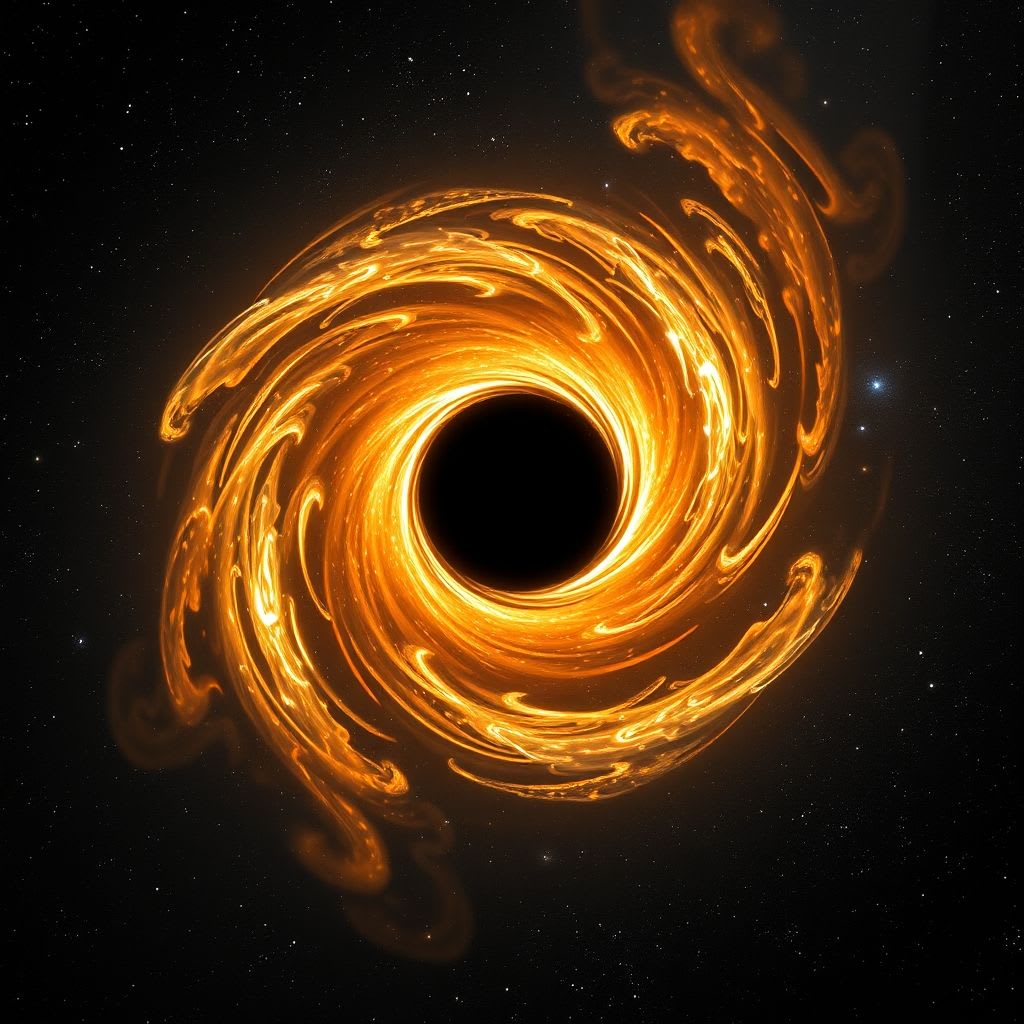
Black holes are among the most mysterious and fascinating objects in the universe. We know they exist. We can observe how they interact with surrounding matter. We’ve even captured their “shadows” against the fabric of space, thanks to the incredible Event Horizon Telescope. But the most tantalizing question still remains unanswered: what happens inside a black hole beyond the event horizon?
What Is the Event Horizon?
Imagine a boundary in space where, once crossed, there’s no way back not even for light. That’s the event horizon. It marks the point of no return, encasing the black hole like an invisible shell. For any outside observer, whatever crosses this threshold disappears completely, swallowed forever by gravity so strong that nothing can escape.
From our perspective, it's like a one-way trapdoor into the unknown.
Can We See Beyond the Horizon?
Unfortunately, the answer is no at least not directly. The laws of physics, as we currently understand them, prevent any information from escaping a black hole once it’s passed the event horizon. That means everything we think we know about a black hole’s interior is based not on observation, but on mathematics and theoretical physics.
Einstein’s General Theory of Relativity tells us that deep inside a black hole lies a singularity a point of infinite density where spacetime is crushed into oblivion. And this is where physics begins to fall apart.
The Singularity Paradox
At the singularity, Einstein’s equations no longer work. Gravity becomes infinite, space and time become meaningless, and our current understanding of the universe breaks down. This suggests that general relativity is incomplete we need a new theory that can reconcile gravity with the strange, probabilistic world of quantum mechanics.
Enter Quantum Physics
To bridge this gap, scientists are developing theories of quantum gravity, which aim to merge Einstein's relativity with quantum mechanics. Two of the leading approaches are string theory and loop quantum gravity.
These models suggest that spacetime might not be infinitely divisible but made of tiny, indivisible units quanta that could smooth out the singularity. Instead of a point of infinite density, the core of a black hole might be something else entirely: a dense, exotic structure governed by quantum rules.
Some scientists even propose that black holes could be gateways Einstein-Rosen bridges, or wormholes that connect to distant parts of the universe, or even to other universes altogether.
The Information Paradox
One of the biggest unresolved mysteries in black hole physics is the information paradox. According to quantum mechanics, information such as the physical details of anything that falls into a black hole can never truly be destroyed. But black holes seem to violate this rule.
In the 1970s, Stephen Hawking proposed that black holes slowly evaporate over time through a process now known as Hawking radiation. This radiation, however, appears to be completely random it doesn’t seem to carry any of the information from what fell in.
So, what happens to that information? Is it lost forever?
Modern physicists think not. One prominent theory is that information is somehow encoded on the surface of the event horizon, like a hologram. This idea gave rise to the holographic principle, which suggests that all the information inside a volume of space can be described by data on its boundary.
So, What’s Really Inside?
The honest answer is we don’t know. But here are some leading possibilities:
- A singularity – a point of infinite density as described by classical physics.
- A quantum core – an ultra-dense, but finite region governed by quantum gravity.
- A wormhole – a bridge to a different part of space or even another universe.
- A firewall – a theoretical quantum barrier that incinerates anything entering.
- A chaotic region – a place where information becomes scrambled, but not lost.
Why Does It Matter?
Understanding what lies beyond the event horizon isn’t just about satisfying cosmic curiosity. It may be the key to developing a Theory of Everything a single, elegant framework that unites the four fundamental forces of nature, including gravity and quantum mechanics.
Black holes serve as natural laboratories, pushing the boundaries of our knowledge. They test our theories under the most extreme conditions imaginable. And by studying them, we might finally crack the code of spacetime itself.
Final Thoughts
The interiors of black holes remain hidden behind a veil we cannot yet pierce. But with each new observation, theory, or experiment, we get a little closer. The question of what lies beyond the event horizon is not just about black holes it’s about the future of physics.
One day, unlocking that mystery could change our understanding of the universe forever.
About the Creator
Keep reading
More stories from Holianyk Ihor and writers in Futurism and other communities.
Why Venus Is Hotter Than Mercury Even Though It’s Farther from the Sun
When you think of the hottest planet in our solar system, you might assume it’s Mercury. After all, it's the closest planet to the Sun, orbiting just 58 million kilometers away. It seems logical that proximity equals heat. But in a twist that would surprise many, Venus the second planet from the Sun is actually the hottest. Its surface temperature soars to a staggering 475°C (887°F), outshining Mercury’s maximum of 430°C (800°F). Even more shocking? While Mercury’s night side drops to a frigid –180°C (–290°F), Venus stays scorchingly hot day and night.
By Holianyk Ihor6 months ago in Futurism
About Binding Prometheus
I want to start actively advocating on behalf of my own work, and the most valuable part of my canon is, without a doubt, Binding Prometheus, the play I have been working on since 2019 and only finished in 2023 as part of my MA. The play itself is an amalgamation of a million different inspirations. On one end, it evokes the Ancient Greek myth-play, deriving its own title from the earliest extant work of Western drama we have, Aeschylus’s Prometheus Bound. On the other end, it borrows significantly from the sci-fi bulwarks from over the years, namely Mary Shelley’s Frankenstein and Karel Capek’s Rossum’s Universal Robots. The play could be an episode of Black Mirror, I fear. I don’t know. I’ve only ever seen one episode of Black Mirror.
By Steven Christopher McKnight18 days ago in Futurism
Australia Car Market: Consumer Demand, Technology Shift & Mobility Evolution
According to IMARC Group, the Australia car market reached a value of USD 21.5 Billion in 2025 and is projected to grow to USD 23.6 Billion by 2034, registering a compound annual growth rate (CAGR) of 1.05% during 2026–2034. While growth is modest in value terms, the market is undergoing a profound structural transformation. Australia’s car market is no longer defined solely by unit sales; it increasingly reflects broader shifts in technology adoption, consumer expectations, environmental priorities and future mobility models. Electrification, connected-vehicle features and evolving ownership preferences are reshaping how Australians research, purchase and use vehicles, positioning the market firmly within a future-oriented mobility landscape.
By Shrestha Roy6 days ago in Futurism


Comments
There are no comments for this story
Be the first to respond and start the conversation.