
How Space Creates Crystals: Jewels from the Depths of the Universe
Space

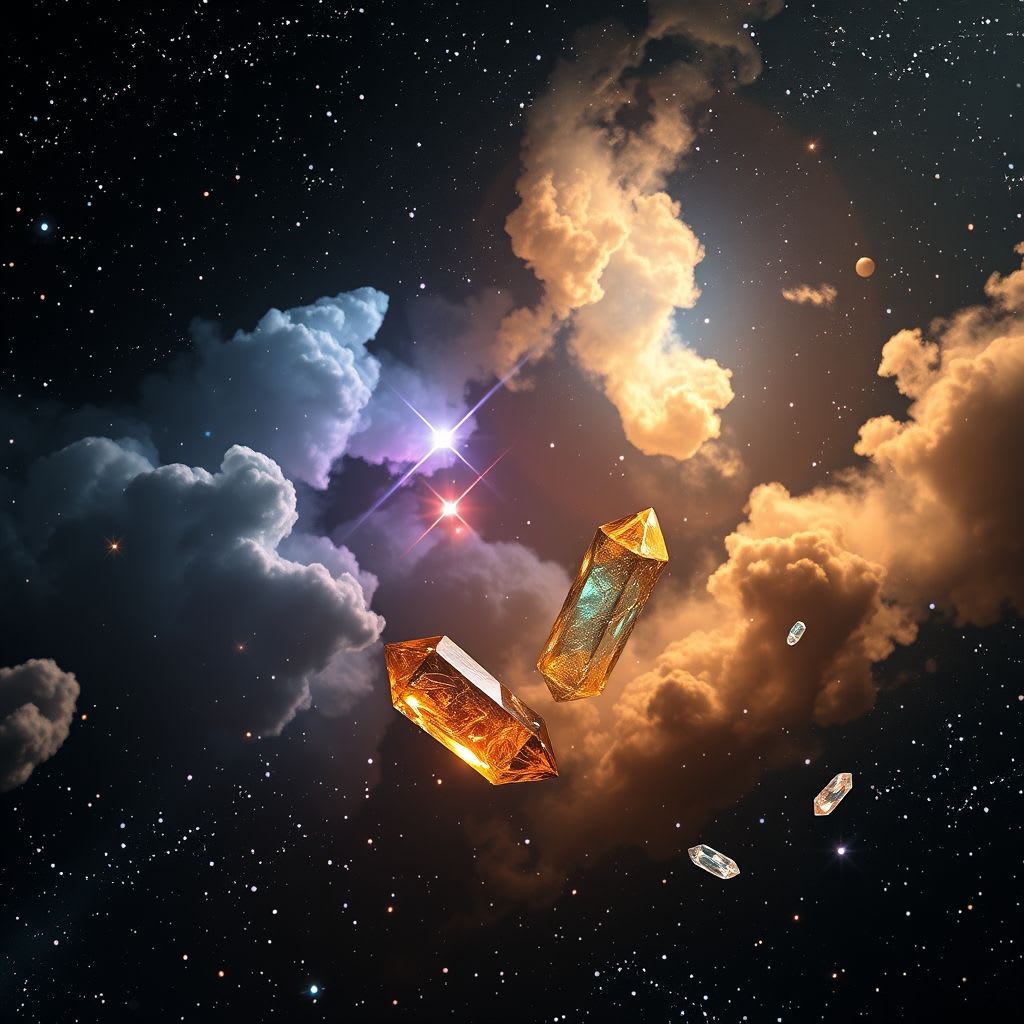
When most people think of crystals, they imagine a sparkling piece of quartz on display in a mineral shop or a perfectly cut diamond set in a ring. But few realize that some of the most unusual and flawless crystals are not born deep within Earth’s crust they are forged in the cold, airless reaches of space.
Yes, space itself is a master jeweler, crafting crystals from atoms and molecules with tools and conditions unlike anything found on our planet.
Crystals in Orbit: Microgravity as the Perfect Workshop
On Earth, the growth of crystals is often affected by gravity. Heavier particles settle, liquids circulate unevenly, and defects form in the structure. In the weightless environment of space, however, crystals grow differently more slowly, but with far greater symmetry and fewer imperfections.
This is why scientists grow protein crystals aboard the International Space Station (ISS). These protein crystals are invaluable in pharmaceutical research: the purer and more perfectly structured the crystal, the easier it is to study its molecular architecture.
For instance, insulin crystals grown in orbit have far fewer defects than their Earth-grown counterparts. That means space can give us not only beautiful minerals, but also the keys to creating more effective medicines.
Interstellar Dust: The Cradle of Minerals
But crystal formation isn’t limited to astronaut laboratories. In the vast depths of space, among clouds of interstellar dust, tiny mineral grains are born grains that will one day become part of planets, asteroids, and comets.
Around dying stars such as red giants, enormous clouds of gas and dust form. Within these clouds, atoms combine into molecules, and over time, arrange themselves into crystalline structures. Minerals like olivine, pyroxene, and corundum can emerge in these stellar “factories.”
When a star ends its life in a supernova explosion, it scatters these crystals across the galaxy. Billions of years later, they may find themselves embedded in a meteorite that falls to Earth.
Crystals in Meteorites: Ancient Travelers
Many meteorites contain crystals that are billions of years old. In carbonaceous chondrites, for example, scientists have found grains of crystalline quartz and perovskite that formed before our Solar System even existed.
Some discoveries are so rare they verge on the impossible: certain meteorites contain crystals that cannot be recreated under Earth conditions. Their structures were shaped under temperatures and pressures we simply cannot reproduce here. These extraterrestrial jewels are like time capsules, preserving stories from the earliest days of our galaxy.
Ice Crystals at the Edge of the Solar System
Not all cosmic crystals are made of rock and metal. At the icy fringes of the Solar System, on distant comets, in the shadowy regions of Saturn’s rings, and on the surface of Pluto, water, methane, and ammonia form dazzling ice crystals.
At temperatures sometimes dipping below −200°C (−328°F), these crystals grow at an almost glacial pace but their shapes can be breathtaking. Some form perfect hexagonal snowflakes, while others develop into intricate branching patterns that resemble fantastical frozen forests.
Why Space Makes Crystals
It might seem that cosmic crystals are just a side effect of various physical processes. In reality, they play crucial roles:
- They serve as the building blocks for future planets.
- They help shape the surfaces and atmospheres of celestial bodies.
- They carry chemical records of the past lives of stars and galaxies.
- They allow scientists to study how order emerges from the chaos of cosmic dust.
Each crystal, no matter how small, is a tiny archive of conditions in the part of the universe where it formed.
Space: The Infinite Jewelry Workshop
In a sense, space is an endless workshop where simple atoms are patiently assembled into masterpieces of crystalline geometry. Some of these we can grow and study aboard orbiting laboratories. Others we find locked in meteorites older than Earth itself. Still others we can only observe from afar, glinting faintly in the light of distant stars.
Every crystal is a frozen story a silent witness to the cosmic forces that shaped it. And perhaps, one day, humanity will learn how to harvest and craft them directly in space, not only for science and technology, but for the sheer beauty of these otherworldly treasures.
About the Creator
Keep reading
More stories from Holianyk Ihor and writers in Futurism and other communities.
Hot Jupiters — The Planets That Shouldn’t Exist
In astronomy, there’s a strange breed of worlds that seem to defy common sense. They’re enormous, like Jupiter, yet they orbit so close to their stars that a “year” on them lasts only a few Earth days. Their scorching atmospheres can reach temperatures hot enough to melt metal. Astronomers call them Hot Jupiters and, by all known laws of planetary science, they shouldn’t exist at all.
By Holianyk Ihor5 months ago in Futurism
About Binding Prometheus
I want to start actively advocating on behalf of my own work, and the most valuable part of my canon is, without a doubt, Binding Prometheus, the play I have been working on since 2019 and only finished in 2023 as part of my MA. The play itself is an amalgamation of a million different inspirations. On one end, it evokes the Ancient Greek myth-play, deriving its own title from the earliest extant work of Western drama we have, Aeschylus’s Prometheus Bound. On the other end, it borrows significantly from the sci-fi bulwarks from over the years, namely Mary Shelley’s Frankenstein and Karel Capek’s Rossum’s Universal Robots. The play could be an episode of Black Mirror, I fear. I don’t know. I’ve only ever seen one episode of Black Mirror.
By Steven Christopher McKnight18 days ago in Futurism
United States Residential Remodeling Market Size and Forecast 2025–2033
Introduction The United States residential remodeling market has entered a transformative phase, driven by evolving homeowner lifestyles, rising property values, and an increased emphasis on sustainability and modernization. According to Renub Research, the United States Residential Remodeling Market is expected to reach US$ 804.02 billion by 2033, up from US$ 531.34 billion in 2024, growing at a CAGR of 4.71% between 2025 and 2033. This steady expansion reflects the essential role of remodeling in maintaining and enhancing the nation’s aging housing stock while aligning homes with contemporary living standards.
By Renub Research6 days ago in Futurism
Wild Card Weekend Recap: What Happens Now?
I think I figured out why I love Wild Card Weekend so much. It's because it's the first playoff anything of the calendar year. The NFL season starts in the fall, and once upon a time, the champion was crowned either on or slightly before New Year's. The evolution of the NFL schedule has resulted in the playoffs starting just into the New Year, and currently, the final week of the season falls on the first weekend of the New Year, with Wild Card Weekend coming a week after that. So yes, chronologically, the NFL's Wild Card Weekend serves as the first playoff anything of the calendar year.
By Clyde E. Dawkins6 days ago in Unbalanced



Comments
There are no comments for this story
Be the first to respond and start the conversation.