Holianyk Ihor
Bio
Stories (419)
Filter by community
Could Dark Matter and Dark Energy Be the Key to Intergalactic Jumps?
Our universe is filled with mysteries vast, puzzling enigmas that defy our understanding. Among the greatest of them are dark matter and dark energy. Together, they make up about 95% of the total mass energy content of the cosmos, yet we can't see them, touch them, or measure them directly. They are the invisible architecture of reality. But what if these elusive forces are more than just curiosities for astrophysicists? What if they’re the missing link in our quest to leap between galaxies?
By Holianyk Ihor7 months ago in Futurism
Could Humans Survive a 1,000-Year Journey?
Imagine embarking on a journey so long that no one who starts it will ever see its end. A voyage lasting not decades or centuries, but an entire millennium. As humanity begins to dream more seriously about interstellar travel, the idea of a 1,000 year mission once the stuff of science fiction is becoming a question of science, engineering, psychology, and even philosophy. Could we really survive such a journey?
By Holianyk Ihor7 months ago in Futurism
How to Navigate Intergalactic Space: The Future of Cosmic Navigation
Traveling between galaxies isn’t just the stuff of science fiction it’s one of the most complex scientific and engineering challenges humanity may ever face. Among the many hurdles we’ll have to overcome, one of the biggest is this: how do you know where you’re going when you’re surrounded by near total emptiness? Without familiar reference points like planets, stars, or even nearby galaxies, how can we determine our direction in the vast void between galactic realms?
By Holianyk Ihor7 months ago in Futurism
Can We “Put a Crew to Sleep” During a Galactic Voyage?
When we imagine humanity’s future among the stars, our minds leap to advanced propulsion systems, cosmic radiation shields, and the challenges of navigating the vastness of space. But there’s one fundamental problem that overshadows all the others: time. Even with the most cutting edge propulsion technology we can conceive, a journey to the nearest star could take decades or longer. And that’s just the beginning if we’re talking about galactic travel spanning thousands of light years.
By Holianyk Ihor7 months ago in Futurism
Could Galaxies Be Connected by Hidden Pathways — Like a Galactic Subway?
Imagine the universe as an enormous megacity, with galaxies as glowing metropolises scattered across a vast cosmic landscape. Each galaxy shines with its own light, brimming with stars, nebulae, and mysteries. At first glance, these galaxies seem isolated floating islands in an endless sea of darkness. But what if they’re not? What if they’re secretly connected by invisible structures like tunnels or subway lines linking city centers?
By Holianyk Ihor7 months ago in Futurism
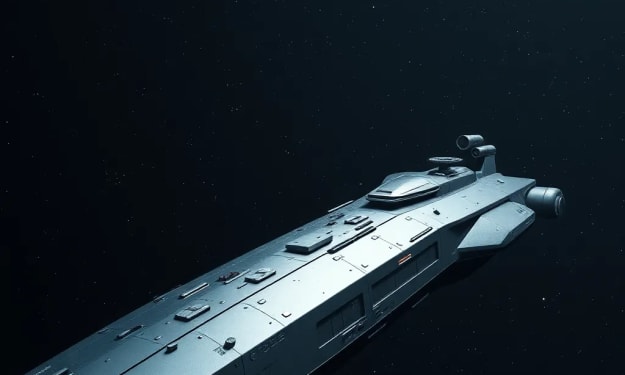
The Intergalactic "Space Ark": A Generational Starship for the Future
When we imagine intergalactic travel, we often think of sleek starships, glowing warp drives, and high speed journeys across shimmering galactic highways. But there’s one concept that feels more like mythology or science fiction than practical engineering: the generational space ark. This isn’t just a ship it’s a floating world, a mobile civilization hurtling through the void for hundreds or even thousands of years.
By Holianyk Ihor7 months ago in Futurism
Why Intergalactic Travel Requires a New Kind of Physics
When we gaze up at the night sky, we’re not just looking at stars and planets we’re peering into the past. The light from distant galaxies takes millions, sometimes billions, of years to reach us. This cosmic time-travel effect is a powerful reminder of the immense scale of the universe and the extraordinary challenge of crossing it. Even reaching the closest star, Proxima Centauri, would take tens of thousands of years with current spacecraft. Now imagine trying to travel to another galaxy, like Andromeda, which is nearly 2.5 million light years away.
By Holianyk Ihor7 months ago in Futurism
What Happens to Fire in Microgravity? A Dance Without Earth’s Rules
On Earth, lighting a candle is a familiar ritual. The flame stretches upward, flickers in the breeze, and dances in a graceful ballet powered by gravity. But take that same flame into space into the strange, weightless world of microgravity and the rules change. The flame no longer climbs. It doesn’t flicker. It morphs into a gentle, glowing sphere, floating like a small, golden ghost. So what exactly happens to fire when gravity no longer calls the shots?
By Holianyk Ihor7 months ago in Futurism
How Astronauts Lose Their Bones in Space: The Invisible Cost of Microgravity
When we watch astronauts floating effortlessly in the serenity of space, it looks magical like a dream come true. But behind the smiles and slow motion somersaults lies a silent threat. In space, their bones are literally dissolving. This invisible consequence of living in microgravity is one of the most serious challenges astronauts face, and we still haven’t cracked the code to solve it.
By Holianyk Ihor7 months ago in Futurism
What If a Spaceship Gets Lost in Deep Space? A Solitary Journey Among the Stars
Outer space isn’t just empty it’s a boundless, cold, and silent void where even the smallest error can spiral into catastrophe. But what would really happen if a spacecraft veered off course and got lost in this cosmic abyss? How likely is such a scenario, and what fate might await the crew?
By Holianyk Ihor7 months ago in Futurism
How Space Radiation Protection Works: Shields of the Future and the Challenges of Today
When we imagine traveling to Mars or exploring the far reaches of the galaxy, we picture sleek spacecraft, lunar colonies, and breathtaking alien landscapes. But behind this thrilling vision lies one of the most serious dangers of space travel cosmic radiation. Unlike Earth, where we’re shielded by our atmosphere and magnetic field, space leaves human bodies exposed to a relentless stream of high-energy particles. That’s why radiation protection systems are not just an option they’re a mission-critical necessity. So, how exactly do they work?
By Holianyk Ihor7 months ago in Futurism
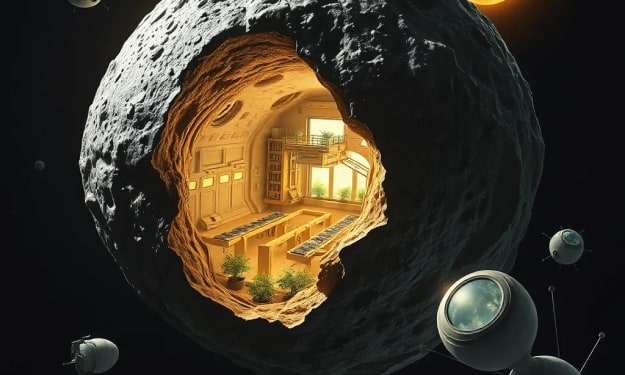
Could We Build a City in the Asteroid Belt? A Dream or the Future of Humanity
When we talk about space colonization, most people immediately picture moon bases or settlements on Mars. But there's another, far more mysterious and daring location that sparks both fascination and skepticism the asteroid belt. Nestled between the orbits of Mars and Jupiter, this vast region is home to millions of rocky, metallic, and icy fragments. At first glance, the idea of building a city in the middle of what seems like a cosmic demolition zone sounds absurd. But is it really?
By Holianyk Ihor7 months ago in Futurism