
What If a Spaceship Gets Lost in Deep Space? A Solitary Journey Among the Stars
Space

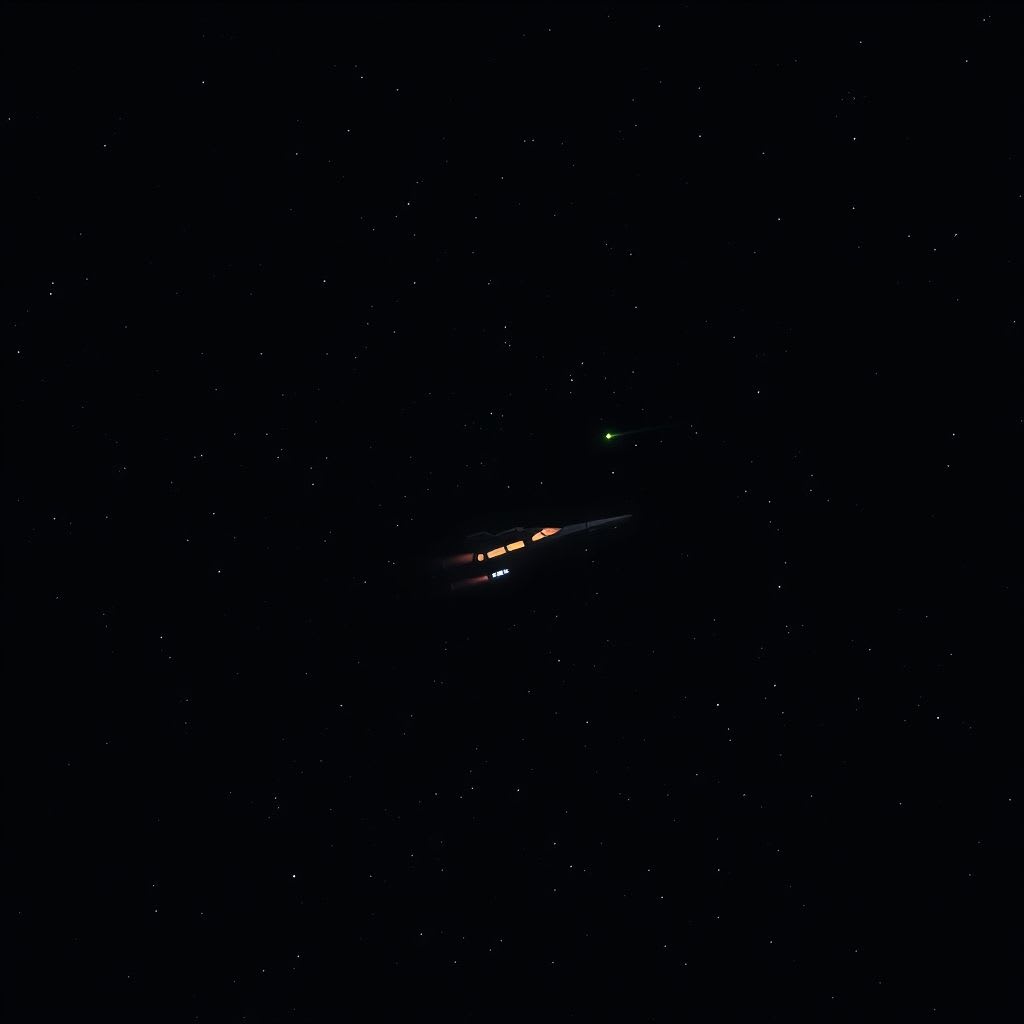
Outer space isn’t just empty it’s a boundless, cold, and silent void where even the smallest error can spiral into catastrophe. But what would really happen if a spacecraft veered off course and got lost in this cosmic abyss? How likely is such a scenario, and what fate might await the crew?
Space Doesn’t Forgive Mistakes
Modern space missions rely heavily on precision: detailed calculations, exact orbital maneuvers, constant communication with Earth, and layers of navigation systems. But even a minor software glitch, hardware failure, miscalculation, or impact with a micro-meteoroid can send a spacecraft drifting off its intended path.
Once the link with Earth is broken or celestial navigation markers disappear, a ship can quickly become lost. In deep space, there are no road signs, no horizons only blackness and the occasional glimmer of distant stars. Orientation becomes a puzzle with missing pieces.
Psychological Pressure: Lost in Nothingness
Imagine waking up aboard your ship to find only silence. No planets, no signals, no nearby stations just endless darkness beyond the window. It’s you, the ship, and infinity.
In such isolation, the psychological toll is immense. Time begins to blur, and reality can start to feel dreamlike. Even the most resilient astronauts aren’t truly prepared for the experience of being lost in the truest sense no direction, no mission, and no certainty that anyone knows you’re still alive.
The lack of external stimuli can lead to a breakdown in mental stability. Studies on Earth have shown how prolonged isolation even in well lit, controlled environments can cause sleep disturbances, memory lapses, and depression. Multiply that by the alienness of space, and it becomes clear that mental endurance would be as critical as life support.
How Long Could a Ship Survive?
The answer depends on its resource reserves. Oxygen, water, food, and energy are all finite. Most current spacecraft are not designed for indefinite autonomy far from Earth. Even with careful rationing, depletion is inevitable.
Some advanced designs include air and water recycling systems, which can extend survival for weeks or even months. But technical functionality doesn't ensure emotional sustainability. Every passing day without contact would erode morale, leaving the crew in a state of suspended desperation.
Is Rescue Even Possible?
It depends. If the ship still has power and can transmit a signal, there's a chance it could be located at least if it hasn’t drifted too far. But “far” in space isn’t like on Earth. A few hundred kilometers can be a massive barrier. If we're talking about distances measured in light years, rescue becomes nearly impossible.
Some researchers envision future AI systems capable of autonomous navigation, recalibrating a ship’s position even in the absence of Earth based guidance. These are promising, but still in development. Until then, recovery efforts would rely on luck, powerful sensors, and timing.
Can the Ship Find Its Own Way Back?
If the spacecraft is equipped with high thrust engines and self-navigation tools, it might attempt to chart a course back perhaps toward the Sun, a known star, or even a relay station. Some futurists propose a network of space “beacons,” like cosmic GPS points that could guide lost vessels. For now, though, those remain science fiction.
Historical Echoes of the Lost
So far, no crewed missions have gone completely off the radar in deep space. But we’ve come close in other ways. In the 1970s, NASA's Pioneer 10 left the Solar System and is now drifting silently through interstellar space. Some unmanned probes have failed mid-mission, vanishing into the black without a trace.
A human mission, however, would carry a heavier emotional weight. The loss wouldn't just be technological it would be deeply human.
Final Thoughts: Alone Among the Stars
To be lost in space is to face eternity head on. It’s more than a mechanical failure; it’s a philosophical dilemma. A being from Earth, bold enough to leave its cradle, finds itself truly alone in an uncaring universe.
This hypothetical reminds us of just how fragile space exploration still is. Every journey beyond Earth is a leap of faith and a testament to human courage. But caution must always be our companion. In the vast, cold blackness, there are no second chances. No guiding stars. Just darkness, silence—and the hope that someone is still listening.
About the Creator
Keep reading
More stories from Holianyk Ihor and writers in Futurism and other communities.
How Space Radiation Protection Works: Shields of the Future and the Challenges of Today
When we imagine traveling to Mars or exploring the far reaches of the galaxy, we picture sleek spacecraft, lunar colonies, and breathtaking alien landscapes. But behind this thrilling vision lies one of the most serious dangers of space travel cosmic radiation. Unlike Earth, where we’re shielded by our atmosphere and magnetic field, space leaves human bodies exposed to a relentless stream of high-energy particles. That’s why radiation protection systems are not just an option they’re a mission-critical necessity. So, how exactly do they work?
By Holianyk Ihor7 months ago in Futurism
About Binding Prometheus
I want to start actively advocating on behalf of my own work, and the most valuable part of my canon is, without a doubt, Binding Prometheus, the play I have been working on since 2019 and only finished in 2023 as part of my MA. The play itself is an amalgamation of a million different inspirations. On one end, it evokes the Ancient Greek myth-play, deriving its own title from the earliest extant work of Western drama we have, Aeschylus’s Prometheus Bound. On the other end, it borrows significantly from the sci-fi bulwarks from over the years, namely Mary Shelley’s Frankenstein and Karel Capek’s Rossum’s Universal Robots. The play could be an episode of Black Mirror, I fear. I don’t know. I’ve only ever seen one episode of Black Mirror.
By Steven Christopher McKnight19 days ago in Futurism
Smart Lock Market Size to Surpass USD 9.9 Billion by 2033 Driven by IoT Integration & Connected Living Trends
According to IMARC Group's latest research publication, global smart lock market size reached USD 2.7 Billion in 2024. Looking forward, IMARC Group expects the market to reach USD 9.9 Billion by 2033, exhibiting a growth rate (CAGR) of 15.43% during 2025-2033.
By Suhaira Yusuf6 days ago in Futurism


Comments
There are no comments for this story
Be the first to respond and start the conversation.