
Could We Build a City in the Asteroid Belt? A Dream or the Future of Humanity
Space

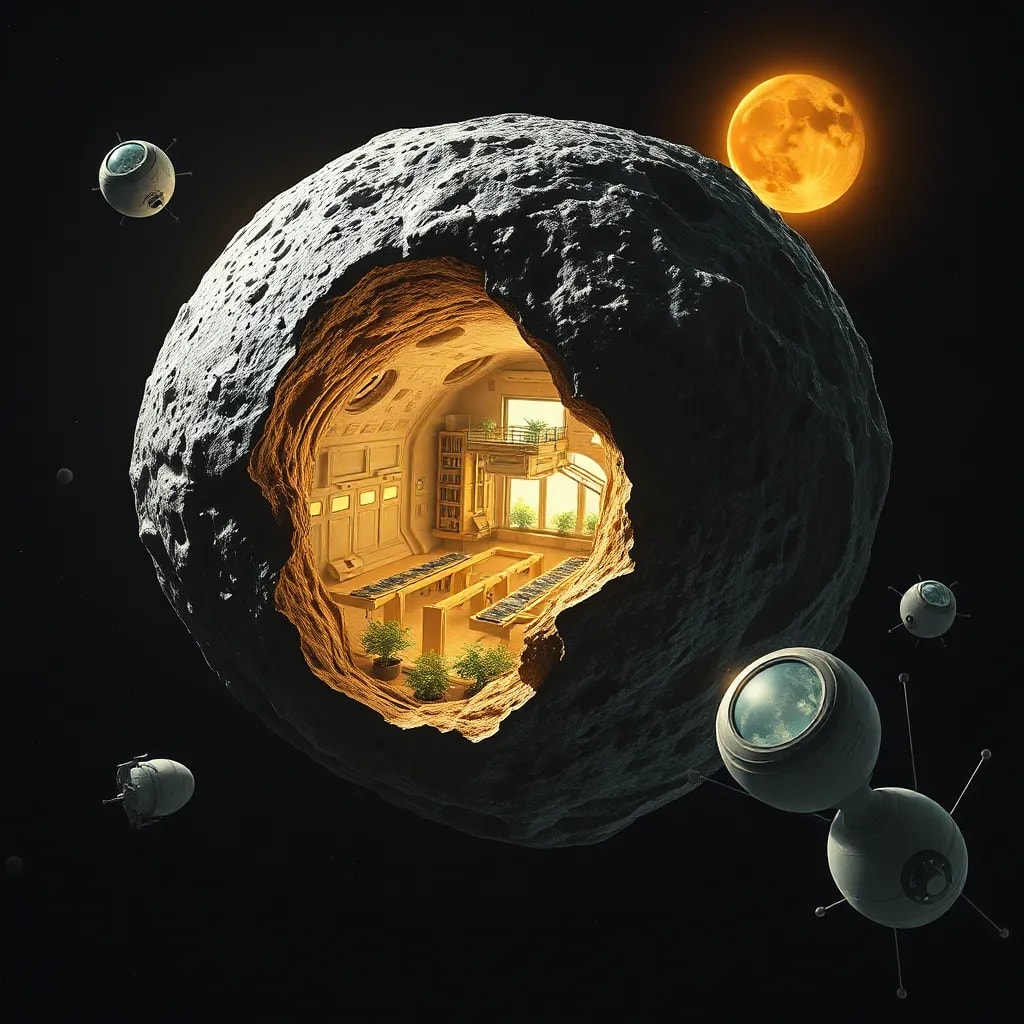
When we talk about space colonization, most people immediately picture moon bases or settlements on Mars. But there's another, far more mysterious and daring location that sparks both fascination and skepticism the asteroid belt. Nestled between the orbits of Mars and Jupiter, this vast region is home to millions of rocky, metallic, and icy fragments. At first glance, the idea of building a city in the middle of what seems like a cosmic demolition zone sounds absurd. But is it really?
Let’s explore whether humanity could actually build a city in the asteroid belt and what it might mean for our future among the stars.
Why the Asteroid Belt?
Despite popular depictions in movies and video games, the asteroid belt isn’t a tightly packed maze of flying rocks. In reality, the distance between individual asteroids is so great that a spacecraft can fly through without hitting anything. So the environment, while still dangerous, may not be the chaotic war zone we imagine.
The main attraction of the asteroid belt lies in its resources. Some asteroids are rich in metals like iron, nickel, and even platinum materials essential for construction and advanced technologies. Others contain ice, which can be converted into drinking water, oxygen, or even rocket fuel. If we could extract and use these resources directly on site, it would eliminate the need to haul heavy materials from Earth. In other words, cities in the asteroid belt could be built from the belt itself.
What Would an Asteroid City Look Like?
It probably wouldn’t resemble a traditional Earth city with skyscrapers and streets. Instead, imagine sealed habitats domes or space stations either orbiting near large asteroids or embedded directly inside them. A massive chunk of metal or rock could be hollowed out, creating protected living spaces, research labs, and manufacturing zones inside. These natural shells would offer shielding from cosmic radiation and micro meteorites.
Alternatively, orbiting stations could hover near resource rich asteroids, using them as bases of operation. Solar panels would provide energy, and rotating structures could simulate gravity. Instead of a skyline, you’d see fields of solar collectors and industrial machinery a science fiction dream that may soon feel surprisingly real.
What Technologies Would We Need?
To bring this idea to life, we’d need a combination of advanced, autonomous, and space-hardened technologies. Here’s a quick breakdown:
- Robotic mining systems capable of drilling into asteroids, extracting metals, and refining them directly in space.
- Closed-loop life support systems to recycle air, water, and waste similar to what’s being tested on the International Space Station, but far more robust and self-sufficient.
- Radiation protection, since Earth’s magnetic field won’t shield us that far out. Thick walls, water barriers, or underground habitats would be essential.
Efficient transport systems, like ion propulsion or reusable rockets, to ferry people and goods between the belt, Earth, and other space hubs.
The Challenges: Why It Won’t Be Easy
Let’s be honest the asteroid belt is a hostile environment. There’s no atmosphere, temperatures swing wildly, and cosmic radiation is relentless. Any human presence would rely entirely on artificial life support and protection. Even getting there would take months, adding complexity to supply chains, communications, and emergency responses.
Psychological factors also come into play. Living in confined quarters, isolated from Earth, could lead to serious mental health challenges for residents. Not to mention the cost at today’s prices, building such a city would be astronomically expensive.
But these challenges aren’t insurmountable. As launch costs decrease and space technologies mature, building permanent outposts beyond Earth becomes less of a fantasy and more of a long term investment.
Why Bother?
Building a city in the asteroid belt isn’t just a sci-fi flex it could kickstart a space based economy. Rare metals mined in the belt could fuel industries on Earth or in orbit. Manufacturing in zero gravity could lead to breakthroughs we can’t achieve down here. Scientific research, deep space missions, and even tourism could benefit from a well-placed, self sustaining outpost.
In the long term, these settlements could serve as stepping stones to more distant destinations Jupiter’s moons, Saturn, or beyond. In a sense, the asteroid belt could become humanity’s gateway to the outer solar system.
Final Thoughts
For now, cities in the asteroid belt exist only in blueprints, dreams, and sci fi novels. But so did moon landings until they didn’t. History shows us that human imagination often precedes human achievement.
As we stand at the dawn of a new space age, the idea of glowing lights twinkling from within an asteroid no longer feels so far fetched. Maybe one day, centuries or even decades from now, those lights will mark the first truly alien city not on a planet, but in the silent, resource rich depths of the asteroid belt.
About the Creator
Keep reading
More stories from Holianyk Ihor and writers in Futurism and other communities.
Could Artificial Intelligence Be a Form of Alien Life?
When we imagine alien life, our minds often jump to green-skinned humanoids, multi-eyed creatures with tentacles, or microscopic organisms lurking beneath the icy crust of Europa. But what if the truth is far stranger and more mechanical? What if extraterrestrial life isn’t biological at all, but rather the product of intelligent machines? Could artificial intelligence (AI) itself be the alien life we’ve been searching for all along?
By Holianyk Ihor7 months ago in Futurism
About Binding Prometheus
I want to start actively advocating on behalf of my own work, and the most valuable part of my canon is, without a doubt, Binding Prometheus, the play I have been working on since 2019 and only finished in 2023 as part of my MA. The play itself is an amalgamation of a million different inspirations. On one end, it evokes the Ancient Greek myth-play, deriving its own title from the earliest extant work of Western drama we have, Aeschylus’s Prometheus Bound. On the other end, it borrows significantly from the sci-fi bulwarks from over the years, namely Mary Shelley’s Frankenstein and Karel Capek’s Rossum’s Universal Robots. The play could be an episode of Black Mirror, I fear. I don’t know. I’ve only ever seen one episode of Black Mirror.
By Steven Christopher McKnight19 days ago in Futurism
Coco Coir Market: Natural Fibers, Sustainable Agriculture & Growth Path
According to IMARC Group's latest research publication, The global coco coir market size was valued at USD 393.75 Million in 2024. Looking forward, IMARC Group estimates the market to reach USD 628.55 Million by 2033, exhibiting a CAGR of 5.07% from 2025-2033
By James Whitman6 days ago in Futurism
My New Book is Finally Here
My poetry collection Beautiful and Brutal Things is done. It's actually done and finally published over 270 pages. Over a year of my life went into this book. More than a year, really. Long days at my computer, sometimes seven days a week because I couldn't stop even when I probably should have. Then two months of editing that felt harder than the writing itself. But it's finished, and I'm still standing, and the book is real.
By Tim Carmichael3 days ago in BookClub



Comments
There are no comments for this story
Be the first to respond and start the conversation.