
Why Intergalactic Travel Requires a New Kind of Physics
Space

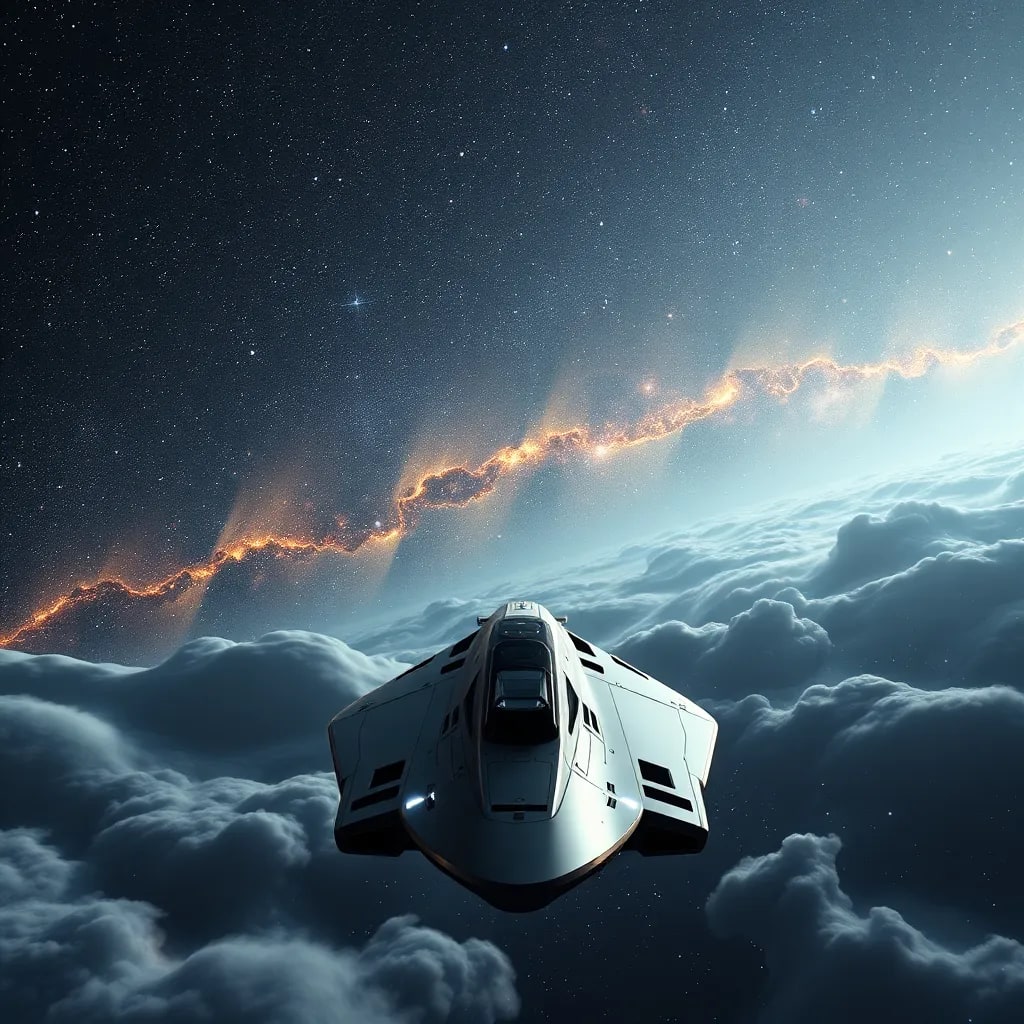
When we gaze up at the night sky, we’re not just looking at stars and planets we’re peering into the past. The light from distant galaxies takes millions, sometimes billions, of years to reach us. This cosmic time-travel effect is a powerful reminder of the immense scale of the universe and the extraordinary challenge of crossing it. Even reaching the closest star, Proxima Centauri, would take tens of thousands of years with current spacecraft. Now imagine trying to travel to another galaxy, like Andromeda, which is nearly 2.5 million light years away.
At that scale, conventional physics reaches its limits. If humanity ever hopes to journey across the cosmic ocean, we’ll need more than faster engines we’ll need to rewrite the rulebook of physics itself.
The Light Speed Barrier
The first and most obvious problem is the cosmic speed limit. According to Einstein’s special theory of relativity, nothing with mass can travel faster than light in a vacuum about 299,792,458 meters per second. That’s unimaginably fast by earthly standards, but still painfully slow when it comes to intergalactic distances. Even if we could somehow accelerate a ship to 99.999% the speed of light, it would still take millions of years to reach Andromeda from Earth.
Such timescales are incompatible with human biology and life support technology. No food storage, energy reserve, or cryogenic sleep chamber could reasonably support life on a trip that long. So, what’s the solution? We may need to rethink the very fabric of space and time.
Bending Space: Warp Drives and Wormholes
Science fiction has long proposed exotic ideas like warp drives and wormholes and surprisingly, these concepts don’t entirely violate the laws of physics, at least not those described by general relativity.
The Alcubierre warp drive, for example, proposes a method of compressing space in front of a ship and expanding it behind, effectively moving the ship by distorting space itself. The ship wouldn’t move through space faster than light instead, space would move around it, like a surfer riding a wave. But there’s a catch: to generate this “warp bubble,” you’d need negative energy, a theoretical substance that has never been observed in sufficient quantities if it exists at all.
Then there are wormholes hypothetical tunnels through spacetime that could connect two distant points instantly. In theory, they could allow for near-instantaneous travel between galaxies. But wormholes are inherently unstable and prone to collapse, unless stabilized by “exotic matter” with negative energy density. Again, that kind of matter remains purely speculative.
Dark Matter and Dark Energy: Unlocking New Tools?
Roughly 95% of the universe is made up of dark matter and dark energy two of the biggest mysteries in modern physics. While we can’t see or touch them directly, we see their effects: dark matter holds galaxies together, and dark energy is causing the expansion of the universe to accelerate.
Some physicists believe that a deeper understanding of these phenomena could lead to revolutionary breakthroughs in propulsion. For instance, dark energy might represent properties of the vacuum itself properties that, if harnessed, could allow us to manipulate space for propulsion, perhaps even enabling “motion without motion.”
It’s a tantalizing thought: that the key to intergalactic travel may be hidden in the 95% of the universe we barely understand.
Quantum Physics and Nonlocality
Quantum mechanics offers another potential path to new physics. At the quantum level, reality behaves in bizarre, often counterintuitive ways. Quantum entanglement, for instance, suggests that two particles can be connected in such a way that a change to one affects the other, no matter how far apart they are.
While this phenomenon doesn’t allow for faster-than-light communication (at least not yet), it hints at a universe where distance may not be as absolute as we think. Continued research into quantum effects could someday lead to technologies that bypass our classical understanding of space and time altogether.
Why Today’s Physics Isn’t Enough
Modern physics is based on observations and experiments conducted within our solar system and nearby cosmic neighborhood. But the universe is vastly more complex than anything we’ve encountered. It’s entirely possible that the limits we perceive like the speed of light or the need for mass-based propulsion are only artifacts of our current understanding.
Intergalactic travel won’t be achieved through better rockets or bigger fuel tanks. It will require new physics a deeper framework that unifies energy, gravity, spacetime, and quantum phenomena in ways we’re only beginning to imagine.
In Conclusion
Today, intergalactic travel remains firmly in the realm of science fiction. But history shows that science fiction often foreshadows reality. Electricity, nuclear energy, and quantum computing were once fantasy. Perhaps the physics we need already exists, hidden in equations we haven’t yet solved or dimensions we haven’t yet discovered.
The universe is vast, but curiosity is boundless. And one day, that curiosity may crack the code of the cosmos, opening the door not just to the stars but to the galaxies beyond.
About the Creator
Keep reading
More stories from Holianyk Ihor and writers in Futurism and other communities.
What Happens to Fire in Microgravity? A Dance Without Earth’s Rules
On Earth, lighting a candle is a familiar ritual. The flame stretches upward, flickers in the breeze, and dances in a graceful ballet powered by gravity. But take that same flame into space into the strange, weightless world of microgravity and the rules change. The flame no longer climbs. It doesn’t flicker. It morphs into a gentle, glowing sphere, floating like a small, golden ghost. So what exactly happens to fire when gravity no longer calls the shots?
By Holianyk Ihor7 months ago in Futurism
About Binding Prometheus
I want to start actively advocating on behalf of my own work, and the most valuable part of my canon is, without a doubt, Binding Prometheus, the play I have been working on since 2019 and only finished in 2023 as part of my MA. The play itself is an amalgamation of a million different inspirations. On one end, it evokes the Ancient Greek myth-play, deriving its own title from the earliest extant work of Western drama we have, Aeschylus’s Prometheus Bound. On the other end, it borrows significantly from the sci-fi bulwarks from over the years, namely Mary Shelley’s Frankenstein and Karel Capek’s Rossum’s Universal Robots. The play could be an episode of Black Mirror, I fear. I don’t know. I’ve only ever seen one episode of Black Mirror.
By Steven Christopher McKnight15 days ago in Futurism
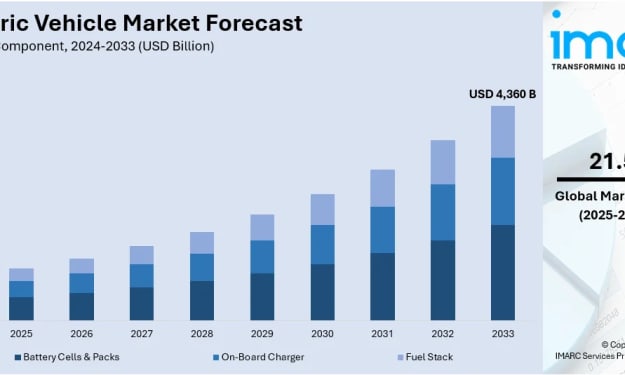
Electric Vehicle Market Size to Hit USD 4,360 Billion by 2033 Driven by Battery Innovation & Cost Declines
Rising environmental concerns, supportive government policies, falling battery costs, and expanding charging infrastructure are accelerating electric vehicle adoption, supported by technological innovation, fuel cost savings, and increasing consumer acceptance worldwide. According to IMARC Group's latest research publication, global electric vehicle market size reached USD 755 Billion in 2024. Looking forward, IMARC Group expects the market to reach USD 4,360 Billion by 2033, exhibiting a growth rate (CAGR) of 21.5% during 2025-2033.
By Abhay Rajput2 days ago in Futurism
Getting Serious About Comedy (Part I)
If I were asked to remark on my life and the childhood that paved some road leading me to this point, I would have to say something about all the funny people who surrounded me for the last 26,872 days (and counting). Somewhere along that road, I became a big fan of laughter and the comedy that spawns it – and, I mean not only my own laughter, but the laughter of others, some of which I have actually been responsible for inducing.
By John Oliver Smith6 days ago in Humor



Comments
There are no comments for this story
Be the first to respond and start the conversation.