
Could Dark Matter and Dark Energy Be the Key to Intergalactic Jumps?
Space

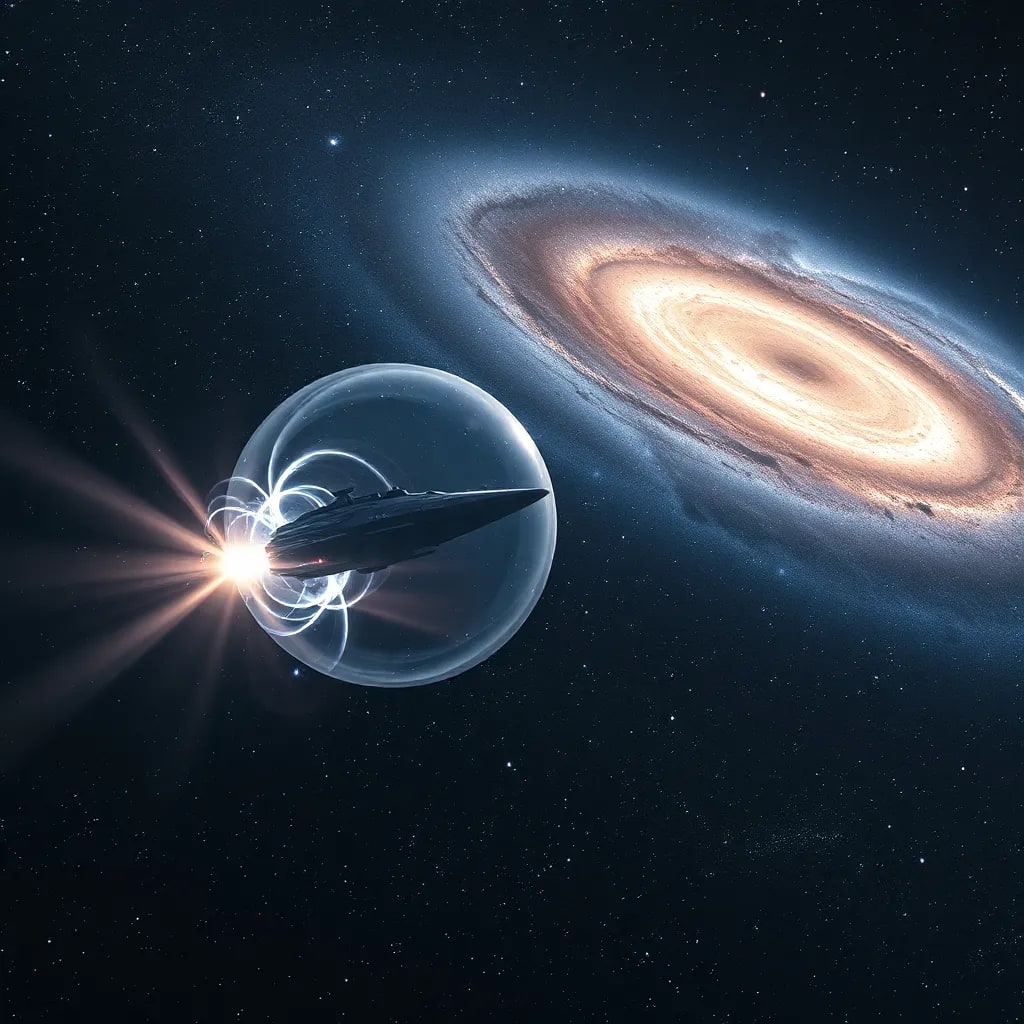
Our universe is filled with mysteries vast, puzzling enigmas that defy our understanding. Among the greatest of them are dark matter and dark energy. Together, they make up about 95% of the total mass energy content of the cosmos, yet we can't see them, touch them, or measure them directly. They are the invisible architecture of reality. But what if these elusive forces are more than just curiosities for astrophysicists? What if they’re the missing link in our quest to leap between galaxies?
The Invisible Fabric of the Universe
Dark matter is a form of matter that doesn’t emit, absorb, or reflect light which makes it essentially invisible. It doesn't interact with electromagnetic forces, but it does exert gravity. Without dark matter, galaxies wouldn’t hold together; their stars would simply fly off into space due to their immense rotational speeds. Dark matter acts like a cosmic glue, binding the structure of the universe.
Dark energy is even more baffling. It's believed to be responsible for the accelerated expansion of the universe as if the very fabric of space has a built-in anti gravity mechanism. While dark matter pulls things together, dark energy pushes them apart. Together, they shape the behavior of the cosmos on the grandest scales.
Jumping Between Galaxies: Sci-Fi or Science Future?
Right now, intergalactic travel feels like pure science fiction. Galaxies are separated by millions of light years. Even the fastest spacecraft we’ve built wouldn’t cross that distance in a hundred lifetimes. The challenge isn’t just speed it’s the fundamental structure of space and time.
But what if we could jump across space, rather than travel through it? Concepts like wormholes and warp drives have been imagined in theory and fiction. These mechanisms would allow us to bypass the limitations of distance by manipulating space itself. However, such techniques would require absurd amounts of energy and possibly exotic materials with negative mass or other unfamiliar properties.
This is where dark matter and dark energy might come into play.
Dark Energy: The Fuel for a Warp Drive?
In 1994, physicist Miguel Alcubierre proposed a theoretical warp drive that could compress space in front of a ship and expand it behind, allowing for fasternthan light travel without violating the laws of physics. But there’s a catch the concept requires negative energy density, something we’ve never observed in practice.
Yet dark energy behaves in a strangely similar way on a cosmic scale. It causes space to expand. If we could somehow harness or control this force, perhaps we could engineer a "warp bubble" a region of space that moves, rather than the ship itself. Within such a bubble, an intergalactic vessel might effectively glide across spacetime, bypassing the speed limit set by light.
It’s speculative yes but no more far-fetched than using electricity to fly would have sounded two centuries ago.
Could Dark Matter Build Gravitational Highways?
While dark energy might push us forward, dark matter could serve as the infrastructure. Since it has mass, it influences gravity. Theoretically, if we understood how to manipulate dark matter, we might use it to shape gravitational "tracks" stable corridors through the cosmic web. Think of them as invisible rails for starships to follow across the darkness.
Imagine engineers of the future laying down intergalactic routes not with metal, but with gravitational distortions built from dark matter. It's purely hypothetical for now but then again, so were black holes a century ago.
The Catch: We Still Don’t Know What It Is
Here’s the sobering truth: we still don’t know what dark matter or dark energy actually are. All current knowledge comes from indirect evidence the way galaxies rotate, how light bends around massive clusters, the expansion of the universe. We can’t replicate these phenomena in labs. We can’t bottle them, harness them, or tweak their settings.
But progress is being made. Projects like the James Webb Space Telescope and the Large Hadron Collider are giving us unprecedented views into the deep workings of the cosmos. With every new discovery, we peel back another layer of the cosmic onion and maybe, just maybe, get closer to a breakthrough.
The Universe Whispers
For now, dark matter and dark energy are like cosmic shadows we see their effects, but not the sources. But perhaps these shadows conceal a door. A door not just to understanding the universe but to moving through it in ways we’ve only imagined.
One day, future starship captains might not talk about parsecs or thrusters. Instead, they might refer to “dark corridors” and “energy bubbles.” The roadmap to other galaxies may not be paved through empty space but through the very fabric of reality itself.
Until then, the universe continues to whisper, through flickering quasars and gravitational distortions, inviting us to listen and learn and leap.
About the Creator
Keep reading
More stories from Holianyk Ihor and writers in Futurism and other communities.
Could Humans Survive a 1,000-Year Journey?
Imagine embarking on a journey so long that no one who starts it will ever see its end. A voyage lasting not decades or centuries, but an entire millennium. As humanity begins to dream more seriously about interstellar travel, the idea of a 1,000 year mission once the stuff of science fiction is becoming a question of science, engineering, psychology, and even philosophy. Could we really survive such a journey?
By Holianyk Ihor7 months ago in Futurism
About Binding Prometheus
I want to start actively advocating on behalf of my own work, and the most valuable part of my canon is, without a doubt, Binding Prometheus, the play I have been working on since 2019 and only finished in 2023 as part of my MA. The play itself is an amalgamation of a million different inspirations. On one end, it evokes the Ancient Greek myth-play, deriving its own title from the earliest extant work of Western drama we have, Aeschylus’s Prometheus Bound. On the other end, it borrows significantly from the sci-fi bulwarks from over the years, namely Mary Shelley’s Frankenstein and Karel Capek’s Rossum’s Universal Robots. The play could be an episode of Black Mirror, I fear. I don’t know. I’ve only ever seen one episode of Black Mirror.
By Steven Christopher McKnight16 days ago in Futurism
Egypt ICT Market: Cloud Adoption, 5G Rollout & Technology Investment Trends
According to IMARC Group's latest research publication, The Egypt ICT market size reached USD 27,685.0 Million in 2024. Looking forward, IMARC Group expects the market to reach USD 39,712.3 Million by 2033, exhibiting a growth rate (CAGR) of 4.09% during 2025-2033.
By Abhay Rajputa day ago in Futurism



Comments
There are no comments for this story
Be the first to respond and start the conversation.