politics
Politics does not dictate our collective cultural mindset as much as it simply reflects it; We've got to look in the mirror sometimes, and we've got one.
EU’s Top Diplomat Rejects Russian Claims of Ukrainian Attack on Government Sites. AI-Generated.
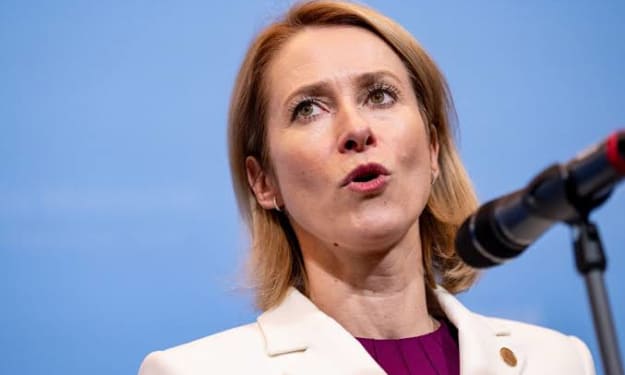
In the latest chapter of the ongoing Russia-Ukraine conflict, the European Union’s top diplomat has publicly rejected Russian claims that Ukrainian forces carried out attacks on government sites in Russian-controlled regions. The statement, coming from Josep Borrell, the EU’s High Representative for Foreign Affairs and Security Policy, underscores the growing tensions between Brussels and Moscow and highlights the broader battle over truth, propaganda, and international perception in the conflict. Russia has repeatedly accused Ukraine of targeting government infrastructure in areas under its control, presenting these allegations as evidence of Kyiv’s “aggression.” These claims were prominently circulated through Russian state media, including RT and TASS, often accompanied by images and footage purportedly showing damage to administrative buildings. However, Borrell and EU officials argue that these reports are unsubstantiated and likely part of a coordinated campaign to shape public perception both domestically and internationally. Speaking at a press briefing in Brussels, Borrell stated, “We have no independent verification that Ukraine has carried out attacks on the government facilities in these areas. The evidence presented by Russian authorities is not credible and appears to be aimed at justifying further military escalation.” This rejection marks a firm stance by the EU, reinforcing its support for Ukraine while also emphasizing the importance of accurate information amid wartime propaganda. The diplomatic tension comes at a critical moment as the conflict enters its third year, with both sides heavily engaged in military and informational warfare. Russia’s attempts to portray Ukraine as the aggressor in occupied territories are part of a broader strategy to legitimize its own military presence and to rally domestic support amid mounting economic sanctions and international criticism. Meanwhile, the EU continues to serve as a key mediator and supporter of Ukraine, providing military aid, economic assistance, and political backing to counterbalance Moscow’s influence. Analysts note that the rejection of Russian claims by the EU also reflects a strategic effort to maintain the credibility of international institutions. By challenging unverified narratives, the EU aims to prevent the normalization of misinformation as a tool of modern warfare. “In conflicts like this, information can be as potent as weapons,” says Dr. Elena Markov, a European security analyst. “Disinformation campaigns shape public opinion, influence policy decisions, and can even affect military strategy. The EU’s public dismissal of these Russian claims is a critical move to protect the integrity of information.” The situation on the ground remains volatile. Ukrainian forces continue to defend strategic regions, while Russia has intensified its military operations in contested areas. Civilian populations in conflict zones face immense challenges, including disruptions to essential services, the threat of bombardment, and limited access to humanitarian aid. Against this backdrop, the battle over narratives becomes particularly significant, influencing international support, the framing of peace negotiations, and public sentiment in Europe and beyond. Beyond the immediate conflict, the episode raises questions about the role of diplomacy and international oversight in wartime reporting. With both sides using media to further strategic goals, third-party verification becomes essential. Organizations like the United Nations, the Organization for Security and Co-operation in Europe (OSCE), and independent journalists play a crucial role in confirming events and providing neutral assessments. Borrell’s comments implicitly highlight the need for such oversight, emphasizing that unilateral claims, especially from parties engaged in conflict, cannot be accepted at face value. The EU’s firm response also sends a clear message to Moscow: attempts to manipulate the narrative will not go unchallenged. By publicly rejecting Russian claims, the bloc reinforces its position as a defender of international norms, including sovereignty, accountability, and the rule of law. This stance resonates strongly with member states, many of which have been directly impacted by the geopolitical and economic repercussions of the Russia-Ukraine war. As the conflict continues, the interplay between military operations and information campaigns is likely to intensify. For the EU and its allies, the challenge will be to balance the need for timely interventions with careful scrutiny of the facts, ensuring that diplomatic efforts are grounded in verified evidence rather than manipulated narratives. The rejection of Russian claims over Ukrainian attacks is not just a diplomatic statement—it is part of a broader strategy to maintain clarity, support Ukraine, and resist the spread of disinformation that could destabilize Europe and the wider international community. In summary, the EU’s top diplomat’s dismissal of Moscow’s allegations reflects both a commitment to Ukraine and a broader recognition of the dangers posed by misinformation in modern conflict. As the war continues to unfold, the battle over truth, perception, and credibility remains as critical as any military engagement, shaping the course of international policy and the future of European security.
By Fiaz Ahmed Brohiabout a month ago in The Swamp
Skills, Patience and Passion Exemplary”: PM Narendra Modi Hails Arjun Erigaisi’s World Blitz Bronze. AI-Generated.
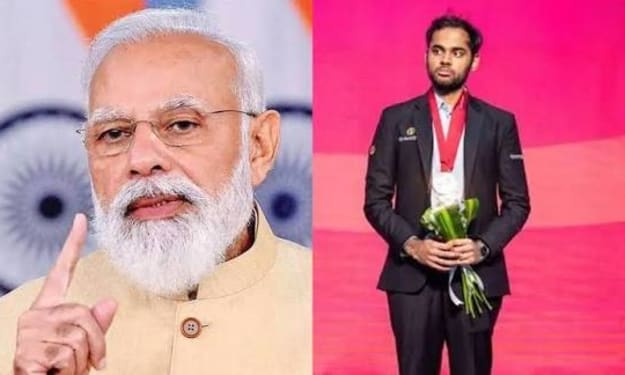
India’s growing presence on the global chess stage received another powerful boost as Prime Minister Narendra Modi praised young grandmaster Arjun Erigaisi for his bronze medal performance at the World Blitz Championship. Calling his achievement a reflection of “skills, patience and passion,” the Prime Minister’s words resonated far beyond a congratulatory message—they highlighted a broader story of India’s chess renaissance and the mindset shaping a new generation of champions. A Historic Moment for Indian Chess Arjun Erigaisi’s bronze medal in one of the world’s most competitive chess formats marks a significant milestone. Blitz chess, known for its lightning-fast pace and unforgiving time controls, tests not just technical knowledge but mental agility, emotional control, and instinct. In a format where games are decided in minutes and a single mistake can be fatal, consistency at the top level is rare. Arjun’s podium finish against a field stacked with elite grandmasters from across the globe underlines his ability to thrive under pressure. It also reinforces India’s reputation as a chess powerhouse that now produces world-class players across all formats—classical, rapid, and blitz. PM Modi’s Message: More Than Praise Prime Minister Modi’s message stood out because it went beyond the usual congratulations. By emphasizing skills, patience, and passion, he touched upon the core values required for excellence not only in chess but in life. Skills reflect years of disciplined training, opening preparation, and tactical sharpness. Patience is vital in chess, especially in high-stakes tournaments where emotional control determines outcomes. Passion fuels the long hours of study, losses, and relentless competition that define a professional chess career. The Prime Minister’s recognition sends a strong signal: intellectual sports like chess are integral to India’s sporting identity, not just physical disciplines. Arjun Erigaisi: A Symbol of the New Generation At just over 20 years old, Arjun Erigaisi represents a fearless, modern generation of Indian chess players. Unlike earlier eras, where Indian players were exceptions on the world stage, today’s young grandmasters grow up competing internationally from a very early age. Arjun’s playing style mirrors this shift. He is known for aggressive opening choices, deep preparation, and a willingness to take risks even against top-ranked opponents. In blitz chess especially, his confidence and speed give him an edge, allowing him to convert small advantages into wins within seconds. India’s Chess Boom: A Perfect Storm Arjun’s success is not an isolated event. Over the past decade, India has witnessed an unprecedented chess boom driven by several factors: Strong Role Models – Legends like Viswanathan Anand paved the way, proving that Indian players could dominate globally. Digital Learning – Online platforms, engines, and global tournaments have made high-level training accessible. Supportive Ecosystem – Increased backing from sponsors, federations, and now political leadership has legitimized chess as a career path. Young Talent Pool – India consistently produces teenage grandmasters who challenge established stars. PM Modi’s public acknowledgment adds another layer of encouragement, motivating parents and young players alike to view chess as a respected pursuit. Blitz Chess: The Ultimate Test of Nerves What makes Arjun’s bronze medal particularly impressive is the nature of blitz chess itself. Unlike classical chess, where players have hours to think, blitz demands instant decision-making. There is no time to second-guess, no room for hesitation. Success in blitz requires: Exceptional pattern recognition Fast calculation under stress Emotional resilience after quick losses Physical stamina over long sessions Arjun’s ability to stay composed and competitive throughout the tournament highlights his maturity and mental strength—qualities often associated with far more experienced players. Inspiration Beyond the Board Achievements like this extend their impact beyond the chessboard. For students, Arjun’s journey reinforces the value of concentration and strategic thinking. For young athletes, it shows that global success is possible without fitting traditional sports stereotypes. And for India as a nation, it strengthens the narrative of excellence in knowledge-driven disciplines. PM Modi’s praise amplifies this message, positioning chess as a symbol of India’s intellectual capital and global competitiveness. Looking Ahead With a World Blitz bronze medal added to his growing list of accomplishments, Arjun Erigaisi’s trajectory points firmly upward. As he continues to compete in elite tournaments, expectations will rise—but so will opportunities. If nurtured correctly, talents like Arjun could soon challenge for world titles, further cementing India’s dominance in modern chess. And with leaders openly celebrating such achievements, the future of Indian chess looks sharper, faster, and brighter than ever.
By Fiaz Ahmed Brohiabout a month ago in The Swamp
Saudi Cabinet Approves Energy MoU with Pakistan: A Strategic Partnership for Power and Progress. AI-Generated.
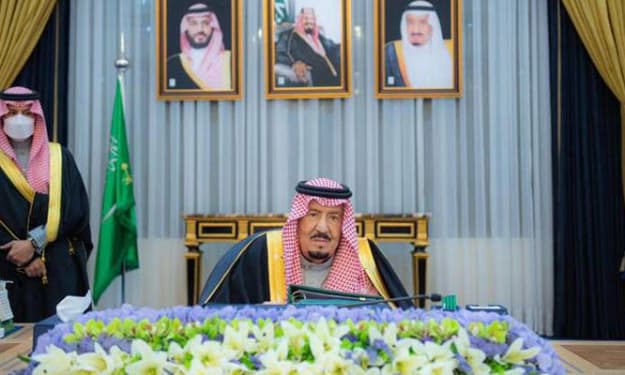
In a significant development for regional energy cooperation, the Saudi Cabinet has approved an energy Memorandum of Understanding (MoU) with Pakistan, signaling a deepening of economic and strategic ties between the two long-standing allies. The agreement comes at a critical time for Pakistan, which is grappling with persistent energy shortages, rising fuel costs, and the urgent need to diversify its power mix, while Saudi Arabia continues to expand its global energy diplomacy beyond oil. Strengthening an Already Close Relationship Saudi Arabia and Pakistan share a decades-long relationship rooted in political cooperation, defense collaboration, and economic support. Over the years, Riyadh has provided financial assistance, oil on deferred payment facilities, and investment pledges to help stabilize Pakistan’s economy during difficult periods. The approval of this energy MoU reflects a shift from short-term relief toward long-term structural cooperation, particularly in the energy sector. For Saudi Arabia, the agreement aligns with its Vision 2030 strategy, which aims to diversify the Kingdom’s economy, expand global partnerships, and position Saudi firms as major players in energy infrastructure, renewables, and downstream projects worldwide. What the Energy MoU Covers While full technical details of the MoU have not yet been made public, officials indicate that it covers cooperation across multiple areas of the energy value chain. These include oil and gas exploration, refining, power generation, renewable energy projects, energy efficiency, and potential technology transfer. The agreement also opens the door for Saudi investment in Pakistan’s energy infrastructure, which has long suffered from underinvestment, inefficiencies, and circular debt. For Pakistan, attracting capital from a trusted partner like Saudi Arabia could help modernize aging facilities and support new power projects without relying solely on Western lenders or multilateral institutions. Addressing Pakistan’s Energy Challenges Pakistan’s energy sector remains one of its biggest economic vulnerabilities. Frequent power outages, high electricity tariffs, dependence on imported fuels, and mounting debt have constrained industrial growth and burdened households. The country is actively seeking foreign partnerships that can bring not only funding but also technical expertise and long-term stability. The Saudi-Pakistan energy MoU could help Pakistan diversify its energy sources, including solar and wind, areas where Saudi Arabia has made major investments domestically in recent years. Collaboration in renewables would also support Pakistan’s climate goals and reduce its reliance on expensive fossil fuel imports. Strategic Benefits for Saudi Arabia For Saudi Arabia, the agreement offers strategic access to South Asia, one of the world’s fastest-growing energy markets. Pakistan’s large population, expanding urban centers, and industrial potential make it an attractive destination for long-term energy investment. Additionally, closer energy ties enhance Saudi Arabia’s geopolitical influence in the region, strengthening its role as a key partner for Pakistan at a time when global energy politics are increasingly shaped by supply security, regional alliances, and the transition to cleaner power. Economic and Geopolitical Implications Beyond energy, the MoU is likely to have wider economic implications. Energy stability is essential for Pakistan’s manufacturing, exports, and overall economic recovery. Improved power availability could boost investor confidence, create jobs, and support sustainable growth. Geopolitically, the agreement underscores Pakistan’s effort to balance its international partnerships. While China remains a major investor through the China-Pakistan Economic Corridor (CPEC), Islamabad is keen to broaden its economic base by attracting investment from Gulf countries, reducing over-reliance on any single partner. For Saudi Arabia, deeper engagement with Pakistan complements its growing ties with other Asian economies, reinforcing its image as a global energy leader rather than just a regional oil supplier. Challenges and the Road Ahead Despite the promise, challenges remain. Pakistan’s regulatory environment, bureaucratic delays, and financial constraints have historically slowed foreign energy projects. Successful implementation of the MoU will depend on policy consistency, transparency, and timely decision-making from Pakistani authorities. Both sides will also need to ensure that projects are financially viable and environmentally sustainable, especially as global investors and governments face increasing pressure to align with climate commitments. A Partnership with Long-Term Potential The Saudi Cabinet’s approval of the energy MoU with Pakistan marks more than just another bilateral agreement. It represents a strategic bet on long-term cooperation, mutual economic benefit, and shared regional stability. If translated into concrete projects and sustained collaboration, the partnership could help reshape Pakistan’s energy future while strengthening Saudi Arabia’s global energy footprint. In an era of uncertain energy markets and shifting alliances, such agreements highlight the growing importance of strategic, trust-based partnerships in securing power, prosperity, and progress.
By Fiaz Ahmed Brohiabout a month ago in The Swamp
The Campania Regional Government and FICO: Governance, Development, and Regional Vision. AI-Generated.
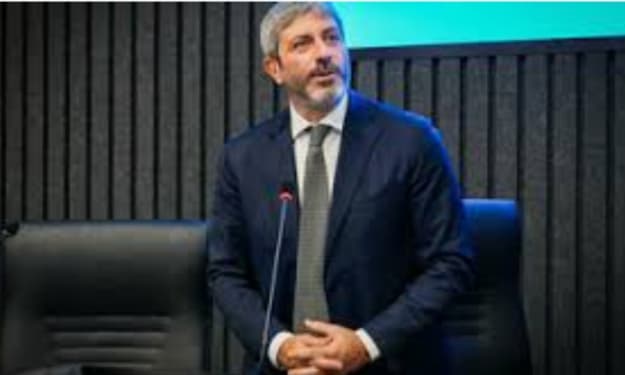
The Campania Regional Government (Giunta Regionale Campania) plays a central role in shaping the economic, social, and institutional future of one of Italy’s most dynamic yet challenging regions. As the executive body of the region, it is responsible for turning political direction into concrete action. Within this framework, references to FICO—often associated with large-scale development models tied to food culture, sustainability, and innovation—highlight broader debates about governance, growth, and regional identity.
By Ayesha Lashariabout a month ago in The Swamp
Man Facing Tax Probe in Germany Declared Bankrupt in Ireland with Debts of €27m. AI-Generated.
A man under investigation for tax irregularities in Germany has been declared bankrupt in Ireland, carrying debts totaling an astonishing €27 million. The case highlights not only the growing complexities of cross-border finance but also the challenges authorities face in tracking assets and liabilities across countries. The Background of the Case The individual in question, whose identity has been kept under strict confidentiality due to ongoing legal proceedings, came under scrutiny in Germany as part of a broader tax probe. German authorities alleged significant tax evasion and questioned the sources of income that funded a lavish lifestyle and investments in multiple jurisdictions. While the investigation in Germany is ongoing, the financial fallout has already manifested in Ireland, where the man declared bankruptcy. Court documents reveal liabilities amounting to €27 million, including loans, unpaid taxes, and obligations to various creditors. This scenario underscores the far-reaching consequences of financial misconduct and raises questions about the effectiveness of international financial oversight. Cross-Border Implications Cases like these are increasingly common in a globalized economy. Individuals with substantial assets often invest or hold accounts in multiple countries, complicating legal proceedings. Authorities in one country may freeze accounts or pursue charges, but without cooperation from international counterparts, recovering assets can be slow and challenging. In this case, the man’s bankruptcy in Ireland allows creditors there to attempt recovery, but it also demonstrates how financial difficulties in one jurisdiction can ripple across borders. German investigators may now collaborate with Irish officials to ensure that assets are accounted for and obligations are met, but these processes are often time-consuming and legally intricate. The Scale of the Debts The €27 million debt figure has raised eyebrows within financial circles. While bankruptcy declarations are not uncommon, the size of this liability makes it a high-profile case, attracting attention from media and regulators alike. The debts include significant sums owed to banks, private investors, and tax authorities, suggesting a pattern of over-leverage and risky financial behavior. Experts note that high-net-worth individuals sometimes underestimate the legal and financial implications of spreading their wealth internationally. While offshore accounts and foreign investments can be legitimate, they can also complicate legal proceedings when financial irregularities arise. This case may serve as a cautionary tale for investors and entrepreneurs managing multi-jurisdictional assets. Legal and Financial Repercussions Bankruptcy proceedings in Ireland will now determine how much creditors can recover and which assets are liquidated. Irish courts typically prioritize secured creditors but also allow claims from unsecured parties. Given the man’s substantial debts, it is likely that only a fraction of the owed €27 million will be recovered immediately. Meanwhile, the ongoing German tax probe could result in additional penalties, fines, and potential criminal charges, depending on the findings of investigators. The combination of bankruptcy in Ireland and legal action in Germany illustrates how financial misconduct can trigger cascading consequences across multiple countries. Wider Implications for Financial Regulation This case also raises important questions about international financial regulation and transparency. Governments and regulators are increasingly focusing on cross-border cooperation to prevent tax evasion, money laundering, and financial fraud. Organizations such as the OECD and the European Union have implemented frameworks to facilitate information sharing, but enforcement remains challenging, especially when multiple legal systems and jurisdictions are involved. Observers suggest that this bankruptcy could prompt further scrutiny of similar high-risk cases where individuals exploit gaps between national regulatory frameworks. Stronger cooperation and timely information exchange between countries are critical to prevent similar incidents in the future. Lessons Learned For individuals and businesses operating internationally, the case underscores the importance of financial discipline and compliance. Failing to adhere to tax regulations or mismanaging debts can have consequences that extend far beyond one country’s borders. Transparency, accountability, and careful legal planning are essential in today’s interconnected financial world. Conclusion The bankruptcy of a man under German tax investigation, with debts totaling €27 million in Ireland, is a stark reminder of the complexities of cross-border finance. It highlights not only the challenges faced by regulators but also the significant risks associated with global wealth management. As investigations continue, both in Germany and Ireland, this case is likely to be cited as an example of the importance of international cooperation in financial oversight. For the public, it serves as a cautionary tale of how financial mismanagement and regulatory breaches can culminate in substantial personal and legal consequences, even across national boundaries.
By Fiaz Ahmed Brohiabout a month ago in The Swamp
Xi Jinping Vows to Reunify China and Taiwan in New Year’s Eve Speech. AI-Generated.
As the world rang in 2026, Chinese President Xi Jinping used his New Year’s Eve address to deliver a message that caught the attention of governments, analysts, and citizens around the globe. Beyond celebrating China’s economic achievements and technological progress, Xi’s speech emphasized one of Beijing’s most sensitive and politically charged topics: the reunification of Taiwan with mainland China. In his address, broadcast live across multiple platforms, Xi reaffirmed China’s long-standing position that Taiwan is an inseparable part of its territory. While the speech didn’t contain direct threats of military action, it made clear that reunification is considered an “unstoppable trend” — a priority that Xi framed as both a historical and cultural mission. A Strong Statement on Reunification Xi Jinping stressed that the bond between people on both sides of the Taiwan Strait is one of “blood and kinship.” For him, reunification is not just political but also a matter of national pride and historical justice. He connected this goal to China’s broader vision of national rejuvenation, portraying Taiwan’s eventual return as part of the country’s destiny. The timing of this declaration is significant. Coming on the eve of a new year and a new Five-Year Plan (2026–2030), it underscores that Taiwan remains central to China’s strategic priorities. Analysts note that this speech, while firm in language, reflects a consistent policy approach rather than a sudden escalation. Military Drills and Regional Tensions The speech followed China’s completion of large-scale military exercises near Taiwan, dubbed “Justice Mission 2025.” These drills included aircraft, naval vessels, and simulated blockades, widely interpreted as a warning to foreign powers and “separatist forces.” Taiwan, for its part, has maintained a stance of peace and stability while simultaneously strengthening its defense capabilities. The U.S. and Japan have closely monitored these developments, concerned that continued military pressure could heighten the risk of miscalculation. This combination of political rhetoric and military demonstrations represents Beijing’s dual strategy: signaling strength while reinforcing territorial claims without triggering direct conflict. International Reactions Xi’s remarks quickly drew global attention. Western governments emphasized the importance of peace and stability in the Taiwan Strait while reaffirming support for Taiwan’s democratic institutions. U.S. policymakers face a delicate balancing act: deterring any unilateral moves on Taiwan while avoiding direct confrontation with China. Neighboring countries in the Indo-Pacific, including Japan, South Korea, and ASEAN nations, have also expressed concern. Taiwan sits at the heart of critical trade routes, so any conflict could disrupt regional economies and global supply chains. Even nations with strong economic ties to China have stressed the need for diplomatic solutions and dialogue. Taiwan’s Perspective Taiwan’s leadership responded by reiterating its commitment to democracy and self-determination. President Lai Ching-te emphasized that Taiwan seeks peaceful relations with China but will not yield to coercion. Strengthening defense capabilities and international partnerships remains central to Taiwan’s strategy. The island’s vibrant democratic system — including independent institutions, free elections, and a strong civil society — contrasts sharply with mainland China’s one-party governance, highlighting why the reunification question remains complex and sensitive. Domestic Messaging in China Within China, Xi framed reunification as part of a broader narrative of national pride and achievement. The speech referenced historic anniversaries, economic milestones, and technological breakthroughs, presenting reunification as a continuation of the country’s progress. By connecting Taiwan to China’s national identity and historical mission, Xi aims to foster unity and reinforce the legitimacy of the government’s strategic goals. The speech also signals to domestic audiences that the leadership remains focused on long-term objectives, even as global attention zooms in on regional security issues. Looking Ahead in 2026 As the new year begins, the Taiwan issue remains one of the most sensitive geopolitical topics in the world. Xi Jinping’s New Year’s Eve message made clear that China’s position is resolute: reunification is inevitable. How this rhetoric translates into action will depend on a complex mix of factors, including Taiwan’s policies, international diplomacy, and global geopolitical shifts. For now, Beijing’s message is clear, and 2026 is likely to be another year of close international attention on the Taiwan Strait. Xi’s speech reminds the world that while new years bring fresh beginnings, some geopolitical challenges persist — and cross-strait relations are at the forefront of both China’s domestic agenda and the international diplomatic spotlight.
By Muhammad Hassanabout a month ago in The Swamp
Pakistan to Enter 2026 as Fifth-Most Populous Country. AI-Generated.
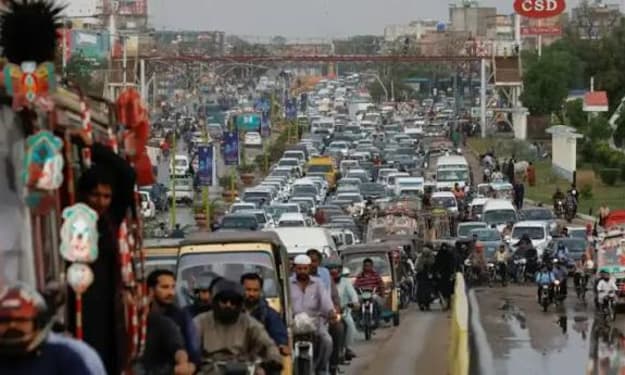
Pakistan is set to enter 2026 as the world’s fifth-most populous country, according to recent demographic projections. With a population surpassing 250 million, Pakistan’s growing populace is shaping its economic potential, societal challenges, and geopolitical significance. Experts say this demographic milestone carries both opportunities and responsibilities for the nation.
By Fiaz Ahmed Brohiabout a month ago in The Swamp
Leaked Calls Reveal Plot by al-Assad Regime Officers to Destabilize Syria. AI-Generated.
Newly leaked recordings have sent shockwaves through the Middle East, revealing a clandestine plot by high-ranking officers of the al-Assad regime to destabilize Syria. The recordings, verified by multiple independent sources, offer an unprecedented glimpse into internal communications, highlighting deliberate strategies aimed at consolidating power while suppressing dissent. The Nature of the Leaked Calls The recordings, spanning months of internal discussions, expose regime officers discussing methods to manipulate public opinion, destabilize opposition-held areas, and coordinate covert operations in regions still affected by conflict. Analysts suggest these communications were intended to reinforce the Assad regime’s control, particularly in areas where political allegiance is fragile or where foreign influence is strong. According to experts, the leaks demonstrate a pattern of calculated interference in both civilian governance and military operations. Officers reportedly debated strategies to create chaos in opposition territories, limit humanitarian access, and exploit social divisions to weaken resistance groups. These tactics mirror long-standing patterns of authoritarian control, where destabilization serves as a tool for maintaining dominance. Implications for Syrian Stability Syria, already decades into a brutal conflict, faces mounting challenges in rebuilding its social and political fabric. The leaked calls indicate that even as international attention has shifted toward reconstruction and diplomatic engagement, elements within the regime continue to engage in destabilizing activities. For ordinary Syrians, these revelations are deeply troubling. Communities attempting to rebuild infrastructure, restore schools, and reopen markets now face the risk of renewed disruption. Humanitarian organizations may encounter heightened obstacles, as the regime’s covert maneuvers could restrict aid or manipulate relief efforts for strategic advantage. International Response and Concerns Global actors, including the United Nations and several human rights organizations, have expressed alarm over the leaked calls. Officials have emphasized the need for continued monitoring of Syria’s internal dynamics and the importance of pressuring the Assad regime to adhere to international norms. The leaks also raise questions about the complicity or negligence of external actors who have maintained alliances with the regime. Analysts argue that while some countries have prioritized strategic interests in Syria, they may now face increased scrutiny regarding the consequences of these partnerships. The Role of Intelligence and Whistleblowers The source of the leaks remains anonymous, though experts believe they stem from internal whistleblowers or intercepted communications. This underscores the critical role of intelligence gathering and investigative journalism in uncovering hidden strategies of authoritarian regimes. By bringing such plots to light, the leaks not only inform global audiences but also provide crucial documentation for potential future accountability measures. Historical Context of Regime Tactics The Assad regime has long relied on a combination of military force, political manipulation, and covert operations to maintain power. Past conflicts, including the initial uprisings in 2011 and subsequent military campaigns, demonstrated a willingness to employ extreme measures to suppress dissent. The leaked calls, therefore, represent a continuation of this approach, adapted to contemporary challenges and international scrutiny. Observers note that these tactics are not unique to Syria; authoritarian regimes worldwide often rely on similar strategies to consolidate power. What makes the current revelations significant is the level of detail they provide, offering concrete evidence of internal plotting that was previously only speculated upon. Potential Outcomes and Future Prospects The exposure of these calls could have several consequences. Domestically, it may embolden opposition groups and civil society organizations to demand accountability and transparency. Internationally, the leaks could influence diplomatic negotiations, shaping how foreign governments engage with the Assad regime. However, analysts caution that while the leaks are significant, they are unlikely to immediately disrupt the regime’s control. Syria’s complex power structures, alliances, and security apparatus mean that implementing meaningful change will require sustained pressure from both internal actors and the global community. Conclusion: A Window into Hidden Strategies The leaked calls reveal the lengths to which the Assad regime will go to maintain authority, even as the world watches and engages in reconstruction efforts. For Syrians, the recordings are a stark reminder that stability remains fragile and that internal machinations continue to threaten peace and security. For the international community, the leaks provide crucial insight into the regime’s mindset, highlighting the importance of vigilance, transparency, and accountability. As Syria navigates a tenuous path toward recovery, understanding these covert operations is essential to preventing further destabilization and supporting long-term peace. The revelations underscore a broader truth: even in conflicts that seem distant, internal strategies and clandestine plots can have profound consequences for both local populations and global security. For now, the leaked calls serve as a critical reminder that in Syria, the struggle for stability is far from over.
By Fiaz Ahmed Brohiabout a month ago in The Swamp
Bangladesh Mourns Khaleda Zia in State Funeral With Massive Crowds. AI-Generated.
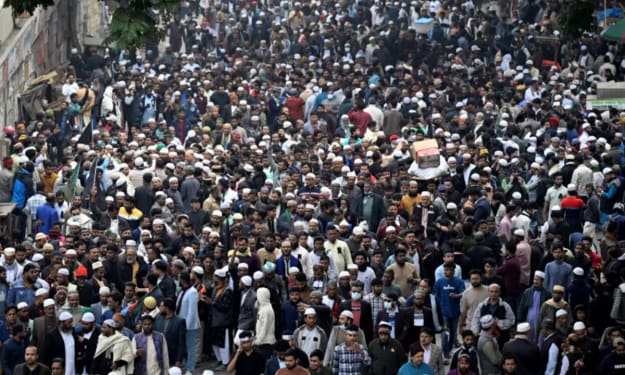
Bangladesh came together in a historic display of grief on December 31, 2025, as the nation bid farewell to Begum Khaleda Zia, the country’s first female prime minister. A state funeral drew massive crowds in Dhaka, with hundreds of thousands — possibly over a million — citizens coming together to honor a leader whose life shaped the destiny of Bangladesh. A Sea of Mourners in Dhaka Even before dawn, streets leading to the National Parliament building were filled with people. Supporters carried Bangladesh Nationalist Party (BNP) banners, national flags, and placards expressing love for their “mother of the nation.” From rural towns to provincial districts, people traveled long distances to participate in the farewell procession. The government declared a three-day national mourning period and a public holiday to allow citizens to pay their respects. Security forces, including over 10,000 police and military personnel, were deployed to maintain order during the unprecedented gathering. Funeral Prayers and National Tribute The funeral prayers (Namaz-e-Janaza) were held at the South Plaza of the Jatiya Sangsad Bhaban (National Parliament Building) in the early afternoon. Dignitaries from across South Asia, including India, Pakistan, Nepal, Bhutan, and Sri Lanka, attended. India’s External Affairs Minister S. Jaishankar presented a letter of condolence from Prime Minister Narendra Modi. Khaleda Zia was laid to rest beside her husband, former President Ziaur Rahman, who was assassinated in 1981. Military honor guards stood in silent tribute as family, party leaders, and foreign diplomats offered their final respects. Remembering Khaleda Zia: Triumphs and Controversies Khaleda Zia’s political career was marked by resilience, determination, and controversy. Born in 1945, she entered politics following her husband’s assassination and became Bangladesh’s first female prime minister, serving three terms over more than a decade. She was a prominent figure in the fight against authoritarian rule during the late 1980s and early 1990s, credited with helping restore parliamentary democracy. Yet her political journey was not without challenges. Legal battles, corruption charges, and periods of house arrest marked her later years, which her supporters decried as politically motivated. Her rivalry with Sheikh Hasina, leader of the Awami League, defined Bangladeshi politics for decades. Dubbed the “Battle of the Begums,” this rivalry often polarized the electorate, reflecting broader ideological divides in the country. The Emotional Farewell Wednesday’s funeral brought together people from all walks of life, reflecting the deep emotional connection many Bangladeshis felt toward Khaleda Zia. For supporters, she symbolized the struggle for democracy and women’s empowerment. Placards calling her “Maa” (mother) were common, a sign of affection and reverence. Sharmina Siraj, a mourner from outside Dhaka, told reporters, “Her programs for girls’ education and women’s empowerment changed our community. It’s hard to imagine such leadership again.” Political Implications Moving Forward With national elections approaching in February 2026, Khaleda Zia’s death adds a layer of uncertainty to the political landscape. Her son, Tarique Rahman, now acting head of the BNP, is likely to play a central role in rallying party support. The massive turnout at the funeral could signal renewed momentum for the party as it prepares for the upcoming elections. A Nation United in Grief While Khaleda Zia’s legacy remains complex, her state funeral served as a powerful reminder of her impact on Bangladesh’s history. Millions came together to mourn, celebrate, and reflect on a life that inspired devotion, debate, and determination. The event was not just a farewell; it was a nationwide tribute to a leader who broke barriers, navigated political turmoil, and left a lasting mark on the country. Whether remembered for her achievements or controversies, Khaleda Zia’s influence on Bangladesh’s political landscape will continue to resonate for years to come. Tags for Vocal Media: Bangladesh, Khaleda Zia, Politics, State Funeral, BNP, Dhaka, South Asia, Women in Politics, Leadership, National Mourning
By Muhammad Hassanabout a month ago in The Swamp
Christians Gathered in Manager Square, Bethlehem.
His Eminence, the Latin Patriarch of Jerusalem, Pierbattista Pizzaballa, spoke to the faithful. Saying the following: "You are the light, we are the light. The light of Bethlehem and the light of the world". He walked the streets, followed by Christians of every stripe, both Palestinians and foreign tourists.
By Nicholas Bishopabout a month ago in The Swamp
Happy New Year 2026: Embracing Fresh Beginnings and New Possibilities. AI-Generated.
As the clock strikes midnight and fireworks light up the skies across the globe, people everywhere are welcoming 2026 with open hearts and renewed optimism. The New Year is a symbolic moment, representing not just the passage of time but the opportunity to reflect, reset, and embrace new possibilities. A Time for Reflection New Year’s Eve has long been a time to look back on the past 12 months, to celebrate achievements, and to learn from challenges. For many, 2025 was a year of personal growth, professional accomplishments, and unexpected hurdles. The dawn of 2026 offers a chance to pause, take stock, and chart a path forward with intention. Reflection is more than reminiscing; it is a tool for growth. Understanding successes and missteps allows individuals and communities to enter the new year with clarity and purpose. Global Celebrations and Traditions Across the world, New Year celebrations showcase the rich tapestry of cultural traditions. In Sydney, Australia, the iconic fireworks over the Harbour Bridge remain a highlight, attracting millions both in person and through broadcasts. In Tokyo, thousands gather at temples and shrines for “Hatsumode,” the first visit of the year, praying for health and prosperity. Meanwhile, in New York City, the famous Times Square ball drop draws crowds that epitomize collective excitement and hope. From the exchange of greetings to traditional meals and customs, the New Year is a moment that unites people across borders. Families gather, friends reconnect, and communities come together to celebrate the promise of a fresh start. Resolutions and Intentions For many, the New Year is synonymous with resolutions — commitments to improve health, relationships, finances, or personal development. While resolutions can sometimes be cliché, they serve an important purpose: setting goals and motivating change. Experts recommend focusing on achievable, meaningful objectives rather than superficial goals. In 2026, trends suggest a shift toward holistic resolutions, emphasizing mental well-being, sustainability, and deeper connections with others. Some choose intentions over resolutions, a practice that emphasizes the mindset and energy with which one approaches life. Intentions are less about rigid targets and more about cultivating habits and attitudes that lead to growth and fulfillment. A Year of Opportunities The arrival of 2026 carries with it not only personal hope but global anticipation. Economically, many countries are exploring innovative approaches to growth, technological advancements are creating new opportunities, and social movements continue to shape societies. This year presents the chance for collective action on issues such as climate change, education, and global health. For individuals, the New Year is a reminder that every day brings the potential for new experiences, learning, and achievement. It is an invitation to step out of comfort zones, embrace challenges, and pursue passions with renewed vigor. Embracing Positivity in a Complex World The past few years have reminded us that the world can be unpredictable and challenging. Yet, the spirit of the New Year is a testament to human resilience and optimism. Celebrating 2026 is not just about parties and fireworks; it is about cultivating hope, practicing gratitude, and strengthening relationships. By focusing on what can be controlled — attitude, effort, and choices — individuals can create a more meaningful and fulfilling year. Communities and leaders alike can harness this spirit by encouraging collaboration, empathy, and action. Whether it’s volunteering, supporting local businesses, or participating in civic initiatives, collective efforts amplify the promise of a brighter year. Conclusion As 2026 unfolds, it offers a blank canvas, waiting for stories of personal triumph, connection, and creativity. The New Year reminds us that while the past shapes us, the future is ours to shape. Celebrating with loved ones, reflecting on lessons learned, and setting meaningful intentions allows individuals to enter the year with purpose and hope. So, as fireworks illuminate the night sky and champagne glasses clink, take a moment to pause, breathe, and embrace the promise of 2026. It is a time for new beginnings, renewed energy, and the endless possibilities that each day holds. Happy New Year — may 2026 bring joy, health, and success to all.
By Fiaz Ahmed Brohiabout a month ago in The Swamp