
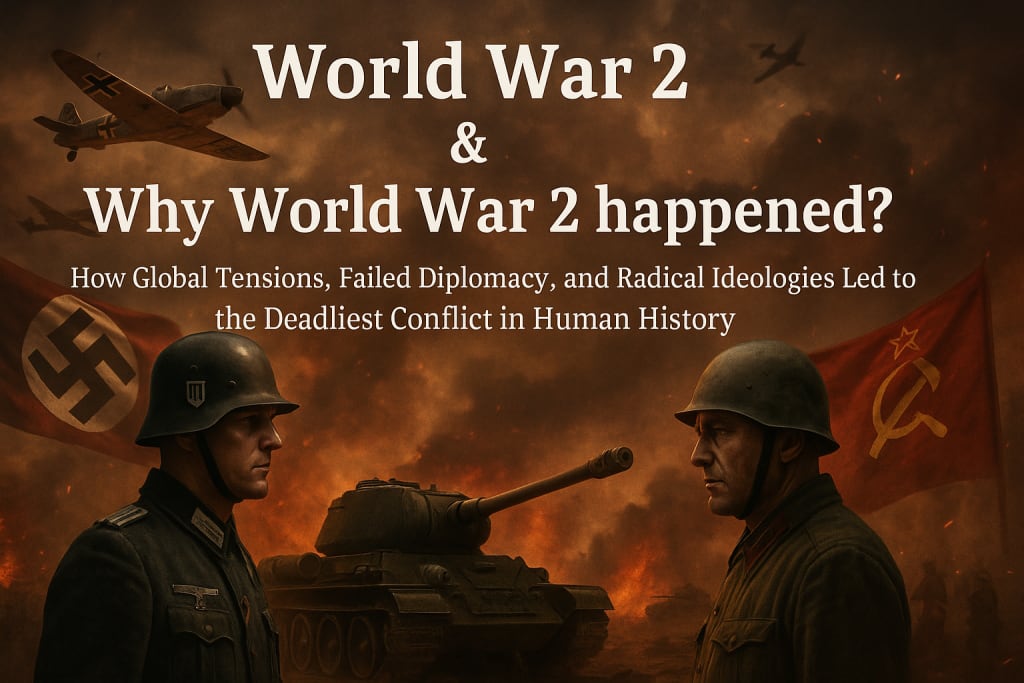
World War 2 & Why World War 2 happened?
How Global Tensions, Failed Diplomacy, and Radical Ideologies Led to the Deadliest Conflict in Human History

Introduction
World War II, spanning from 1939 to 1945, was the most catastrophic and transformative conflict in human history. Involving more than 30 nations and resulting in an estimated 70 to 85 million deaths, it reshaped the political, economic, and social fabric of the modern world. But how did such a devastating war begin just two decades after the "war to end all wars"? The causes of World War II are complex and deeply rooted in the aftermath of World War I, economic instability, the rise of totalitarian regimes, and the failure of international diplomacy. This article explores the multifaceted origins of World War II, offering a clear and comprehensive account of why the world descended into another global conflict.
---
The Legacy of World War I and the Treaty of Versailles
The First World War ended in 1918, leaving Europe in ruins and disarray. The Treaty of Versailles, signed in 1919, aimed to hold Germany accountable for the war. It imposed harsh territorial losses, disarmament measures, and heavy reparations on the German Empire. Rather than ensuring long-term peace, the treaty sowed seeds of resentment and humiliation in Germany.
The treaty's punitive nature crippled the German economy and ignited nationalist anger. Many Germans viewed the treaty as a diktat — a forced and unjust peace. This widespread disillusionment provided fertile ground for extremist ideologies to take root, especially the rise of Adolf Hitler and the Nazi Party, who promised to restore Germany’s former glory.
---
Economic Collapse and the Rise of Totalitarian Regimes
The global economy plunged into chaos following the 1929 stock market crash, leading to the Great Depression. Unemployment and poverty surged, especially in Germany, Italy, and Japan — countries that felt deeply marginalized by the post-WWI world order.
In Germany, economic despair made extremist solutions attractive. Adolf Hitler rose to power in 1933, leveraging anti-Semitism, anti-communism, and a promise of economic revival. Similarly, Benito Mussolini in Italy and militarists in Japan capitalized on national discontent, building authoritarian states that glorified war, conquest, and expansion.
These totalitarian regimes not only suppressed internal opposition but also aggressively pursued expansionist agendas, believing that military conquest would solve economic woes and restore national prestige.
---
The Failure of the League of Nations and Western Appeasement
The League of Nations was established after World War I to prevent future conflicts through collective security and diplomacy. However, it proved weak and ineffective. It lacked enforcement power and the support of major powers like the United States, which never joined.
In the 1930s, Japan invaded Manchuria (1931), Italy attacked Ethiopia (1935), and Germany began rearming in violation of the Versailles Treaty. The League failed to take meaningful action in all cases. This inaction emboldened aggressors.
Western democracies, particularly Britain and France, adopted a policy of appeasement. Hoping to avoid another war, they allowed Hitler to occupy the Rhineland (1936), annex Austria (Anschluss, 1938), and seize the Sudetenland from Czechoslovakia (Munich Agreement, 1938). Instead of containing Hitler, appeasement only encouraged further aggression.
---
Nazi Ideology and the Quest for Lebensraum
A core component of Nazi ideology was the concept of Lebensraum — the belief that Germany needed more living space to thrive. Hitler envisioned a vast empire in Eastern Europe, to be cleansed of Jews, Slavs, and other "undesirables," and repopulated with Germans.
This ideology was not merely political rhetoric. It directly translated into policy. The invasion of Poland in 1939, which triggered World War II, was driven by this expansionist vision. Hitler sought to destroy the Polish state and exterminate or enslave its people. Later invasions into the Soviet Union and other parts of Europe followed the same genocidal logic.
---
The Trigger: Invasion of Poland and the Start of War
On September 1, 1939, Nazi Germany invaded Poland using a false-flag operation to justify the attack. This blatant act of aggression violated prior treaties and shocked the international community. Two days later, Britain and France declared war on Germany, officially beginning World War II.
But Germany was not alone. A secret non-aggression pact signed in August 1939 between Hitler and Soviet leader Joseph Stalin — the Molotov-Ribbentrop Pact — divided Eastern Europe into spheres of influence. The Soviet Union invaded eastern Poland shortly after Germany’s attack, and both totalitarian regimes carved up the country.
---
Conclusion: A Perfect Storm of Chaos
World War II did not erupt from a single event, but from a toxic combination of unresolved grievances from World War I, economic catastrophe, ideological extremism, and the failure of international institutions. The aggressive ambitions of Nazi Germany, Fascist Italy, and Imperial Japan clashed with the complacency and wishful thinking of Western democracies, culminating in a war that engulfed the globe.
Understanding why World War II happened is not just an academic exercise. It is a crucial lesson for humanity — a stark reminder of the dangers of unchecked power, economic despair, and the silence of good nations in the face of rising tyranny.
About the Creator
Keep reading
More stories from Engr. Mansoor Ahmad and writers in History and other communities.
Why World War 1 Happened: The Spark That Ignited the World
The First World War was not just a sudden eruption of violence—it was a storm that had been brewing for decades. Often remembered for its massive scale and horrific trench warfare, World War 1 (1914–1918) was caused by a complex web of political tensions, alliances, nationalism, and a single, fatal spark. But what exactly triggered this global conflict? Why did the world plunge into war? Let’s break it down.
By Engr. Mansoor Ahmad8 months ago in History
The Night the Radio Terrified America
On the evening of October 30, 1938, the United States was a country on edge. The Great Depression was still casting a long shadow, and the drumbeats of war were growing louder in Europe. Families gathered around their wooden radio consoles, seeking a brief escape through music and drama. What they got instead was a chilling announcement that changed the history of mass media forever: The Martians had landed.
By Irshad Abbasi 3 days ago in History



Comments (1)
good bro