
When Allies Disagree: How Global Partnerships Are Being Redefined
Why modern alliances are no longer built on blind loyalty, but on shifting interests

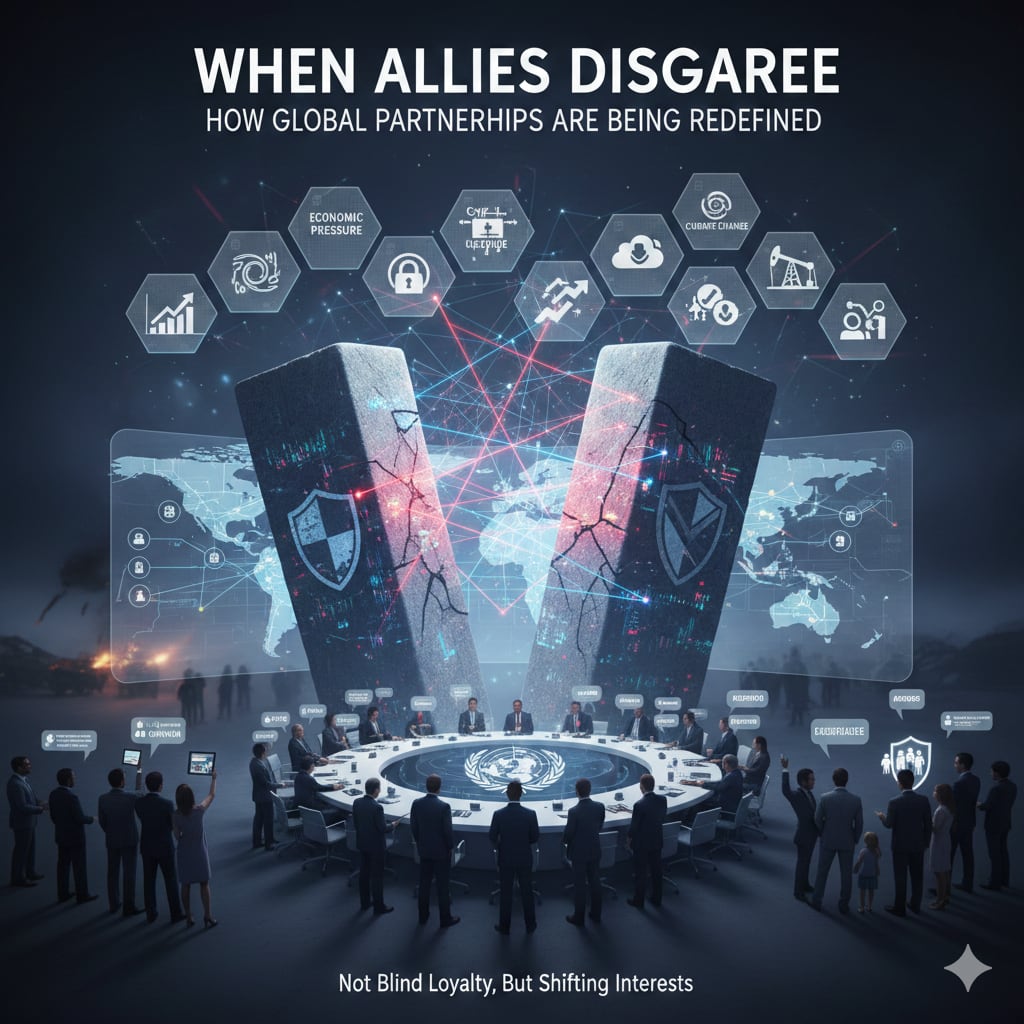
When Allies Disagree: How Global Partnerships Are Being Redefined
For much of the modern era, global alliances appeared firm and predictable. Powerful countries formed blocs, promised mutual support, and stood together during times of war and crisis. But in today’s world, those alliances are changing. Recent disagreements between long-standing partners show that global cooperation is no longer based on automatic loyalty—it is increasingly shaped by national interests, public opinion, and long-term stability.
Alliances were once driven mainly by military threats. During the Cold War, nations aligned themselves clearly, often choosing sides based on ideology. Today, however, threats are more complex. Economic pressure, cyber warfare, climate change, energy security, and regional instability have blurred traditional lines. As a result, countries now question whether old commitments still serve their present needs.
One key reason alliances are shifting is divergent priorities. A decision that benefits one country may harm another. Military action, for example, might appear necessary from a distance, but countries closer to the conflict zone often face greater risks. Refugee flows, economic shocks, and security threats affect neighboring states far more directly. This reality forces allies to speak up, even when it creates tension.
Another factor is domestic politics. Leaders today operate under intense public scrutiny. Citizens are more informed, more vocal, and often more skeptical of foreign wars. Governments must consider how international decisions will be received at home. Supporting an ally’s military action can become politically costly if it is seen as unnecessary or dangerous.
Economic interdependence also plays a major role. Countries are connected through trade, energy supplies, and financial systems. A conflict involving one ally can disrupt supply chains and markets across the world. As global economies become more fragile, governments are cautious about actions that could trigger instability.
Diplomacy has become more visible in this environment. Instead of quietly agreeing behind closed doors, allies increasingly express differences publicly. While this may appear as weakness or division, it can also be a sign of maturity. Open disagreement allows for negotiation, compromise, and clearer understanding of limits.
International organizations add another layer of complexity. Groups like the United Nations, NATO, and regional alliances aim to coordinate action, but consensus is harder to achieve when member states face different risks. Decisions require careful balancing between collective security and individual national interests.
This shift does not mean alliances are collapsing. Rather, they are evolving. Modern partnerships are less rigid and more conditional. Support is often tied to specific goals, legal frameworks, and public accountability. Allies may cooperate in one area while disagreeing in another.
The danger lies in misinterpreting disagreement as hostility. When differences are framed as betrayal, trust can erode quickly. This is why communication is crucial. Clear dialogue helps prevent misunderstandings and keeps disagreements from escalating into deeper divisions.
History shows that alliances survive when they adapt. Those that fail to adjust to new realities often weaken over time. In a world facing shared challenges—climate change, pandemics, cyber threats—cooperation remains essential, even when views differ.
The future of global partnerships will depend on flexibility, respect, and realism. Strong alliances are not those without disagreement, but those that manage it wisely. In today’s world, unity does not mean uniformity—it means understanding when to stand together and when to speak honestly.
About the Creator
Wings of Time
I'm Wings of Time—a storyteller from Swat, Pakistan. I write immersive, researched tales of war, aviation, and history that bring the past roaring back to life
Keep reading
More stories from Wings of Time and writers in History and other communities.
Saudi Arabia Warns Against War
Saudi Arabia Warns Against War: Why Riyadh Opposes a U.S. Attack on Iran As tensions between the United States and Iran continue to rise, Saudi Arabia has taken a notable and cautious position: warning against any U.S. military attack on Iran. This stance may surprise some observers given the long history of rivalry between Riyadh and Tehran, but it reflects a broader regional concern that another major war in the Middle East could spiral beyond control.
By Wings of Time 2 months ago in History
There Are Tree That Literally Grow Gold and Scientists Are Obsessed
I remember the exact moment I stopped thinking about gold the way everyone else does. I was standing in a sun-drenched clearing, watching the way afternoon light moved through the canopy above me, turning every leaf translucent and warm. It looked, genuinely, like the trees were glowing.
By CurlsAndCommas4 days ago in History


Comments
There are no comments for this story
Be the first to respond and start the conversation.