
"Voices of Liberty: The Night That Changed a Nation"
In the heart of rebellion, one letter could ignite a revolution. A tale from the shadows of American independence.

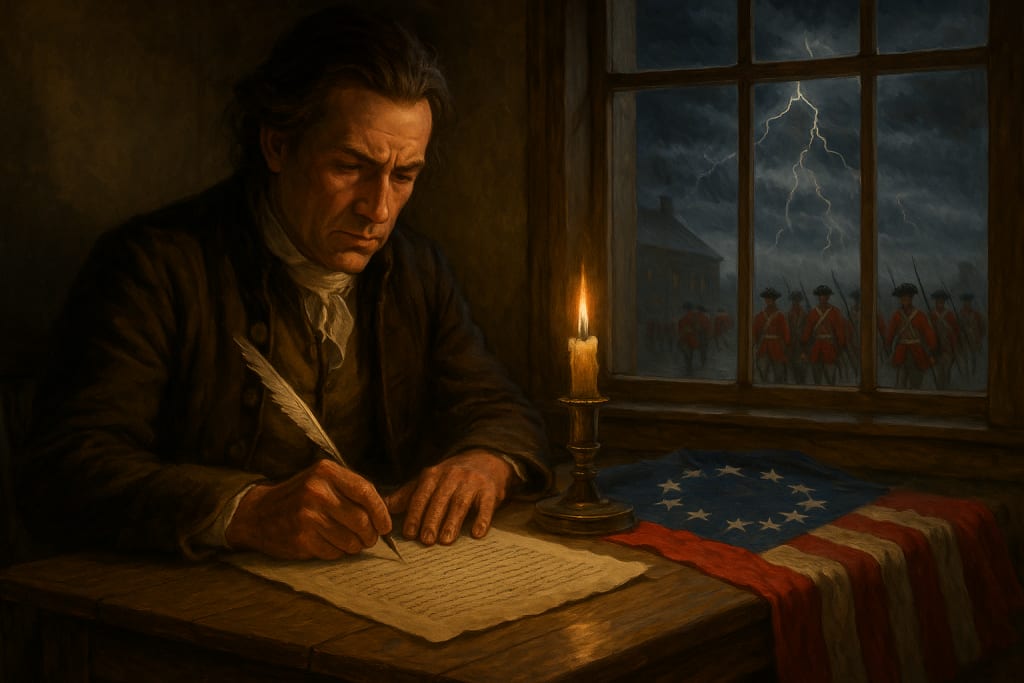
The storm raged over Philadelphia, cracking the sky with thunder as if echoing the turmoil burning within thirteen colonies. It was July 2nd, 1776, and the city held its breath. Inside a modest stone house just blocks from the State House, a man sat hunched over a wooden desk, ink staining his fingertips, eyes burning with urgency.
His name was Elias Moore, a quiet printer by trade, but tonight, he wasn’t printing leaflets—he was writing a letter that could get him hanged.
“Dear Clara,” he began, pausing as lightning lit the small window beside him. His wife and daughter were miles away in Boston, where British control suffocated like a noose. “If I do not survive the days to come, let this be the truth I leave behind.”
Elias had seen too much. British soldiers enforcing harsh taxes, raiding homes under the guise of "order," and jailing neighbors for speaking of freedom. He watched his cousin whipped in the streets for refusing to pay the king's levy. But the worst—he still heard the cries—was the massacre in Boston, where blood stained cobblestones older than Britain’s claim to the land.
That pain had turned into purpose.
Elias was part of an underground circle of patriots, ordinary men who met under false names and hidden lanterns. They didn’t speak loudly, but they printed truth, whispered ideas, and passed messages laced with hope. Their greatest act was yet to come: spreading the Declaration of Independence once it was signed.
“They will try to silence us,” Elias wrote, “but truth echoes in hearts louder than gunfire.”
Two blocks away, inside the Pennsylvania State House, debates roared. Thomas Jefferson had crafted words that shook the ground—“We hold these truths to be self-evident…” Yet even among the colonies, not all agreed. Fear gripped many: war with the world's most powerful empire seemed madness. But courage, Elias believed, was not the absence of fear—it was defiance in its face.
He dipped his quill again. The storm calmed for a moment, replaced by the faint sounds of footsteps outside. Elias froze. Through the slit in the shutters, he spotted them—two redcoats moving slowly, inspecting doors. He extinguished his candle, heart pounding.
Would they find the hidden leaflets beneath the floorboards? The coded letters sewn into the curtains?
He reached for the old musket under his desk but stopped. He would not win in a fight—but maybe in words.
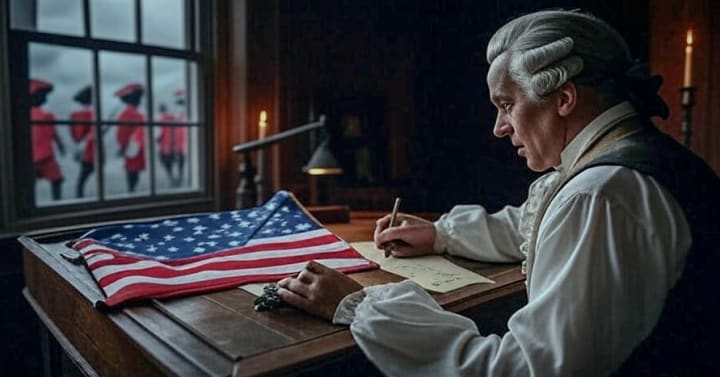
The redcoats moved on. Elias lit his candle again, knuckles white with tension. He would finish the letter. He had to.
“Clara, tell Sarah that freedom is not given—it is taken. That the price of liberty is paid not only in blood but in bravery, in boldness, in the choice to rise even when we are told to kneel. We rise now.”
At dawn on July 4th, church bells rang out across Philadelphia. The delegates had reached a decision. The colonies would break from Britain—not with apology, but with fire in their souls.
Elias was there, among the hundreds who gathered outside the State House. He clutched a copy of the declaration—the ink still fresh, its words like lightning in every line.
He saw the old and the young crying alike. He watched blacksmiths raise their hammers to the sky, farmers gripping their hats with trembling hands, mothers holding children whispering, “You’ll grow up free.”
And for a moment, time paused.
A nation had been born—not yet built, not yet safe, but born. And Elias, a simple printer, had helped breathe life into it.
Years later, long after the war had been won and the United States had become a reality, a letter was found in a chest in Boston. Its parchment was yellowed, its words slightly smudged. It began with, “Dear Clara…” and ended with, “We rise now.”
That letter became part of a museum exhibit titled “Voices of Liberty.”
Because independence didn’t just come from the men who signed the Declaration.
It came from Elias.
And every soul who chose courage over comfort, truth over silence, and freedom over fear.
About the Creator
TrueVocal
🗣️ TrueVocal
📝 Deep Thinker
📚 Truth Seeker
I have:
✨ A voice that echoes ideas
💭 Love for untold stories
📌 @TrueVocalOfficial
Locations:
🌍 Earth — Wherever the Truth Echoes
3 Real People Who Accidentally Became Myths
History has a strange habit of refusing to leave certain people alone. Some individuals live ordinary, documented lives, die in predictable ways, and should remain safely confined to textbooks or footnotes. Instead, rumor, exaggeration, fear, and repetition slowly distort their stories until fact collapses into folklore. Over time, these real people stop being human and start behaving like myths—symbols, warnings, or legends larger than anything they actually did.
By Enoch Sagini5 days ago in History
Rachel Reviews: The Spiral Archive by Pieter Hendrik
It's difficult for me to know where to start with a review of this book as it was, for me, an entirely unique experience and one that I'll probably never have again. I don't want that to be interpreted as unenjoyable but it has left me scratching my head a little and ruminating on its content, its themes and its characters.
By Rachel Deemingabout 23 hours ago in BookClub



Comments (1)
Elias writing that risky letter during the storm shows real courage in the face of danger. The underground patriots' work to spread the Declaration was a bold and important mission.