
3 Real People Who Accidentally Became Myths
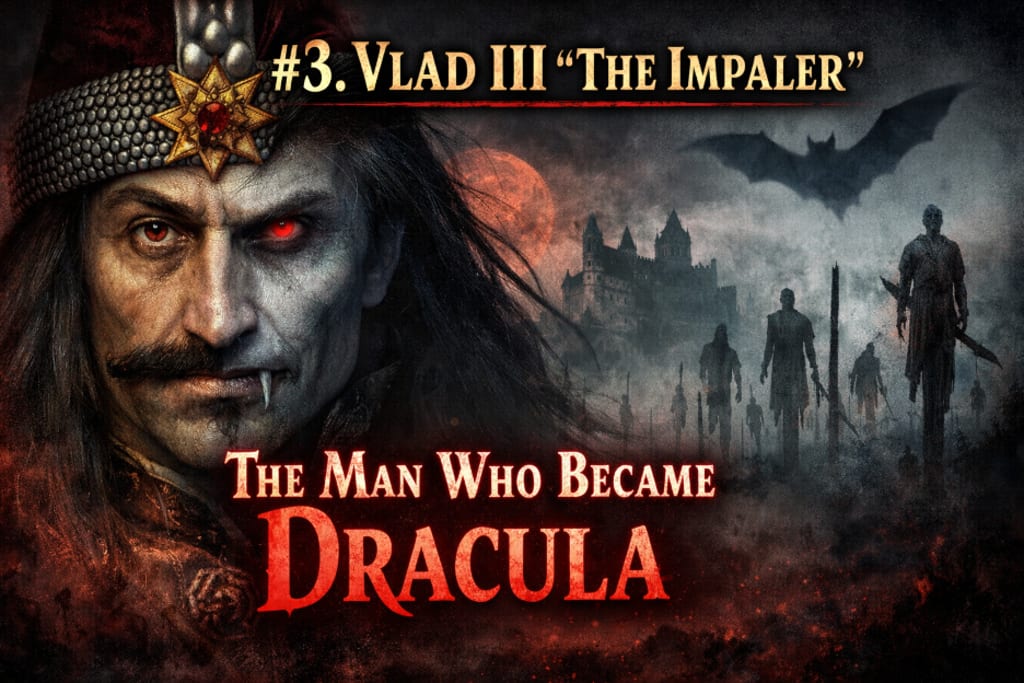
#3. Vlad III “The Impaler” — The Man Who Became Dracula
History has a strange habit of refusing to leave certain people alone. Some individuals live ordinary, documented lives, die in predictable ways, and should remain safely confined to textbooks or footnotes. Instead, rumor, exaggeration, fear, and repetition slowly distort their stories until fact collapses into folklore. Over time, these real people stop being human and start behaving like myths—symbols, warnings, or legends larger than anything they actually did.
What makes these cases fascinating isn’t that the stories are false, but that they are almost true. Each began with a real person, a real place, and a real event. The myth grew not because someone planned it, but because people kept retelling the story until accuracy became optional.
Here are three real individuals whose lives were so misunderstood, exaggerated, or repurposed that they accidentally became myths.
3. Vlad III “The Impaler” — The Man Who Became Dracula
Vlad III of Wallachia was a 15th-century ruler whose reputation would eventually eclipse his reality. Born in 1431 in what is now Romania, Vlad lived in a region perpetually caught between powerful enemies, particularly the Ottoman Empire. His rule was brutal, but not unusual for the era. Medieval Europe was not known for gentle leadership, and public executions were common tools of intimidation.
What made Vlad stand out was his preferred method of punishment: impalement. Enemies, criminals, and political rivals were executed in ways designed to terrify observers. These actions were intended to discourage invasion and rebellion, and by many historical accounts, they worked.
The myth began almost immediately. German pamphlets circulated exaggerated stories of Vlad’s cruelty, portraying him as a sadistic monster rather than a calculating ruler. Centuries later, Bram Stoker drew loosely from these tales when creating Dracula. The name, the region, and the reputation merged into a single fictional figure.
Vlad never drank blood, slept in coffins, or transformed into a bat. Yet today, his historical identity is inseparable from a vampire myth he never consented to. A medieval warlord became an immortal monster simply because his story was too dramatic to remain grounded.
2. Elizabeth Báthory — The Countess Who Became a Cautionary Tale
Elizabeth Báthory, a Hungarian noblewoman born in 1560, is often remembered as the “Blood Countess,” a woman accused of murdering hundreds of young girls and bathing in their blood to preserve her youth. The image is so grotesque that it borders on fantasy—and that is precisely the problem.
Báthory was arrested in 1610 and accused of killing dozens, possibly hundreds, of servants. While there is evidence that abuse occurred in her household, the scale of the crimes remains hotly debated by historians. Crucially, she was never formally tried in court. Much of the testimony came from witnesses under torture, and the political climate of the time made her a convenient target.
As a wealthy widow controlling significant land, Báthory posed a problem for powerful men, including the Hungarian crown. Removing her quietly solved multiple political and financial disputes. She was imprisoned rather than executed, and over time, rumors filled the gaps left by the lack of a public trial.
The myth evolved quickly. Stories of blood baths, mirrors, and satanic rituals emerged decades later, unsupported by contemporary records. These additions transformed a possibly abusive noblewoman into a supernatural monster, a symbol of vanity, evil, and female power gone wrong.
Whether Elizabeth Báthory was a serial killer or a victim of political exaggeration remains unresolved. What is certain is that her legacy is no longer historical—it is mythological.
1. Ned Kelly — The Criminal Who Became a National Legend
Ned Kelly was born in 1854 in colonial Australia to an Irish immigrant family struggling under British rule. He lived a life of crime, engaging in robberies, shootouts, and eventually murder. By any strict legal definition, Kelly was a criminal and an outlaw.
Yet Kelly’s transformation into myth came from context rather than confusion. Many working-class Australians saw him not as a villain but as a rebel resisting a corrupt colonial system that targeted the poor and favored the wealthy. His crimes were reframed as acts of defiance rather than violence.
The image that sealed his legendary status was his homemade armor. During his final confrontation with police in 1880, Kelly emerged wearing a crude suit of metal plating, making him appear almost supernatural. Newspapers reported the event with awe, and the visual alone guaranteed immortality.
After his execution, stories grew. Songs, poems, films, and paintings reshaped Kelly into a folk hero—a symbol of resistance, injustice, and national identity. His violence was minimized, his motives simplified, and his humanity flattened into legend.
Ned Kelly did not set out to be a myth. He wanted survival, revenge, and recognition. Instead, history turned him into something far larger: a national symbol whose meaning changes depending on who tells the story.
Conclusion
Myths don’t always begin in ancient times or with divine intervention. Sometimes, they start with ordinary people placed in extraordinary circumstances. When stories are repeated often enough—especially during times of fear, conflict, or political tension—facts become flexible, and individuals become symbols.
Vlad III, Elizabeth Báthory, and Ned Kelly were all real people with complex lives shaped by violence, power, and survival. None of them chose to become myths. Yet history, eager for villains and heroes, reshaped them anyway.
The most unsettling part is how easily it happens. All it takes is repetition, exaggeration, and time—and suddenly, a person is no longer remembered for who they were, but for the story we prefer to tell.
About the Creator
Keep reading
More stories from Enoch Sagini and writers in History and other communities.
3 Things That Were Invented for Good Reasons and Used for Terrible Ones
Human history is full of optimism. Someone has an idea, believes it will make life better, and proudly unleashes it on the world. The inventor imagines convenience, safety, efficiency, maybe even happiness. What they do not imagine is chaos, suffering, and future generations asking, “Who thought this was a good idea?”
By Enoch Saginia day ago in History
Power's Sake
When it comes to gaining power, bad people use it to gain more They never gain power to do something with it, they gain power to have it, relish in it, double it down on itself so it grows exponentially and never goes anywhere. Even if you see the people in power commit an atrocity, that is never the true goal. It is a deplorable action for sure but the action itself usually doesn't matter it's the outcome.
By Donny Foley4 days ago in History
Military Strength of Alexander the Great and the Chola Empire: A Historical Comparison
Though separated by more than a thousand years and operating in vastly different geographical and cultural contexts, both forces achieved extraordinary success through discipline, innovation, and strategic brilliance. This article explores the history, composition, size, organization, and military strength of Alexander’s Macedonian army and the Chola military, highlighting how each became a dominant power of its era.
By Say the truth 4 days ago in History
Miss Persephone's Manual to a Seemingly Ordinary Life
Miss Persephone was found at the dining table, her blue eyes swollen, her tears arriving and retreating like the tides of the ocean. Earlier that day, her family had visited her in the retirement home where she had lived for eight years. It was her eightieth birthday.
By Imola Tóth2 days ago in Fiction



Comments
There are no comments for this story
Be the first to respond and start the conversation.