
Iran's Regime Could Fall...But America Must Act Now
Iran Is Burning — And the World Is Running Out of Time

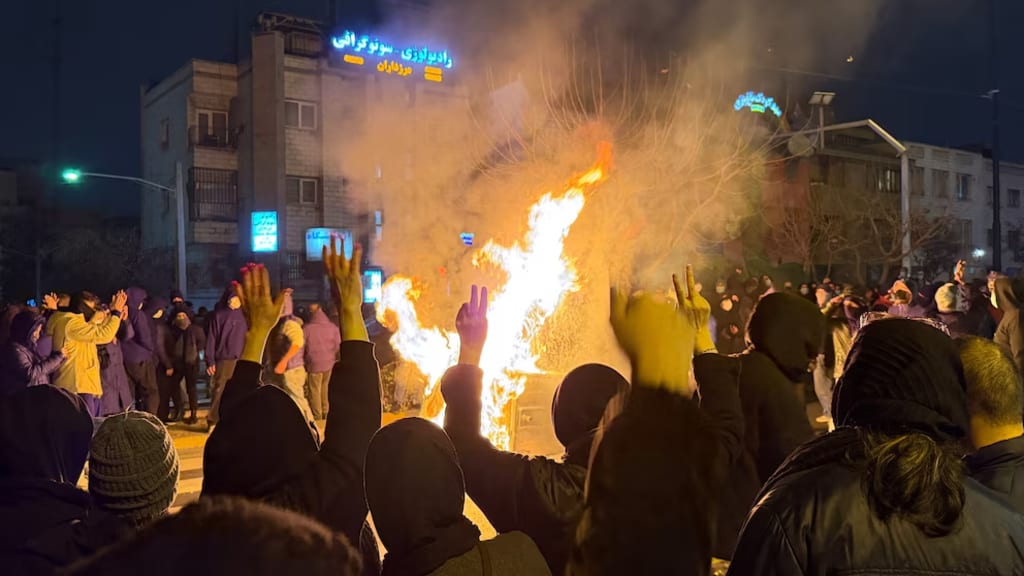
Revolutions rarely arrive with warning sirens. They creep in quietly, then all at once. And right now, Iran is no longer protesting — it is revolting.
What began as nationwide unrest has crossed a far more dangerous threshold. Millions of Iranians are now openly challenging the state, not just in Tehran, but across nearly every province and major city. Soldiers patrol the streets. Internet access is choked. Gunfire echoes through neighborhoods. And by conservative estimates, hundreds — possibly thousands — are already dead.
This is not another flash-in-the-pan uprising. This is something different.
A Regime at Its Most Perilous Moment
By every available indicator, Iran’s ruling system is facing its gravest internal threat in generations. Worse than the 2009 Green Movement. Worse than the 2019 fuel protests. Worse even than the Mahsa Amini demonstrations of 2022.
Entire districts have slipped from regime control. Government buildings are burning. Mass strikes have spread across key industries. Protesters chant openly for the death of Ali Khamenei and the collapse of the Islamic Republic itself.
This matters — because once slogans cross from reform to removal, there is no easy way back.
Why This Time Is Different
Unlike previous protest waves, this uprising is driven less by ideology and more by economics. Decades of sanctions, corruption, inflation, and systemic mismanagement have hollowed out public faith — even among traditional regime supporters. There are now very few Iranians who believe the system can fix itself.
The movement is also smarter.
Protesters are decentralized, locally organized, and tactically adaptive. Communication persists through satellite connections despite state blackouts. Gen Z is leading from the front, having studied the failures of earlier uprisings and the successes of revolutions elsewhere. Women, minors, and the elderly are being actively shielded where possible, while young men absorb the brunt of regime violence.
Most critically: the regime has already crossed its own red lines.
Mass executions. Publicized killings. Broadcast terror meant to break morale.
Once a state does that, it sends an unintentional message — weakness.
Violence as a Confession of Fear
Authoritarian systems do not massacre civilians because they are confident. They do it because they are scared.
Reports emerging from hospitals and forensic centers suggest death tolls far higher than official counts. Some independent estimates place the number of protesters killed in the thousands. Detentions now exceed ten thousand. State media openly labels protesters as “terrorists,” while pro-regime rallies are staged only under heavy guard and during daylight hours.
The social contract is shattered. And the protesters know it.
This is now a point-of-no-return revolution. If it fails, the reprisals will be catastrophic. Too much blood has already been spilled for half-measures.
The International Variable No One Can Ignore
Historically, revolutions succeed not just because regimes are weak — but because the international environment shifts at the right moment.
That moment may be approaching.
Western intelligence agencies are quietly reassessing earlier assumptions that regime change was unlikely. Israeli analysts are increasingly confident this is a unique window. The Iranian diaspora is mobilizing. Even long-cautious observers now concede Iran checks nearly every box for revolutionary success: fiscal collapse, elite fragmentation, mass mobilization, and a shared vision of a different future.
What’s missing is external pressure.
And that’s where things get dangerous.
Washington, Jerusalem, and the Clock
If outside actors choose to intervene — even indirectly — they could tip the balance almost overnight. Iran’s air defenses remain degraded. Its leadership is exposed. Its economy is already on life support.
The question isn’t capability. It’s timing.
The United States, under Donald Trump, has signaled unusual willingness to act abroad. Recent operations, threats, and rhetoric all point to an administration far more comfortable with decisive intervention than prolonged hesitation.
Israel, for its part, is watching closely — prepared, but waiting.
Iran, sensing the danger, is attempting a dual-track strategy: threatening retaliation while quietly floating negotiations. It is the diplomatic equivalent of blinking and clenching a fist at the same time.
History suggests that rarely works.
The Narrow Window
On the streets of Iran, ordinary people are doing everything they can. They have pushed the regime closer to collapse than at any point since 1979. But revolutions are endurance contests — and endurance has limits.
If the balance remains even, morale becomes decisive. Fear spreads. Participation drops. The regime regroups.
But if the scales are tipped — now — the Islamic Republic could fall with stunning speed.
Delay, and the sacrifices already made may come to nothing.
This is the moment. Not next month. Not after another thousand funerals.
History doesn’t wait — and neither does revolution.
About the Creator
Lawrence Lease
Alaska born and bred, Washington DC is my home. I'm also a freelance writer. Love politics and history.
Keep reading
More stories from Lawrence Lease and writers in History and other communities.


Comments
There are no comments for this story
Be the first to respond and start the conversation.