
Unraveling the Secrets of Nakht's Tomb and the Dimensions of His Life and Times
Nakht,whose name means- Strong

Unraveling the Secrets of Nakht's Tomb and the Dimensions of His Life and Times
The Tomb of Nakht, Deir el-Medina They lived during the New Kingdom period of Egypt, but there is a lot we can learn from the Tomb of Nakht (TT52) discovered in Deir el-Medina.
Although much of what we know about Nakht is relatively little known, the tomb itself offers some fascinating glimpses into his social standing, personal relationships, and the rich cultural milieu of his time. Named Nakht, or "Strong," he was both a scribe and a serving priest. That he held these roles is indicative of his important role in society, as he likely performed pivotal roles in both the religious and administrative aspects of life in ancient Egypt.
About Nakhtw about his life.
Most of what is known of Nakht comes from artistic renderings and inscriptions within the tomb. Yet these sources offer only a fragmentary picture of his personal history.
It is known, for example, that Nakht was married to a woman named Tawy, who bore the title of ''chantress of Amon.'' She is recorded with the title servant of Amon (mouth of Amon), which likely indicates her role in religious ceremonies.
Possibly as a singer or performer, devoted to the worship of Amon, one of the suprewme gods in the Egyptian pantheon. Their son Amenemapet is also referenced, but little is known about his life or his status.
Without an abundance of written records or written references to Nakht in other sources, his tomb is the primary access point for exploring his life and times.
Providing more than a burial location, it serves as a permanent, visual progression with an abundance of stories of everyday life and ceremonial customs in ancient Egypt.
Images from Nakht's Tomb
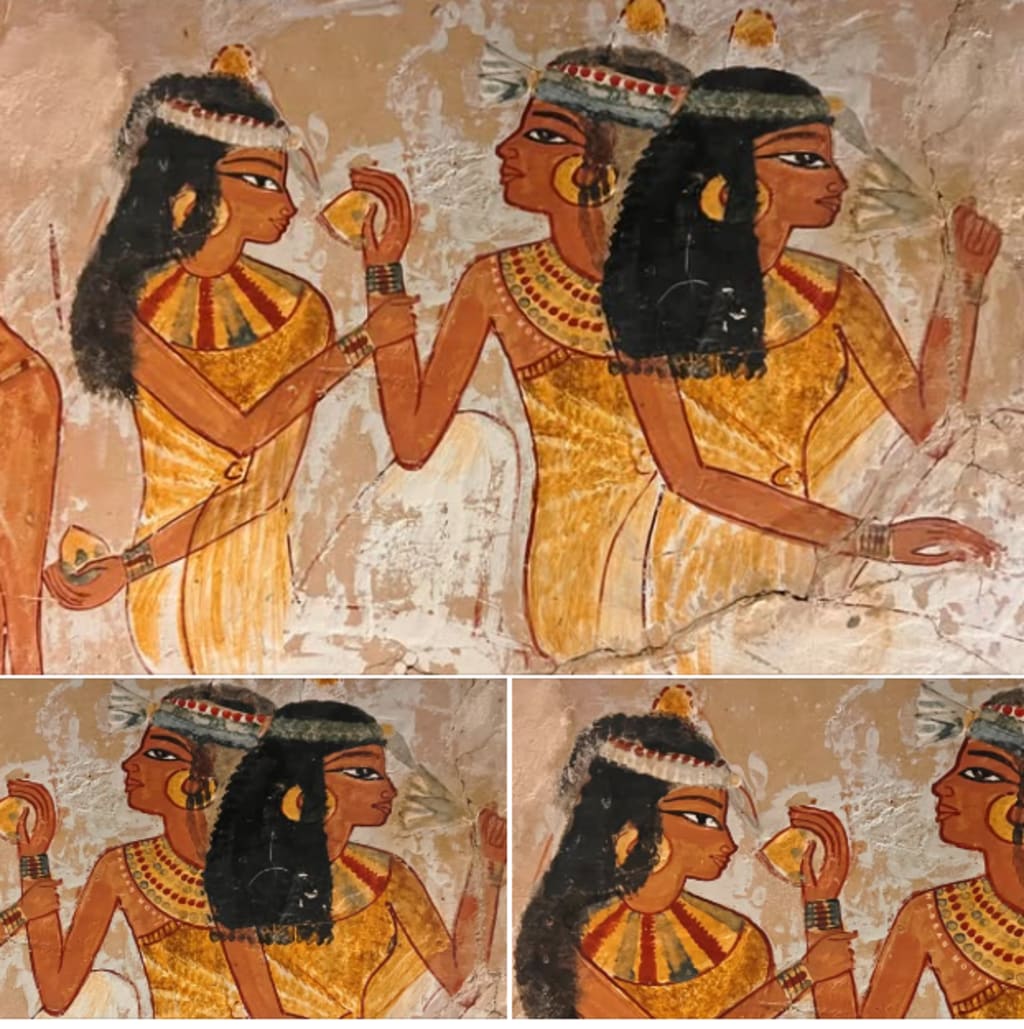
Among the most absorbing elements of Nakht's tomb is its striking portrayal of the guests and attendants at something like a social function. The tomb's artwork features a scene depicting a number of female guests, their attendants and musicians.
These guests are shown in styles and manners of splendour, kneeling on reed mats, lavishly adorned. Defining the lives of these people in such detail is very much about knowing in which order to get on the throne, or perhaps what colour robe to wear that day, as it signifies who you were, and where you stood in the tower of nobility.
The women are posed in various positions in this scene as well, adding texture and flow to the image. Three of the guests kneel side by side, one of them inhaling the scent of a lotus flower, a vision that conveys the sumptuousness of the situation.
They had always beaky and a little storky, and the arrangement of the women gave the impression of some form of movement or conversation. The guest with the lotus flower is partly hidden behind another girl, who is in turns handing a fruit to a third woman. These exchanges of fruit could also be an indication of their customs of hospitality or generosity, it is all we know about that time.
The third woman seated behind the other two is holding a tray in front of her that contains fruit. The tray is probably meant to go around the line stressing the public, ritualistic aspect of the action.
The act of passing fruit around, from guest to guest, implies a sharing of something, of resources, or perhaps of blessings, in accordance with the familiar forms of sociality typical of Egyptian life.
The Meaning Behind Clothes and Jewelry
There are women in the scene all wearing dresses that share the same design,but they each accessorized it with different styles of jewels.
The same dresses indicate unifomity of social identity within the group, whereas the broad necklaces and large round gold earrings show their individual wealth and status.
Jewellry in Ancient Egypt was not only decorative but also carried importance in culture and religion serving often as a sign of status and as a symbol of protection and divine endorsement.
Thank you so much for reading my work! Any feedback or support that you have to offer is accepted and appreciated.
About the Creator
Keep reading
More stories from Rohitha Lanka and writers in History and other communities.
From Misunderstanding to Modern Understanding of Women's Health
The Evolution of Hysteria A term once so ubiquitous in both medical and societal discourse regarding women, serves as a potent example of the misconceptions and biases that have plagued the history of women's health.
By Rohitha Lanka11 months ago in History
3 Everyday Items That Accidentally Became Deadly
We like to believe danger announces itself. Spikes look sharp. Poisons come with skulls. Explosives are loud and rude about it. Everyday items, by contrast, earn our trust through familiarity. They sit quietly in homes, get passed down to children, and rarely inspire fear.
By Enoch Saginiabout 4 hours ago in History
Are Banks Open on Martin Luther King Jr. Day?
Introduction Martin Luther King Jr. Day, also called MLK Day, is a national holiday in the United States. Many people enjoy a day off from work or school on this day. However, a common question people ask is: Are banks open on MLK Day?
By Farhan Sayedabout 20 hours ago in History



Comments
There are no comments for this story
Be the first to respond and start the conversation.