
3 Everyday Items That Accidentally Became Deadly
#2. Wallpaper That Quietly Poisoned Entire Families
We like to believe danger announces itself. Spikes look sharp. Poisons come with skulls. Explosives are loud and rude about it. Everyday items, by contrast, earn our trust through familiarity. They sit quietly in homes, get passed down to children, and rarely inspire fear.
History has betrayed that trust repeatedly.
Some objects were not designed to harm anyone. They were practical, fashionable, or fun. Their creators had good intentions, and their users had no reason to suspect danger—until bodies, illnesses, and lawsuits started appearing.
These aren’t weapons. They’re household items that accidentally crossed the line from helpful to harmful.
Here are three everyday objects that proved far more dangerous than anyone expected.
3. Lawn Darts: When Backyard Fun Turned Into a Medical Emergency
Lawn darts, also known as Jarts, were marketed as wholesome outdoor entertainment. Imagine a sunny afternoon, grass, and laughter. A casual game involving large, heavy darts thrown high into the air toward plastic rings.
Already, in hindsight, this feels like foreshadowing.
Lawn darts were essentially oversized metal spikes with fins, designed to land point-first. The goal was accuracy. The problem was gravity. When thrown, these things came down fast, sharp, and without concern for who was standing underneath.
Throughout the 1970s and 1980s, reports piled up. Children were struck on the head. Skulls were fractured. Eyes were lost. In several documented cases, lawn darts caused fatalities.
Parents were understandably shocked. This was a toy sold in toy stores, advertised with smiling families and sunshine. The danger wasn’t obvious because it was normalized. A dart was just a dart—until it wasn’t.
Eventually, governments stepped in. By 1988, lawn darts were banned in the United States and several other countries.
Humanity looked at medieval battlefield technology and thought, “Yes. This belongs at birthday parties.”
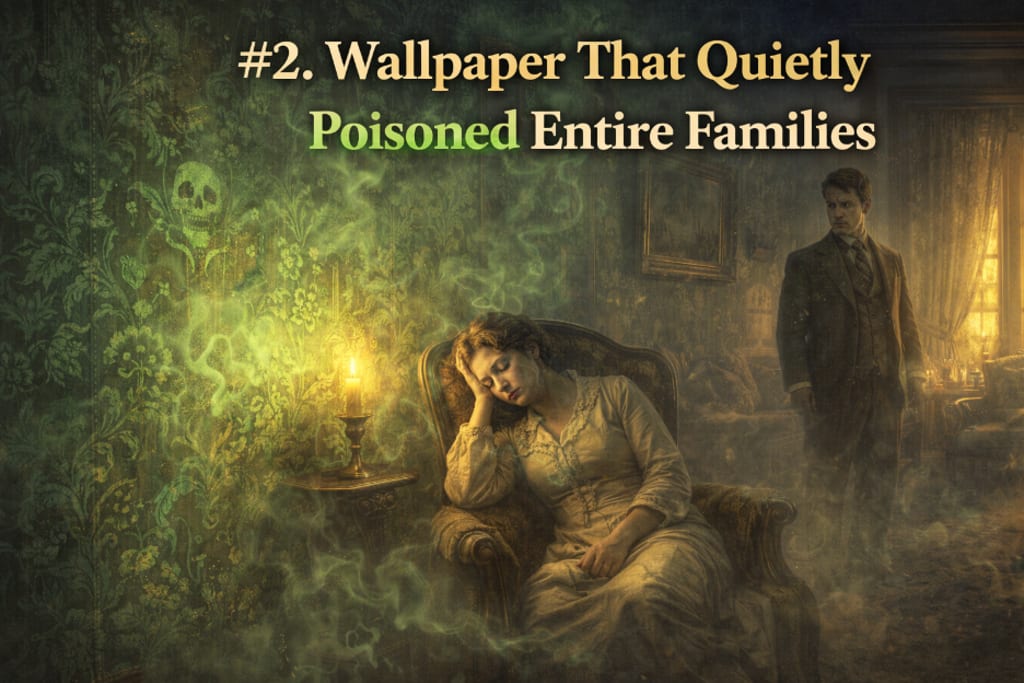
2. Wallpaper That Quietly Poisoned Entire Families
Wallpaper is the definition of harmless. It doesn’t move. It doesn’t hum. It just sits there, politely decorating walls.
In the 19th century, however, wallpaper had a secret hobby: slowly killing people.
The problem was color. Specifically, a vibrant green pigment known as Scheele’s Green and later Paris Green, both made with arsenic. These colors were fashionable, luxurious, and wildly popular across Europe and North America.
Arsenic was not considered particularly dangerous in this context. It wasn’t ingested. It was just there. On the walls and everywhere.
Except arsenic doesn’t stay put.
Over time, dampness and heat caused arsenic compounds to break down into toxic dust or gas. Families living in these homes experienced chronic illnesses: headaches, vomiting, respiratory problems, skin lesions, and unexplained deaths.
People blamed bad air, weak constitutions, or stress. Doctors were baffled. The walls—the literal background of daily life—were not suspected.
Even Napoleon Bonaparte may have been affected. Some historians believe the wallpaper in his exile home released arsenic, contributing to his declining health.
The horror here is subtle. No explosions. No immediate symptoms. Just decoration quietly poisoning households while everyone admired the color.
Eventually, arsenic-based pigments were phased out. But for years, beauty literally became toxic.
1. Baby Powder That Contained Asbestos
Few items feel safer than baby powder. It’s soft. It smells clean. It’s associated with care, comfort, and infants—arguably the group we are most motivated to protect.
And yet, for decades, some talc-based baby powders contained asbestos.
Talc and asbestos are naturally occurring minerals that can form near each other underground. If mining isn’t carefully controlled, asbestos contamination can occur. For years, this risk was underestimated—or ignored.
Asbestos fibers are microscopic and deadly when inhaled. They lodge in the lungs and can cause mesothelioma, lung cancer, and other severe illnesses—often decades later.
People used baby powder daily. On themselves, on children, and in enclosed bathrooms. The exposure was small but constant.
The connection between talc use and cancer took years to establish. Lawsuits followed. Internal documents revealed that some companies were aware of contamination risks long before products were reformulated.
The betrayal here is profound. An item associated with care and protection became a source of long-term harm—not through misuse, but through trust.
Conclusion
What unites these stories isn’t recklessness, but normalcy.
People didn’t misuse these items. They used them exactly as intended. They played games. Decorated homes. Took care of their families. The danger came not from behavior, but from blind spots in design, science, and oversight.
Of course, throwing metal spikes near children was a bad idea. Of course, arsenic on the walls was a problem. Of course, asbestos in baby products was unacceptable. But these realizations came after the consequences.
Everyday items are powerful because they earn our trust. That trust, once broken, reshapes regulations, industries, and public awareness.
The lesson isn’t paranoia. It’s humility. Even the most ordinary objects deserve scrutiny—because history has shown us that danger doesn’t need to look dramatic.
Sometimes it just sits quietly on a shelf, waiting for time to do the rest.
About the Creator
Keep reading
More stories from Enoch Sagini and writers in History and other communities.




Comments
There are no comments for this story
Be the first to respond and start the conversation.