
This Place Is Full of Pirate Gold, Why Can't No One Find It?
Prepare yourself to immerse in the enigmatic and fabled narrative of the Oak Island treasure. Gather your map and embrace your spirit of exploration, as we embark on a journey to unravel the mystery that has captivated adventurers for countless generations. This minuscule island situated off the coast of Nova Scotia, Canada, is surrounded by tales of concealed wealth, cleverly designed traps, and never-ending quests. According to the legends, a magnificent treasure, said to encompass a wide range of valuables, including plunder from pirates and ancient manuscripts, lies hidden beneath the island's surface. Despite numerous years of excavation, drilling, and audacious expeditions, the Oak Island treasure has proven elusive. Consequently, one may question its very existence.
It is rumored that this location is teeming with wealth that has been stashed there for hundreds of years, yet no one has successfully claimed it from this valuable island. Since 1795, treasure hunters have been captivated by this site.
Many individuals have attempted to uncover the hidden treasure believed to have been concealed on this island by Spanish Pirates or the Knights Templar. However, access to the island is restricted to private parties, making it impossible for the general public to explore. The only option available is to embark on an ocean tour around the island or catch glimpses of it through a TV reality show featuring the adventurous Lagina Brothers, Rick and Marty. These brothers are dedicated enthusiasts who tirelessly search for the Treasures of Oak Island in Nova Scotia, Canada. It appears that there are no limits to where TV producers can venture, as they even managed to capture one of the most well-known discoveries, the infamous Money Pit. Despite its promising name, this pit did not contain a fortune. To delve further into its history, we must transport ourselves back 200 years ago when a 16-year-old boy stumbled upon the Money Pit in 1795.
Daniel McGinnis went fishing at Oak Island and noticed an oak tree with unusual markings. Intrigued, he decided to investigate further. McGinnis discovered a sunken area and immediately began digging with the help of his two friends. However, instead of uncovering valuable treasures, they found logs buried at regular intervals. Despite this disappointment, they stumbled upon a granite stone with an engraved inscription. Many attempts to decipher it failed, except for one translation that indicated buried treasure 40 feet below, weighing 2 million pounds. Interestingly, coconut fiber was also discovered in the pit. This finding raised eyebrows since coconut trees do not naturally grow in Nova Scotia, where Oak Island is located. The nearest coconut tree is about 1500 miles away, suggesting that the fiber was deliberately brought there. Researchers speculate that the coconut fiber may have been used to lower treasures into the pit using ropes. In addition to the Money Pit, there are other mysteries surrounding Oak Island. In the late 1800s, the Oak Island Treasure company extensively explored and excavated the island, believing that something significant was hidden there. Although they drilled 153 feet underground, they did not find gold or diamonds. However, they did stumble upon a manuscript. Some theorists propose that it is one of Shakespeare's lost works, hidden by Francis Bacon, who some believe to be the true author of Shakespeare's plays. However, there is no concrete evidence to support this claim. Before the discovery of the Money Pit, treasure hunters were drilling at Smith's Cove. During their excavation, they found a wooden piece shaped like a "U" with Roman numerals, believed to be from 1769 after further examination by specialists.
The Money Pit was discovered 26 years later, sparking speculations that the structure could be linked to the sought-after treasure shaft. Consider this Templar coin, which, although not the first discovery on the island, held significant importance. In medieval times, such coins held immense wealth and were typically stored in European fortresses. For treasure hunters, finding this coin was a promising indication that there was more to be found on the island. The reasoning is simple: if one coin of its kind exists, there must be more. And they were correct. The discovery of a crossbow bolt on the Southwest Shore of the island, believed to date back to the 13th century, further confirmed their suspicions. While not the primary focus of the treasure hunters, additional coins were unearthed on the island. Rick and Marty Lagina found a precious copper coin in a swamp, which originated from Spain. Initially, they could only see the number eight engraved on the coin. However, after thorough examination by experts, it was determined to have been minted around the 17th century, with the date 1652 engraved on the back. There is a theory that Spanish explorers discovered treasure but chose to hide it instead of delivering it to the king. Therefore, it is possible that this coin fell from a chest filled with coins and jewels, making it part of the sought-after treasure. Alternatively, it could have been accidentally lost by someone during their search for the treasure. Another renowned treasure hunter, Gary Drayton, and his team, alongside Rick Lagina, stumbled upon two 17th-century King Charles II Britannia coins while metal detecting on the island. One of these coins bore a clear inscription indicating that it was minted in 1771.
A potentially Spanish treasure, believed to have originated from a swamp, has been discovered. This particular artifact is a silver ring that has undergone two instances of repair. On one occasion, the ring was enlarged, while on another, it was reduced in size. Additionally, the ring features an ornate floral design, which was fashionable in Europe during the 1730s.
Rick and Marty Lagina discovered a silver button at Isaac Point, which is believed to be from the middle of the 18th century. This finding wasn't particularly significant since it could have simply belonged to a farmer living peacefully on the island. There are no official records of any chests filled with gems and coins found on Oak Island, but enthusiasts did uncover some jewels. One of the pieces they found was a brooch with a stunning red gem, which was initially mistaken for a ruby but later identified as a garnet by a professional gemologist. This silver brooch is believed to have been crafted in the 15th or 16th century. Another brooch discovered had an intricate design featuring a leaf motif and an ornate rope. The leaf design consisted of 13 branches, adding to the overall mystery of the treasure hunt. Interestingly, there is a carving of a 13-branched tree on a rock along the North Shore of the island, leading many to believe it has significance to the Knights Templar. Not far from the location where Daniel McGinnis, the discoverer of the Money Pit, lived, enthusiasts found another brooch. Unfortunately, this brooch, when examined by a professional gemologist named Charles Lewton-Brain, turned out to have no gems. The stone that appeared to be a gem was actually just a piece of glass, although it was processed using a special technique known as leaded glass. The brooch, however, did have a portion made of gold and is believed to date back to the 14th century. Despite these intriguing findings, it remains unclear if any of these items are the treasure everyone has been searching for.
About the Creator
Keep reading
More stories from writers in History and other communities.
Once Wealthy Estates Now Lost to Ruins
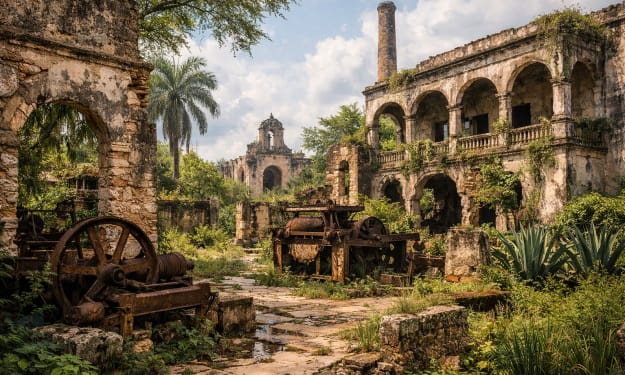
In the tropical landscapes of southern Yucatán, Mexico, the ruins of once-grand haciendas stand quietly among overgrown fields and crumbling stone walls. These estates were once the heart of a booming industry built around a plant that locals called “green gold.” For decades, the production of sisal fiber brought enormous wealth to the region, transforming the economy and shaping the lives of thousands of people. Today, however, many of these estates lie abandoned, their glory fading into history.
By Irshad Abbasi 2 days ago in History



Comments
There are no comments for this story
Be the first to respond and start the conversation.