
The White Horse of Uffington
England's Historic Chalk Giants: Solving the Mysteries of the Forgotten Hill Figures and the Uffington White Horse

The Secret Chalk Giants of England: Ancient Artwork in Plain Sight
For more than 3,000 years, giant shapes sculpted into the hills of England have spoken in hushed tones of ancient civilizations. These gigantic geoglyphs—giants, horses, crosses, and symbols—cover the southern English countryside, combining art, enigma, and history. Of them, the Uffington White Horse stands apart, not just for its elegance but for the secrets it prefers not to reveal entirely. Let's delve into the enigma of the chalk giants and discover why they remain intriguing to us today.
Chalk Art Across the Centuries
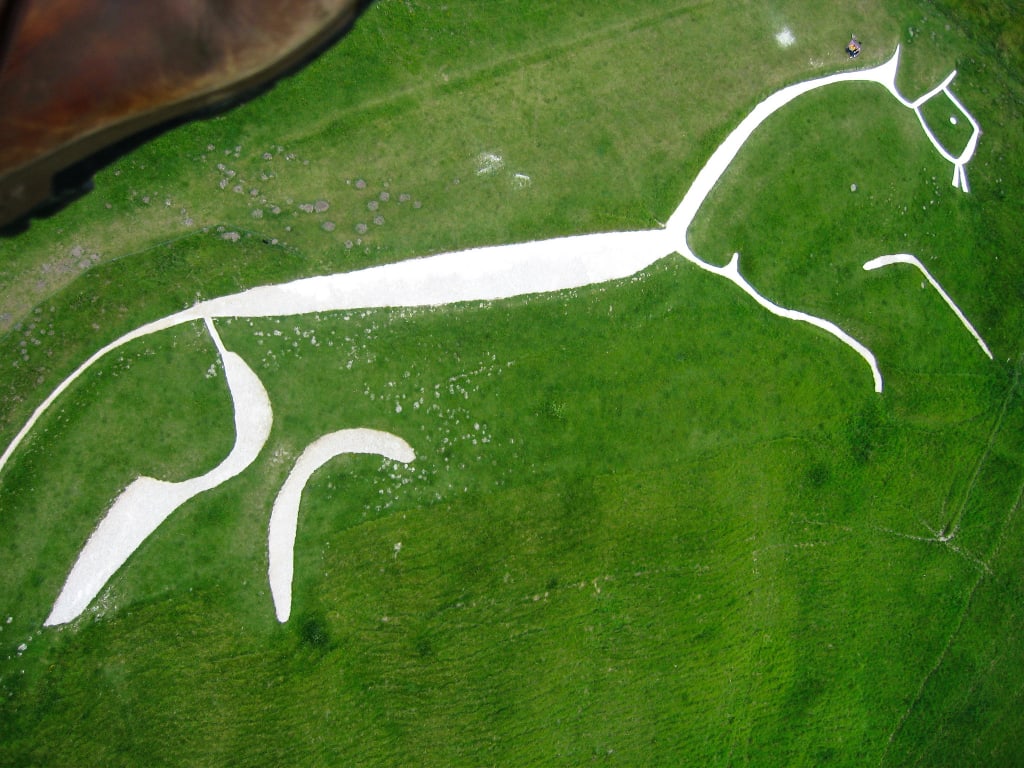
Imagine walking across a grassy mound and coming face-to-face with a big horse, its white, smooth body glistening in the green landscape.
This is the enchantment of England's hill figures. These photographs were made by removing grass to reveal the white chalk underneath and never did so in order to endure forever. Without upkeep, grass reclaims the land, covering up the designs in a matter of years. Some have endured for thousands of years, however, such as the Uffington White Horse, through the people who kept them cherished heirlooms. Of the 56 English geoglyphs unearthed, all but a few are younger than 300 years. But the oldest among them, such as the Uffington Horse and the Long Man of Wilmington, a disputed topic, are mysterious. Are they ageless traditions behind left? Tribe symbols? Or messages to the gods?
The Uffington White Horse: A Bronze Age Enigma
Perched atop a hill in Oxfordshire, the Uffington White Horse is an exercise in minimalism. Its arched body, long legs, and beak-like snout make it more of a phantom than a horse. Yet this humble image has stood for more than 2,600 years, placing it among the most ancient geoglyphs on the planet.
Historians had linked the horse to the Iron Age (c. 1st century BCE) for centuries and compared it to depictions of horses on early coins. But science reversed all that in 1995. Researchers, employing soil dating techniques, found that the horse had been carved between 1400 and 600 BCE—much older than was thought. This places its date of creation as being during the Late Bronze Age, when neighbouring hillforts such as Uffington Castle were flourishing.
Why Was the Horse Carved?
Why would early humans carve a horse so massive that one sees it only as a whole when looking from an aerial view? That is where the mystery gets more intense:
A Tribal Marker? The horse rests alongside Bronze Age burial tumuli and a cemetery containing more than 30 graves. Perhaps it was a sign of a mighty tribe, claiming their territory?
A Sacred Ritual? Others give it to Celtic mythology, for example, Epona, the goddess of horse fertility. But Epona's cult came to England 600 years later than the carving of the horse. Perhaps it is more likely to be in honor of Rhiannon, a Welsh goddess riding on a white horse, instead?
A Map of the Heavens? Its correlation with the Ridgeway, an ancient route, and Bronze Age monuments suggests a ritual landscape, where art and astronomy meet.
The Struggle to Remain Seen
It was work maintaining a hill figure. Just creating one was just part of the struggle. It was work to maintain it being seen. Societies would often gather to "clean" the horse—remove grass and repaint chalk. The figure would vanish if a society lost or discontinued the tradition. Most geoglyphs were lost this way, along with their meanings together with their shapes.
The Uffington Horse was able to avoid this fate. There are references in the 1070s to "White Horse Hill," and its image was noticed by the 1190 CE. Its tradition was preserved by community festivals and ceremonies, illustrating how integral it was to the cultural heritage.
Historic Art Meets Modern Science
The 1995 soil tests not only altered the horse's timeline—they transformed our understanding of ancient art. By studying light trapped in soil particles, scientists uncovered a 3,000-year-old secret. But questions linger: Who created it? Why a horse? And how did its meaning change over the centuries?
The process of construction is also a mystery. In contrast to more recent hill figures, the Uffington Horse was not carved out with precision. Its form developed to some extent over the centuries as people altered the lines, indicating it was more of a living tradition than merely a monument
More Than Just Fleeting Art
Most of the geoglyphs would have been transient—temporary rituals inscribed into the ground. The survival of the Uffington Horse suggests something deeper. It may have represented power, belief, or bonding with the earth for individuals during the Bronze Age. To us, it symbolizes a connection with their reality, how "transient" art can survive empires.
Visit the Vale of the White Horse
Nowadays, the Uffington Horse remains a wonderful thing to behold. On a fine day, you can spot it from 30 km away. Walk along the ancient Ridgeway track, explore the remains of Uffington Castle, or visit the Lambourn Seven Barrows burial ground. Stand in the place where the eyes of Bronze Age people have gazed upon these chalk markings, and you'll feel the weight of history—and the thrill of the unknown.
Last Reflection
The giants of white England are not art—they're dialogues with the past.
The Uffington White Horse, with its timeless appeal and persistent mysteries, is a testament that some secrets were not meant to be uncovered.
As tribal icons, religious offerings, or merely art, these geoglyphs remind us to keep searching, searching, and excavating for clues among the hills. Ultimately, the next ancient artefact may still be buried beneath grass, ready to share its tale.
About the Creator
Shadow
Sharing and learning are things I enjoy. You can read my story to explore your curious mind, and subscribe to my Vocal Media page.I will repay you in the same manner that you honor me. Then, we will go to infinity with each other. Thank you
Father of Millions, Yet Not Always a Father to His Own Sons
Few figures in world history have left as profound a mark as Genghis Khan. Known for his extraordinary military genius and ruthless campaigns, he forged the largest contiguous empire the world had ever seen—the Mongol Empire. Yet beyond the battlefield and the politics of conquest lies a fascinating paradox: while Genghis Khan is believed to be the ancestor of millions of people today, his relationship with his own sons was complicated, strained, and sometimes filled with uncertainty.
By Irshad Abbasi about 17 hours ago in History
My First Time Skiing and I Got Lost, Alone, in the French Alps
Looking back, I can trace some of my life’s biggest adventures to a simple action from my sister. She’d introduced me to Tommy (a very long time ago), a colleague of hers, who had overshared his penchant for Italian-looking women, and I ticked that box.
By Chantal Christie Weissabout 12 hours ago in Humans


Comments (1)
Great work