
The Main Reason Behind the Israel-Iran Conflict
How Ideology, Nuclear Ambitions, and Regional Power Struggles Fuel the Israel-Iran Conflict

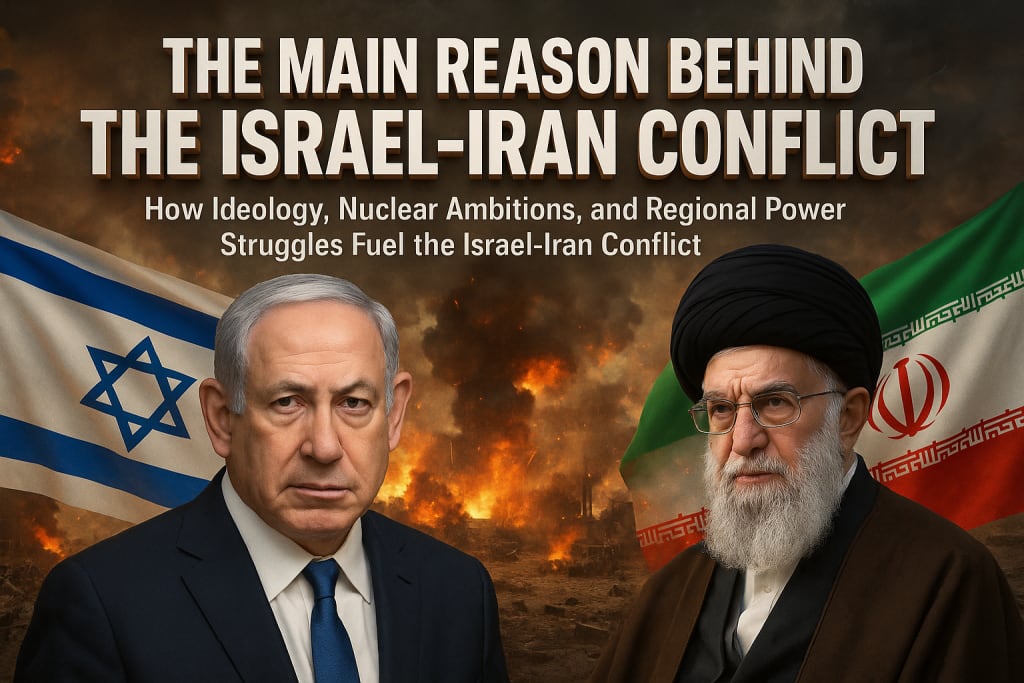
The conflict between Israel and Iran is one of the most dangerous tensions in the Middle East. It is not just about religion or politics—it’s a mix of historical distrust, security concerns, nuclear weapons, and regional influence. To understand why Israel and Iran are enemies today, we must look at real events, official statements, and international reports that clearly explain the reasons.
---
1. Ideological and Political Differences
One of the core reasons for the Israel-Iran conflict is ideology. Since the 1979 Islamic Revolution, Iran’s government has been openly against Israel. Iran’s leaders, especially Ayatollah Khomeini and his successors, have called Israel a “Zionist regime” and have said it should be removed from the map. These are not just words—these statements have been repeated many times by top Iranian officials, including Supreme Leader Ayatollah Ali Khamenei.
In return, Israel sees Iran as a major threat to its existence. Israel is a Jewish state, while Iran’s regime is based on Islamic Shi’a ideology. These differences create deep political and religious tensions.
---
2. Iran’s Support for Anti-Israel Groups
Iran gives strong military, financial, and political support to groups that attack Israel, such as Hezbollah in Lebanon and Hamas in Gaza. According to the U.S. State Department and various UN reports, Iran has provided weapons, training, and money to these groups for years.
Hezbollah: Formed in the 1980s, this group is backed by Iran and operates from Lebanon. It has fired thousands of rockets at Israeli towns and cities, especially during the 2006 Lebanon War.
Hamas: Based in Gaza, Hamas is also supported by Iran. The group is responsible for rocket attacks and suicide bombings in Israel.
This support makes Israel feel surrounded by Iranian proxies. As a result, Israel often strikes weapons convoys and warehouses in Syria and Lebanon, where Iran is believed to supply weapons to these groups.
---
3. Iran’s Nuclear Program
One of the biggest fears for Israel is Iran’s nuclear program. Israel believes Iran is secretly trying to build nuclear weapons, even though Iran says its program is for peaceful energy purposes.
In 2018, Israeli Prime Minister Benjamin Netanyahu presented evidence from a secret Iranian nuclear archive, claiming it proved Iran lied about its nuclear ambitions.
The International Atomic Energy Agency (IAEA) has confirmed that Iran has enriched uranium far above the levels needed for peaceful use. In 2023, the IAEA reported Iran enriched uranium up to 60%, while nuclear weapons need around 90%.
Israel sees a nuclear-armed Iran as a direct threat and has said it will act militarily if needed. Israel has been accused of cyberattacks (like the Stuxnet virus in 2010) and the killing of Iranian nuclear scientists to slow down Iran’s nuclear progress.
---
4. Regional Power Struggle
Both Iran and Israel want to have influence in the Middle East. Iran tries to expand its influence through its support for Shi’a militias in Iraq, Syria, Lebanon, and Yemen. Iran also supports the Assad regime in Syria and uses Syrian land to move weapons closer to Israel.
Israel, on the other hand, wants to stop Iran’s expansion. That’s why Israel regularly strikes Iranian targets in Syria. According to the Syrian Observatory for Human Rights, Israel has carried out hundreds of airstrikes in Syria against Iranian forces and weapons convoys since 2017.
---
5. Recent Escalations
In April 2024, Iran launched more than 300 drones and missiles at Israel after an Israeli airstrike in Syria killed an Iranian general. Most of the missiles were shot down by Israeli and allied air defense systems, but this was Iran’s first direct attack on Israeli soil—showing how serious the conflict has become.
---
Conclusion
The Israel-Iran conflict is not just about one issue—it is a mix of deep ideological hatred, fear of nuclear weapons, and a fight for power in the Middle East. Iran supports groups that attack Israel, while Israel takes military action to stop Iran from growing stronger. Both countries see the other as a serious threat to their survival.
This conflict remains one of the most dangerous in the world today. Without dialogue or international pressure, the risk of full-scale war continues to rise.
About the Creator
Keep reading
More stories from Engr. Mansoor Ahmad and writers in History and other communities.
The History and Origin of Football (Soccer)
Football, or soccer as it is called in some parts of the world, is the most popular sport globally. With billions of fans and players, it commands unparalleled attention. Its history, however, is as fascinating as the game itself—rich in culture, conflict, and evolution over millennia.
By Engr. Mansoor Ahmad8 months ago in History
The Invasion of Kuwait: Saddam’s Four-Day ‘Revolutionary Republic
On August 2, 1990, the world woke up to a geopolitical earthquake. Under the orders of Saddam Hussein, over 100,000 Iraqi troops, backed by hundreds of tanks, surged across the border into the tiny, oil-rich emirate of Kuwait. While history remembers this as the spark for the Gulf War, the first few days of the occupation featured a bizarre political theater: the creation of a short-lived puppet state known as the **"Republic of Kuwait."**
By Irshad Abbasi 6 days ago in History
Bomb Scare
It was 2027, and the world never thought it would happen. A missle hit the United States, but it wasn't where they had anticipated. A little town in the northeast was hit by a missile strike, they didn't know why, and they didn't know exactly where it hit, but they did know it was a coastal community, somewhere between Maine and Delaware.
By Gregory Payton7 days ago in Fiction



Comments (1)
amazing