

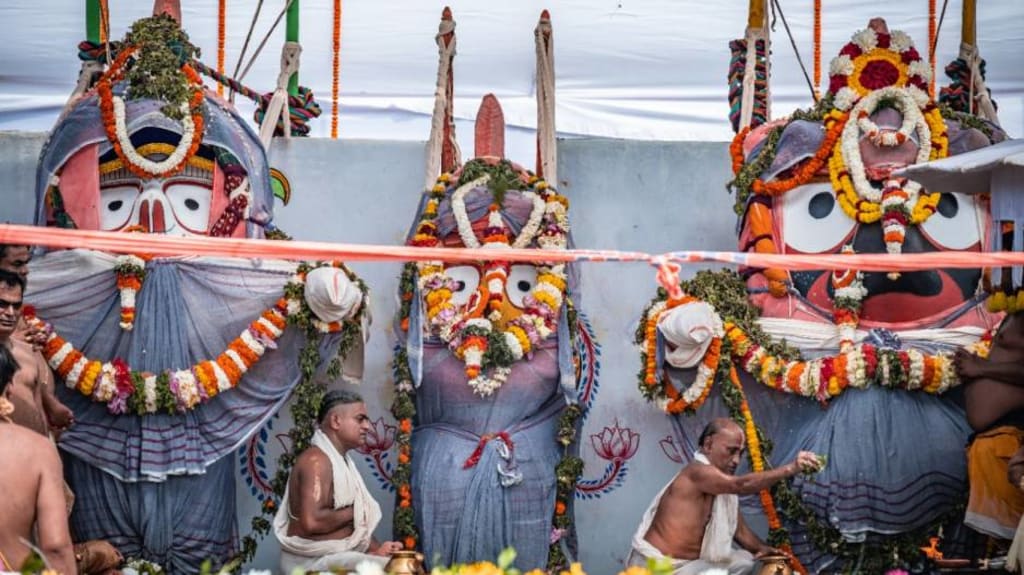
**1. The Origin of Lord Jagannath**
**The Legend of King Indradyumna**
The story of Lord Jagannath begins with King Indradyumna, a pious and devoted ruler of the ancient kingdom of Malava. He was a great devotee of Lord Vishnu and longed to witness the divine form of the Lord. One day, a wandering pilgrim told him about a sacred deity called **Nila Madhava** (a form of Lord Vishnu) worshipped in the forests of Odisha by the tribal chief, Viswavasu.
King Indradyumna sent his priest, Vidyapati, to locate Nila Madhava. After much difficulty, Vidyapati found the deity and married Viswavasu's daughter, Lalita. However, Nila Madhava disappeared before King Indradyumna could visit. Distraught, the king decided to fast until death. In a dream, Lord Vishnu instructed him to carve a deity from a sacred log of wood (daru) that would wash ashore.
**The Divine Log (Daru Brahma)**
A divine log of wood (daru) appeared on the shores of Puri, glowing with spiritual energy. King Indradyumna invited the celestial architect, **Vishwakarma**, to carve the deity. Vishwakarma agreed but set a condition: he would work in complete secrecy, and the king must not open the door until the work was complete.
After many days, the king grew impatient and opened the door prematurely. Vishwakarma disappeared, leaving the idols incomplete. The idols had no arms or legs, but a divine voice assured the king that this was the desired form of the Lord. The idols were installed in the temple, and Lord Jagannath, along with his siblings **Balabhadra** (Balarama) and **Subhadra**, became the central deities of worship.
---
**2. The Unique Form of Lord Jagannath**
Lord Jagannath's form is unlike any other Hindu deity. He is depicted as a wooden idol with large, round eyes, no visible limbs, and a vibrant, colorful appearance. This form symbolizes the following:
- **Universality**: Lord Jagannath represents the formless, all-pervading nature of God.
- **Inclusivity**: His simple, abstract form makes him accessible to all, regardless of caste, creed, or religion.
- **Divine Play (Leela)**: The incomplete form reflects the idea that God's true nature is beyond human comprehension.
---
**3. The Jagannath Temple in Puri**
The **Jagannath Temple** in Puri, Odisha, is one of the **Char Dham** pilgrimage sites and a cornerstone of Hindu spirituality. Built by King Anantavarman Chodaganga Deva in the 12th century, the temple is an architectural marvel. It is also known for its unique traditions and mysteries:
- **No Shadow**: The temple's main dome casts no shadow, a phenomenon that defies scientific explanation.
- **Sudarshan Chakra**: The chakra atop the temple appears the same from every angle, symbolizing the omnipresence of God.
- **Mahaprasad**: The temple's sacred food, offered to Lord Jagannath, is considered highly auspicious and is distributed to millions of devotees without discrimination.
---
**4. The Rath Yatra (Chariot Festival)**
The **Rath Yatra** is the most famous festival associated with Lord Jagannath. It takes place annually in Puri and attracts millions of devotees from around the world. During the festival, the deities of Lord Jagannath, Balabhadra, and Subhadra are placed on massive, elaborately decorated chariots and pulled through the streets by devotees.
**Significance of the Rath Yatra**
- The festival symbolizes the journey of Lord Jagannath from his temple to his aunt's home (Gundicha Temple), representing the bond between family members.
- It also signifies the Lord's desire to come out of the temple and bless his devotees directly.
---
**5. The Nabakalebara Ritual**
One of the most sacred and mysterious rituals associated with Lord Jagannath is **Nabakalebara**, which occurs every 12 to 19 years. During this ritual, the old wooden idols are replaced with new ones carved from a sacred neem tree (daru). The process involves:
- Identifying the sacred tree through divine signs.
- Carving the new idols in secrecy by a select group of priests.
- Transferring the **Brahma Padartha** (divine essence) from the old idols to the new ones.
- Burying the old idols in the temple premises.
The Nabakalebara ritual symbolizes the cycle of birth, death, and rebirth, reflecting the eternal nature of the soul.
---
**6. The Tribal Connection**
The worship of Lord Jagannath has deep roots in the indigenous traditions of Odisha. The **Sabara tribe**, led by their chief Viswavasu, was the first to worship Nila Madhava. Even today, the **Daitapatis**, descendants of the Sabara tribe, play a vital role in the temple's rituals, especially during Nabakalebara.
---
**7. The Philosophical Significance**
Lord Jagannath's worship transcends religious boundaries and embodies profound philosophical teachings:
- **Unity in Diversity**: The deity's universal appeal brings together people of all faiths and backgrounds.
- **Equality**: The distribution of Mahaprasad to all devotees, regardless of caste or creed, emphasizes the idea of equality.
- **Devotion and Surrender**: Lord Jagannath's form and rituals teach devotees to surrender to the divine will and embrace the mysteries of life.
---
**8. The Untold Stories of Devotion**
- **Salabega**: A Muslim devotee whose heartfelt prayers moved Lord Jagannath to halt his chariot during the Rath Yatra.
- **Chaitanya Mahaprabhu**: The 15th-century saint and founder of Gaudiya Vaishnavism, who was a ardent devotee of Lord Jagannath and spread his worship across India.
- **Daruki and the Daru Brahma**: The sacred log of wood used to carve the idols is believed to have a divine origin, connecting Lord Jagannath to the cosmic energy.
---
**9. The Mysteries and Miracles**
- **Anasara**: After the Snana Yatra (bathing festival), the deities are believed to fall ill and are kept in isolation for 15 days. During this time, special rituals are performed to restore their health.
- **Chandan Yatra**: A 21-day festival where the deities are smeared with sandalwood paste and taken on a boat ride in the temple tank.
- **No Birds Fly Over the Temple**: It is believed that no birds fly over the Jagannath Temple, adding to its mystical aura.
---
**10. Lord Jagannath in Modern Times**
Today, Lord Jagannath is not just a deity but a cultural icon. His worship has spread beyond India, with Rath Yatras being celebrated in countries like the USA, UK, and Australia. The teachings of Lord Jagannath continue to inspire millions, emphasizing devotion, humility, and the unity of all beings.
---
The story of Lord Jagannath is a testament to the enduring power of faith and the divine. It is a story that transcends time and space, reminding us of the eternal presence of God in our lives.
About the Creator
Himansu Kumar Routray
i am a creative writer on Vocal Media, passionate about crafting stories that inspire and engage. Covering topics from lifestyle and self-growth to fiction, Outside writing, always seeking new ideas to spark their next story.
Keep reading
More stories from Himansu Kumar Routray and writers in History and other communities.
The Hidden Victims of America’s First Nuclear Test
On July 16, 1945, the United States carried out the world’s first nuclear explosion in the desert of New Mexico. This historic event, known as the Trinity Test, marked the beginning of the atomic age and forever changed global politics, warfare, and science. But behind this “scientific achievement” lies a dark and largely untold story — the story of innocent civilians who were exposed to deadly radiation and then forgotten by history.
By Irshad Abbasi 5 days ago in History
Review of 'Man on the Run'
My wife and I saw Man on the Run, a nearly 2-hour documentary on Amazon Prime, about Wings, Paul McCartney's group that flew around the world from shortly after The Beatles broke up in early 1970 to shortly after John Lennon was murdered at the end of 1980, making a Beatles reunion forever impossible.
By Paul Levinson3 days ago in Beat


Comments
There are no comments for this story
Be the first to respond and start the conversation.