
The Letter Einstein Wrote—and Spent the Rest of His Life Regretting
One signature that helped unleash the atomic age

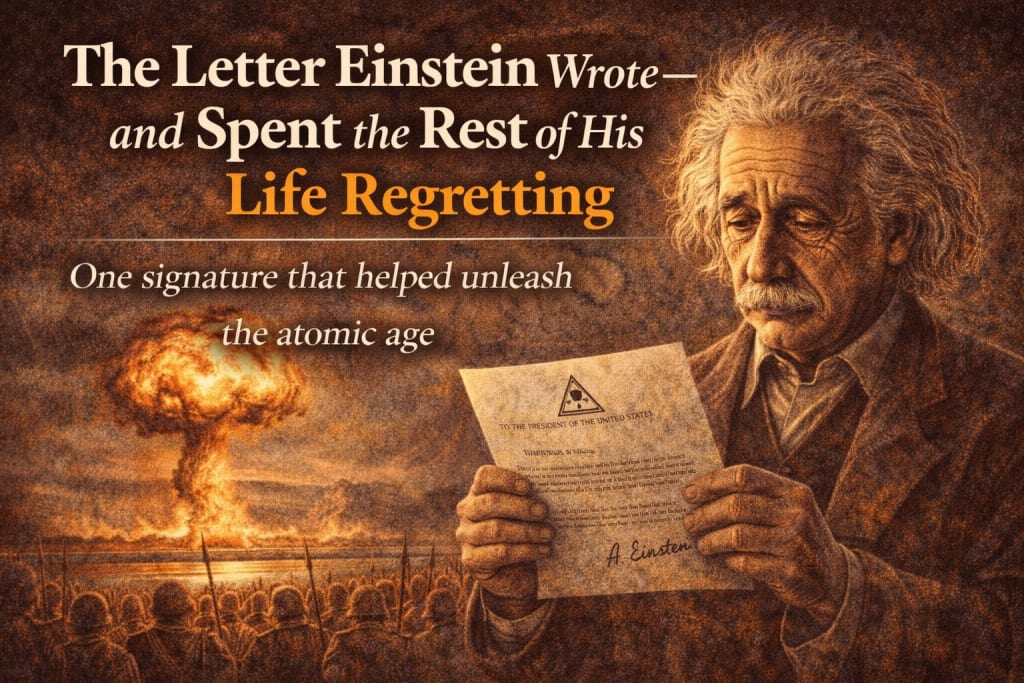
Albert Einstein is remembered as a genius, a pacifist, and a man who believed deeply in peace.
But in 1939, he made one decision that haunted him for the rest of his life.
It wasn’t a scientific discovery.
It wasn’t an equation.
It was a letter.
A World on the Edge:
In the late 1930s, Europe was collapsing into fear.
Nazi Germany was expanding aggressively. Adolf Hitler had already absorbed Austria and was pushing outward. Jewish scientists were fleeing Europe, carrying with them terrifying rumors.
One rumor, in particular, reached Einstein’s ears:
Germany might be trying to build a bomb unlike anything the world had ever seen—powered by nuclear fission.
Einstein understood what that meant.
If such a weapon were possible, it would be devastating beyond imagination.
And if Hitler got it first, the consequences would be unthinkable.
Einstein the Pacifist:
This is the cruel irony of the story.
Einstein hated war.
He had publicly opposed militarism his entire life. He believed violence corrupted humanity and that scientists had a moral responsibility to protect life—not destroy it.
Yet now, history placed him in an impossible position.
Do nothing—and risk Nazi domination.
Or act—and open a door that could never be closed.
THE LETTER:
Einstein did not write the letter alone.
Two fellow physicists, Leo Szilard and Eugene Wigner, urged him to use his fame. They knew Einstein’s name carried weight that no other scientist possessed.
The letter was addressed to President Franklin D. Roosevelt.
It warned that:
- Nuclear chain reactions were possible
- A new kind of bomb could be built
- Germany might already be working on it
- The United States could not afford to ignore this threat
Einstein signed it.
On August 2, 1939, the letter was sent.
A Small Action With Massive Consequences:
At first, the letter did little.
But as the war escalated, Roosevelt took it seriously.
That letter helped lead to the creation of the Manhattan Project—a massive, secret effort involving thousands of scientists and billions of dollars.
Einstein himself was not allowed to work on the project.
The U.S. government considered him a security risk due to his pacifism and political views.
Ironically, the man whose name sparked the project was excluded from its creation.
The Moment the World Changed:
On August 6, 1945, an atomic bomb was dropped on Hiroshima.
Three days later, another fell on Nagasaki.
Over 200,000 people died—many instantly, many slowly.
The atomic age had begun.
When Einstein heard the news, he was silent.
Friends later recalled that he looked devastated.
A Lifetime of Regret :
After the war, Einstein spoke openly about his remorse.
He once said:
“Had I known that the Germans would not succeed in producing an atomic bomb, I would have done nothing.”
Another time, he admitted:
“I made one great mistake in my life… when I signed that letter.”
Einstein spent his remaining years advocating against nuclear weapons.
He warned humanity that science had outpaced morality.
The weapon born from fear could now end civilization.
Why Einstein’s Regret Matters :
Einstein didn’t build the bomb.
He didn’t design it.
He didn’t drop it.
Yet he felt responsible.
Why?
Because history is not only shaped by actions—but by permissions.
That letter gave permission to move forward.
It showed how even the smallest decisions, made under pressure, can ripple across generations.
THE HUMAN SIDE OF GENIUS :
We often imagine great thinkers as beings above doubt.
Einstein proves the opposite.
He was human.
He feared evil.
He acted under uncertainty.
He carried regret.
His story reminds us that intelligence does not protect us from moral weight.
Sometimes, it increases it.
The Quiet Lesson of the Letter
The letter was logical.
The fear was real.
But logic cannot predict consequences fully.
Einstein’s regret teaches us something uncomfortable:
Doing what feels necessary today can become tomorrow’s burden.
History doesn’t judge intentions.
It judges outcomes.
Final Reflection
Albert Einstein unlocked secrets of the universe.
But he could not escape the consequences of one decision made in fear.
The letter he signed did not just help win a war.
It reshaped the future of humanity—and left one of history’s greatest minds wishing he had stayed silent.
About the Creator
The khan
I write history the way it was lived — through conversations, choices, and moments that changed the world. Famous names, unseen stories.
Alexander the Great: The Life, Conquests, Vision, and Legacy of History’s Greatest Warrior King
Part 1: Birth and Early Life Alexander was born in 356 BCE in Pella, the capital of Macedonia. He was the son of King Philip II of Macedon and Queen Olympias. From an early age, Alexander was surrounded by power, politics, and warfare. Olympias deeply influenced him, often telling him that he was descended from Achilles and even the god Zeus. These stories shaped Alexander’s belief that he was destined for greatness.
By Say the truth 4 days ago in History
Our Song
Evening has given way to night. Gently, I settle next to you on the comfortable, old love seat and reach for your hand. You snatch it away, again. It cuts me to the quick, but I hide the pain, understanding that the reaction is but part of your demented state. Since the accident, your presence here in our cozy home has been clouded by a haze I can't see. Nevertheless, I feel the frigidity of your expressions and it serves as an excruciating reminder of the immeasurable distance between us.
By Dana Crandell4 days ago in Fiction


Comments
There are no comments for this story
Be the first to respond and start the conversation.