
The Day Alexander the Great Was Forced to Turn Back
The only time the world’s greatest conqueror admitted defeat

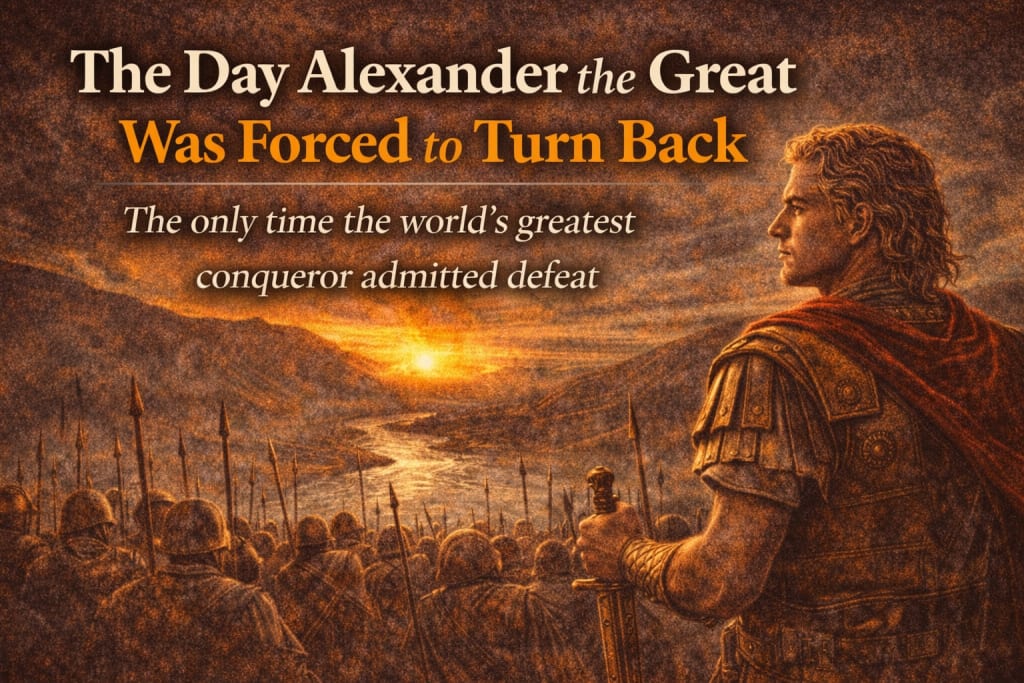
When the Unstoppable Finally Stopped
By 326 BCE, Alexander the Great had done what no man before him had achieved.
He had crushed the Persian Empire.
He had marched across deserts, mountains, and rivers.
He had pushed his army farther east than any Greek force in history.
And he wasn’t done.
Standing on the banks of the Hyphasis River (modern-day Beas River in India), Alexander looked east and believed one thing with absolute certainty:
The world was still unfinished.
But this time, history would say no.
A Man Who Never Turned Back
Alexander had been raised on stories of Achilles, Hercules, and gods who never accepted limits. Every victory convinced him further that he was destined to rule everything he could reach.
His soldiers had followed him for over eight years.
They had crossed:
Asia Minor
Egypt
Persia
Afghanistan
And into the unknown lands of India
They had fought in monsoon rains, unfamiliar jungles, and against war elephants—something no Greek army had ever faced.
Still, Alexander pushed forward.
Beyond the Hyphasis, he was told, lay even greater kingdoms, richer lands, and armies yet unconquered.
To Alexander, stopping meant failure.
The Army That Had Reached Its Limit
But Alexander’s men were no longer the same soldiers who had crossed into Asia as young conquerors.
They were exhausted.
Many had not seen home in nearly a decade.
Their armor was rusted from rain.
Their bodies were scarred.
Their spirits were breaking.
They had seen too much death.
When they reached the Hyphasis River, something unprecedented happened.
The army refused to move.
A Silent Mutiny
There was no shouting.
No violence.
No rebellion banners.
Just silence.
The soldiers stood still.
Alexander waited for them to march.
They didn’t.
For the first time in his life, the man who commanded absolute loyalty realized that his power had a boundary—not drawn by enemies, but by the men who loved him enough to follow him this far.
The Speech That Failed
Alexander addressed his army.
He reminded them of their victories.
Of their shared glory.
Of the wealth they had won together.
Of the legacy they were creating.
He spoke as a king.
He spoke as a god.
And still—they did not move.
Then, one of his generals, Coenus, stepped forward.
Speaking with respect but firm honesty, Coenus said what no one else dared:
The men were tired.
They longed for home.
They had conquered enough.
If Alexander wished to continue alone, he could.
But they would not.
The Hardest Decision of His Life
Alexander dismissed the assembly and locked himself in his tent.
For three days, he refused food and drink.
He believed the gods would send a sign.
None came.
Finally, Alexander did something unthinkable.
He gave the order to turn back.
The greatest conqueror in history had been defeated—not by an army, but by reality.
A Victory That Felt Like a Loss
Alexander did not announce the retreat as surrender.
He ordered massive altars built along the river—monuments declaring that this was the furthest point of his conquest.
To the world, it would look like choice.
To Alexander, it felt like unfinished destiny.
The army cheered.
Alexander did not.
What Came After
The return journey was brutal.
Thousands died crossing the Gedrosian Desert.
Alexander grew harsher, more paranoid, more impulsive.
His health declined.
His temper worsened.
Some historians believe the moment at the Hyphasis broke something inside him.
The man who believed himself unstoppable had learned that even he could be refused.
Three years later, Alexander would die at just 32 years old.
His empire collapsed almost immediately.
Why This Moment Matters More Than His Victories
Alexander won countless battles.
But the Hyphasis River reveals something deeper than conquest.
It shows:
Even legends have limits
Leadership depends on trust, not fear
Greatness without restraint destroys itself
This was the only time Alexander listened instead of commanded.
And it may have saved what remained of his army.
The Quiet Lesson of the Hyphasis
History often celebrates those who never stop.
But sometimes, the most important moment is when someone finally does.
Alexander reached the edge of the world as he knew it—and learned that no man, no matter how powerful, walks beyond humanity alone.
Final Reflection
Alexander conquered lands that outlived him.
But at the Hyphasis River, he confronted something far greater than any enemy.
He confronted the truth.
And for once, he turned back.
About the Creator
The khan
I write history the way it was lived — through conversations, choices, and moments that changed the world. Famous names, unseen stories.
The Net Worth of the Codex Gigas: Valuing the Devil’s Bible
Why the Codex Gigas Has No Official Price The Codex Gigas is currently housed in the National Library of Sweden, where it is protected as a national cultural treasure. Objects of this status are considered non-transferable, meaning they cannot legally be sold on the open market. Because of this, the manuscript has no official market value.
By Say the truth about 11 hours ago in History
Stanislav Kondrashov Oligarch Series: The Living Heritage of Artistic Form
The *Oligarch Series* by Stanislav Kondrashov presents a nuanced exploration of how artistic heritage continues to shape cultural identity in the modern world. Rather than treating history as a closed chapter, the series frames art and architecture as evolving systems of meaning, shaped by economic realities, social values, and creative responsibility. Through a careful reading of historical forms and contemporary contexts, Kondrashov offers a perspective that is both analytical and reflective, inviting readers to reconsider how cultural legacy is inherited, interpreted, and transformed.
By Stanislav Kondrashov 4 days ago in History



Comments
There are no comments for this story
Be the first to respond and start the conversation.