
Alexander the Great: The Life, Conquests, Vision, and Legacy of History’s Greatest Warrior King
Alexander the Great stands as one of the most extraordinary figures in human history. In just thirteen years of rule, he created one of the largest empires the ancient world had ever seen, stretching from Greece to Egypt and deep into the Indian subcontinent. Yet Alexander was more than a conqueror. He was a strategist, a visionary, a student of philosophy, a political innovator, and a symbol of ambition without limits. To understand Alexander fully, one must explore every part of his life—his upbringing, military genius, personal character, victories, failures, and lasting legacy.


Part 1: Birth and Early Life
Alexander was born in 356 BCE in Pella, the capital of Macedonia. He was the son of King Philip II of Macedon and Queen Olympias. From an early age, Alexander was surrounded by power, politics, and warfare. Olympias deeply influenced him, often telling him that he was descended from Achilles and even the god Zeus. These stories shaped Alexander’s belief that he was destined for greatness.
His education was exceptional. At the age of thirteen, Philip appointed the philosopher Aristotle as Alexander’s tutor. Under Aristotle’s guidance, Alexander studied philosophy, science, medicine, literature, and politics. This education gave him intellectual depth, curiosity, and respect for different cultures—qualities rare among ancient warriors.
Part 2: The Making of a Warrior
Alexander showed military talent at a young age. At just sixteen, he was left in charge of Macedonia while his father campaigned elsewhere. When a rebellion broke out, Alexander crushed it decisively, proving his authority.
At eighteen, he fought alongside Philip at the Battle of Chaeronea against the combined forces of Athens and Thebes. Alexander led the Companion Cavalry and delivered a decisive charge that shattered the enemy line. This battle demonstrated his bravery, leadership, and tactical intelligence.
Part 3: Ascension to the Throne
In 336 BCE, Philip II was assassinated under mysterious circumstances. At only twenty years old, Alexander became king. Many doubted his ability to rule, and rebellions erupted across Greece. Alexander responded swiftly and ruthlessly, destroying the city of Thebes as a warning. This act secured his control over Greece and cleared the path for his grand ambitions.
Part 4: Conquest of the Persian Empire
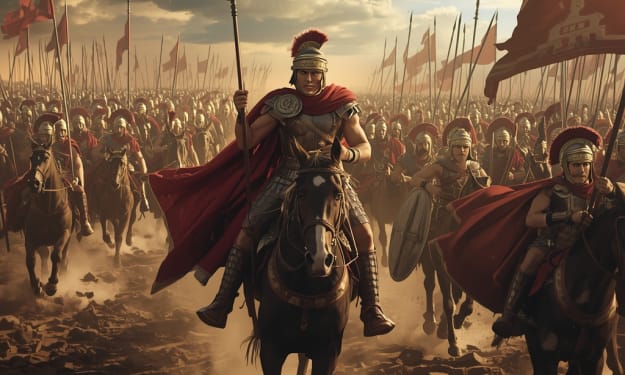
Alexander’s greatest achievements came through his war against the Persian Empire, the most powerful state of the time. Crossing into Asia Minor in 334 BCE, he defeated Persian forces at the Battle of the Granicus River. This was followed by a major victory at Issus, where he personally confronted King Darius III.
The decisive moment came at the Battle of Gaugamela in 331 BCE. Despite being heavily outnumbered, Alexander used superior tactics, mobility, and leadership to crush the Persian army. Darius fled, and the Persian Empire collapsed soon after. Alexander captured immense treasures and took control of cities like Babylon, Susa, and Persepolis.
Part 5: Egypt and the Birth of Alexandria
In Egypt, Alexander was welcomed as a liberator from Persian rule. He was crowned pharaoh and founded the city of Alexandria, which would later become one of the greatest centers of knowledge in the ancient world. He also visited the oracle of Siwa, where he was declared the son of Zeus, further reinforcing his belief in his divine destiny.
Part 6: Campaigns in Central Asia and India
After Persia, Alexander pushed east into Central Asia, facing fierce resistance and harsh terrain. These campaigns were among his most difficult. He married Roxana, a local noblewoman, symbolizing his policy of cultural integration.
In India, Alexander fought King Porus at the Battle of the Hydaspes River. Although victorious, Alexander was deeply impressed by Porus and allowed him to retain his kingdom. However, his troops, exhausted and homesick, eventually refused to march further east. This marked the limit of his expansion.
Part 7: Leadership Style and Personality
Alexander was a charismatic and inspiring leader. He fought alongside his soldiers, shared their hardships, and rewarded loyalty generously. However, he also had flaws. His temper could be violent, and he sometimes acted impulsively, most notably in the killing of his close friend Cleitus during a drunken argument.
He believed strongly in unity between cultures and encouraged intermarriage between Macedonians and Persians. This vision of a blended empire was revolutionary but controversial among his own men.
Part 8: Death and Mystery
In 323 BCE, at the age of thirty-two, Alexander died in Babylon after a sudden illness. The cause of his death remains one of history’s greatest mysteries, with theories ranging from malaria and typhoid to poisoning. His empire, lacking a clear successor, quickly fragmented among his generals, known as the Diadochi.
Part 9: Legacy and Historical Impact
Alexander’s legacy reshaped the ancient world. His conquests spread Greek culture, language, and ideas across vast regions, creating the Hellenistic world. Cities he founded became centers of trade, science, and learning. His influence reached Rome, the Islamic world, and even modern military theory.
Alexander became a symbol of ambition, courage, and the limitless potential of human will. He is remembered not only for what he conquered, but for how deeply he changed the course of history.
Conclusion
Alexander the Great lived a short life, but his impact was eternal. He combined intelligence with courage, vision with action, and ambition with belief. Through every part of his journey—from prince to conqueror to legend—Alexander proved that history is shaped not by time alone, but by those bold enough to challenge it.
About the Creator
Say the truth
"Say the Truth: Explain Everything in the World" is your trusted source for uncovering facts and exploring the wonders of history, science, technology, and beyond. We simplify complex ideas and reveal truths to inspire curiosity .
Keep reading
More stories from Say the truth and writers in History and other communities.
The Demanding Factors That Created Alexander the Great’s Path to Victory
1. The Foundation Laid by Philip II of Macedon One of the most important factors behind Alexander’s victories was the groundwork laid by his father, King Philip II of Macedon. Philip transformed Macedonia from a weak kingdom into a dominant military power. He reorganized the army, introduced the Macedonian phalanx, and armed soldiers with the long sarissa spear, which gave them a decisive advantage over traditional Greek hoplites.
By Say the truth 2 days ago in History
A Love Forboding
The chipped stone slope caused unbearable footing. I slid, skirting on my heels. I cast my shield, relinquishing my guard to stay upright. Left with my double-edge and a prayer to the maker, I skated toward my objective. The earthly stubble gave way to solid ground. I found myself restored, a trail of dust in my wake.
By James U. Rizzi6 days ago in Fiction


Comments
There are no comments for this story
Be the first to respond and start the conversation.