
The Downfall of the Ottoman Empire: Causes and Consequences
How Centuries of Internal Decay and Global Pressures Led to the Collapse of the Ottoman Empire

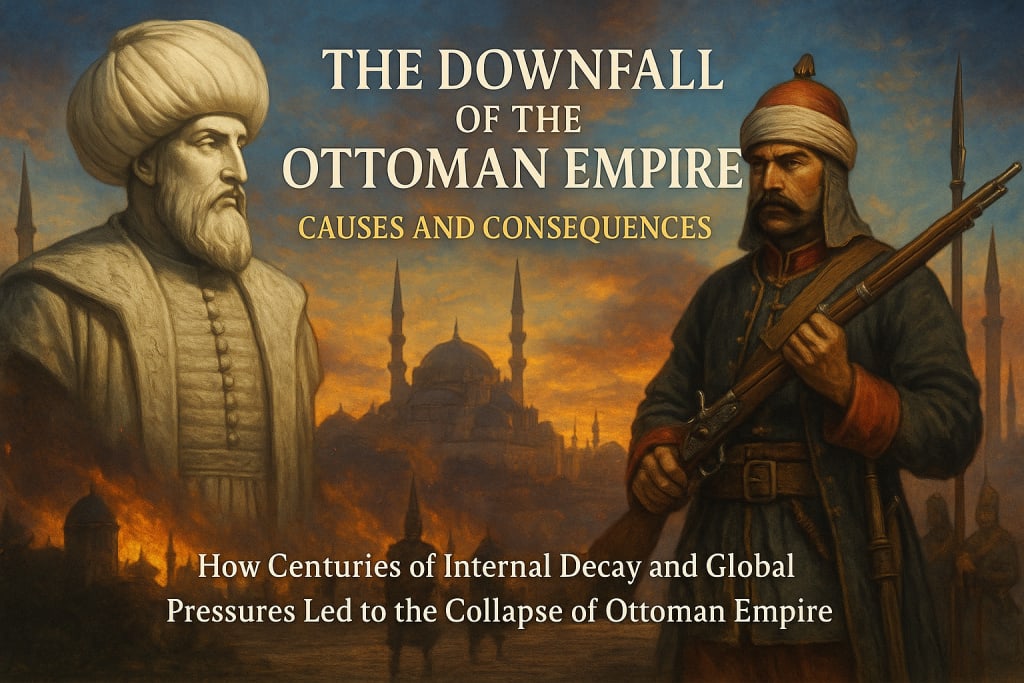
The Ottoman Empire, once a vast and powerful dynasty spanning Europe, Asia, and Africa, existed for more than six centuries. At its height during the 16th and 17th centuries, it was one of the most formidable empires in history. However, by the early 20th century, it had disintegrated into political, economic, and military chaos, eventually collapsing after World War I. The fall of the Ottoman Empire was a gradual process, marked by both internal decay and external pressures. This article explores the key causes and consequences of the empire’s decline.
---
Origins of a Superpower
Founded by Osman I in 1299, the Ottoman Empire expanded rapidly, conquering Constantinople in 1453 under Sultan Mehmed II, which marked the end of the Byzantine Empire. At its peak, the empire controlled vast regions including the Balkans, the Middle East, and North Africa. Its military strength, centralized administration, and strategic control over trade routes made it a dominant force in Eurasia.
However, beneath this power lay early signs of strain. After the death of Suleiman the Magnificent in 1566, the empire began a long, uneven decline. Over the next centuries, it would struggle to keep up with global developments while facing growing internal unrest.
---
Key Causes of Decline
1. Administrative Corruption and Weak Leadership
One of the primary causes of the empire’s decline was political corruption and the weakening of central authority. The once-effective administrative system began to falter due to nepotism, bribery, and inefficiency. Later sultans lacked the capability and vision of their predecessors. Many were inexperienced or uninterested in governance, leaving decisions to court officials, viziers, or members of the harem.
Additionally, the once-elite Janissary corps became politicized and resistant to reform. They interfered in palace politics and frequently deposed sultans, contributing to a cycle of instability.
---
2. Military Defeats and Technological Lag
From the late 17th century onward, the Ottoman military suffered a series of humiliating defeats against European powers. The 1683 defeat at the Battle of Vienna marked the beginning of territorial losses in Europe. As European armies modernized and adopted new strategies and technologies, the Ottomans failed to keep pace.
Despite efforts at military reform in the 18th and 19th centuries — including the Tanzimat reforms — the empire’s armed forces remained outdated and ineffective. Military defeats led to the loss of critical provinces and further exposed the weaknesses of the state.
---
3. Economic Decline and Debt
Economically, the empire began to stagnate as European powers developed alternative sea trade routes that bypassed Ottoman-controlled land routes. The empire’s dependence on agriculture and lack of industrialization left it economically vulnerable.
In the 19th century, the empire became heavily indebted to European creditors. To manage its finances, it granted economic concessions to foreign powers, undermining its economic sovereignty. The Ottoman Public Debt Administration, established in 1881, gave European creditors control over key aspects of the empire’s economy.
---
4. Rise of Nationalism and Ethnic Tensions
As European nationalist ideologies spread, various ethnic and religious groups within the multiethnic empire began demanding autonomy or independence. Greek independence in 1830 marked the beginning of nationalist uprisings.
The Balkans became a hotbed of rebellion throughout the 19th century. Serbs, Bulgarians, Albanians, Armenians, and Arabs increasingly resisted Ottoman rule. The empire struggled to maintain unity, and the Balkan Wars of 1912–1913 resulted in the loss of most of its European territories.
---
5. European Imperialism and the Eastern Question
European powers, including Britain, France, Austria-Hungary, and Russia, viewed the Ottoman Empire as a declining power ripe for exploitation — a concept known as the “Eastern Question.” They frequently intervened in Ottoman affairs, often under the pretense of protecting Christian minorities or maintaining peace.
Territorial encroachments, such as France’s occupation of Algeria (1830) and Britain’s control of Egypt (1882), further weakened the empire’s geopolitical standing.
---
The Final Blow: World War I
The empire’s decision to join the Central Powers in World War I proved catastrophic. During the war (1914–1918), the Ottomans faced military defeats on multiple fronts — from Gallipoli to the Arab Revolt in the Middle East. The British-backed Arab uprising, led by figures such as T.E. Lawrence, further undermined Ottoman control over the Arab provinces.
Following their defeat in 1918, the victorious Allied powers imposed the Treaty of Sèvres in 1920, effectively partitioning the empire. Istanbul was occupied, and vast territories were placed under French and British mandates.
---
The End of the Empire and Birth of Modern Turkey
The treaty sparked outrage among Turkish nationalists, led by Mustafa Kemal Atatürk. The Turkish War of Independence (1919–1923) ultimately resulted in the abolition of the Ottoman Sultanate in 1922. The Republic of Turkey was officially declared on October 29, 1923, and the caliphate was abolished in 1924.
---
Consequences and Legacy
The fall of the Ottoman Empire led to lasting consequences for the modern Middle East and southeastern Europe:
Redrawing of Borders: The former Arab provinces were divided between Britain and France, sowing the seeds for future conflicts.
Rise of Nationalism: The end of Ottoman rule allowed for the emergence of nation-states but also ignited ethnic and sectarian tensions.
Legacy of Modernization: Though the empire fell, Atatürk’s reforms aimed to modernize Turkish society and break with the Ottoman past.
---
Conclusion
The downfall of the Ottoman Empire was not the result of a single event but a gradual erosion driven by internal mismanagement, external threats, and a failure to adapt to a changing world. Its collapse reshaped the global political landscape and left a legacy that still influences international relations and regional politics today.
About the Creator
Keep reading
More stories from Engr. Mansoor Ahmad and writers in History and other communities.
The Fall of the Roman Empire: Causes and Consequences
The Roman Empire, once the most powerful civilization in the ancient world, ultimately fell after centuries of domination across Europe, North Africa, and the Middle East. Its collapse is one of history's most significant turning points, signaling the end of classical antiquity and the beginning of the Middle Ages in Europe. Understanding the fall of the Roman Empire involves a complex combination of internal weaknesses and external pressures that eroded Rome’s ability to sustain itself. This article explores the key causes behind the downfall of the Roman Empire and the enduring consequences of its demise.
By Engr. Mansoor Ahmad6 months ago in History
Alexander the Great’s Looted Wealth from India: A Historical and Economic Estimation
While his campaigns reshaped the ancient world politically and culturally, one of their most lasting impacts was the massive wealth he acquired from conquered territories, especially during his Indian campaign. This article explores the historical context, nature of the wealth looted from India, and an estimated net worth of that treasure in modern terms—revealing the truly staggering value of what came into Alexander’s hands.
By Say the truth 5 days ago in History
A woman from a vanished female dynasty was discovered buried with 270,000 beads.
In a Copper Age tomb close to Seville, Spain, the Montelirio bead assemblage contains over 270,000 beads that identify the ladies buried there as elites. The discovery is the biggest collection of beads ever
By Francis Dami2 days ago in History
Wild Card Weekend Recap: What Happens Now?
I think I figured out why I love Wild Card Weekend so much. It's because it's the first playoff anything of the calendar year. The NFL season starts in the fall, and once upon a time, the champion was crowned either on or slightly before New Year's. The evolution of the NFL schedule has resulted in the playoffs starting just into the New Year, and currently, the final week of the season falls on the first weekend of the New Year, with Wild Card Weekend coming a week after that. So yes, chronologically, the NFL's Wild Card Weekend serves as the first playoff anything of the calendar year.
By Clyde E. Dawkins4 days ago in Unbalanced


Comments (1)
amazing