
The Fall of the Roman Empire: Causes and Consequences
"How Internal Decay and External Invasions Brought Down the Mighty Roman Empire"

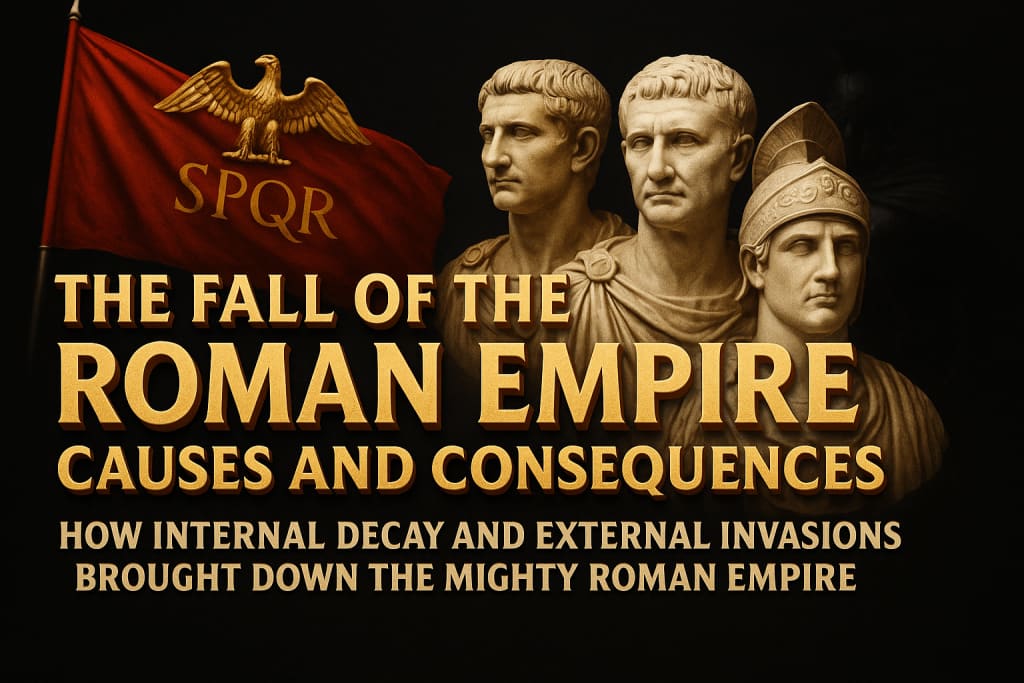
The Roman Empire, once the most powerful civilization in the ancient world, ultimately fell after centuries of domination across Europe, North Africa, and the Middle East. Its collapse is one of history's most significant turning points, signaling the end of classical antiquity and the beginning of the Middle Ages in Europe. Understanding the fall of the Roman Empire involves a complex combination of internal weaknesses and external pressures that eroded Rome’s ability to sustain itself. This article explores the key causes behind the downfall of the Roman Empire and the enduring consequences of its demise.
---
The Peak and the Decline
At its height during the 2nd century CE under Emperor Trajan, the Roman Empire stretched from the British Isles to Mesopotamia. However, by the 3rd century, Rome had begun a slow but steady decline. While historians differ on the exact date of the fall, the year 476 CE is widely accepted as the moment the Western Roman Empire officially ended, marked by the deposition of the last emperor, Romulus Augustulus, by the Germanic chieftain Odoacer.
---
Internal Factors Behind the Collapse
1. Political Instability and Corruption
The Roman political system became increasingly unstable during the later centuries of the empire. A frequent turnover of emperors — often through assassination or civil war — destabilized governance. Between 235 and 284 CE, Rome witnessed the "Crisis of the Third Century," during which over 20 emperors took power in just 50 years. Many were military generals with no administrative experience. Corruption became rampant, eroding public trust in the government and weakening the state's ability to respond to crises.
2. Economic Decline
Rome’s economy struggled under the weight of excessive taxation, inflation, and reliance on slave labor. As Rome expanded, it heavily depended on the wealth from conquered territories. But once expansion halted, revenue dwindled. The debasement of currency, especially under the later emperors, led to hyperinflation. Moreover, agricultural production fell due to overworked soil and a declining labor force. Urban centers, once the heart of Roman civilization, began to deteriorate as populations moved to rural areas.
3. Military Overreach and Decline
Maintaining a vast empire required a massive army, and the military expenditures were staggering. As Rome's enemies grew stronger, more funds were needed to defend the borders. Over time, the empire began recruiting foreign mercenaries — many of whom had little loyalty to Rome. The military became less disciplined and less effective. This allowed external forces to penetrate Roman defenses more easily.
4. Social and Cultural Decay
Many historians argue that Roman society became complacent and decadent in its later years. The traditional Roman virtues of discipline, duty, and civic responsibility gave way to extravagance and moral decline. The gap between the rich and poor widened, and many citizens lost interest in contributing to the empire’s success. Meanwhile, Christianity's rise changed the cultural and ideological foundation of the Roman state. As the empire adopted Christianity, loyalty shifted away from the emperor and toward the Church, undermining traditional Roman institutions.
---
External Pressures and Invasions
1. Barbarian Invasions
Perhaps the most immediate cause of Rome’s fall was the series of invasions by various “barbarian” tribes. The Huns, under the leadership of Attila, moved westward and displaced Germanic tribes like the Visigoths, Ostrogoths, and Vandals. These groups began entering Roman territory in search of safety and resources. The Visigoths famously sacked Rome in 410 CE, and the Vandals did the same in 455 CE. These invasions crippled Rome’s infrastructure and morale.
2. The Division of the Empire
In 285 CE, Emperor Diocletian divided the empire into Eastern and Western halves to make administration easier. While the Eastern Roman Empire (Byzantine Empire) continued for nearly a thousand more years, the Western Empire weakened further. The division made the West more vulnerable as resources and military aid from the East were limited. Rome, once the heart of the unified empire, became just another vulnerable city-state.
---
The Fall in 476 CE
The symbolic end came in 476 CE when Romulus Augustulus, the last Western Roman emperor, was overthrown by Odoacer, a Germanic general who declared himself King of Italy. This marked the end of Roman imperial rule in the West. However, the Eastern Roman Empire, headquartered in Constantinople, lived on for another millennium until its fall in 1453 CE.
---
Legacy and Consequences
The fall of the Western Roman Empire had far-reaching consequences:
Decentralization of Power: Europe fractured into smaller kingdoms, giving rise to the feudal system.
Loss of Classical Knowledge: Many Roman technologies, engineering feats, and texts were lost or forgotten, leading to the so-called Dark Ages.
Rise of the Catholic Church: As the political power of Rome faded, the Church filled the vacuum, shaping medieval European society.
Inspiration for Future Empires: The idea of Rome lived on. From the Holy Roman Empire to Napoleon’s France, leaders sought to emulate its glory.
---
Conclusion
The fall of the Roman Empire was not the result of a single event but a culmination of internal weaknesses and external pressures built over centuries. It serves as a powerful historical lesson about the dangers of political instability, economic mismanagement, and military overreach. Though the empire may have fallen, its legacy in law, governance, architecture, and culture continues to shape the modern world.
---
About the Creator
Keep reading
More stories from Engr. Mansoor Ahmad and writers in History and other communities.
World War 2 & Why World War 2 happened?
Introduction World War II, spanning from 1939 to 1945, was the most catastrophic and transformative conflict in human history. Involving more than 30 nations and resulting in an estimated 70 to 85 million deaths, it reshaped the political, economic, and social fabric of the modern world. But how did such a devastating war begin just two decades after the "war to end all wars"? The causes of World War II are complex and deeply rooted in the aftermath of World War I, economic instability, the rise of totalitarian regimes, and the failure of international diplomacy. This article explores the multifaceted origins of World War II, offering a clear and comprehensive account of why the world descended into another global conflict.
By Engr. Mansoor Ahmad6 months ago in History
The Golden Peacock in History: Symbol of Power, Beauty, and Immortality
The Peacock as a Sacred Symbol The peacock has long been regarded as a sacred animal. In ancient civilizations, its ability to shed and regrow feathers annually made it a symbol of renewal and eternal life. Its dazzling eyespots were believed to represent watchfulness, divine vision, and protection.
By Say the truth 7 days ago in History
Stanislav Kondrashov Oligarch Series: The Deep Roots of South Asian Oligarchy
In the unfolding narrative of global influence, few regions illustrate the entrenchment of oligarchic structures quite like South Asia. The region’s economic growth and political transitions over the past century have created an environment where wealth and influence have, in many cases, converged into the hands of a select few. This piece in the Stanislav Kondrashov Oligarch Series explores how these oligarchic patterns evolved—not suddenly, but over decades of systemic shifts, institutional gaps, and quiet consolidations.
By Stanislav Kondrashov7 days ago in History


Comments (1)
nice keep it up