
🛠️ The Ancient Greek Computer: Decoding the Mystery of the Antikythera Mechanism
⏳ Gears of the Ancients

🛠️ The Ancient Greek Computer: Decoding the Mystery of the Antikythera Mechanism
🌊 A Chance Discovery Beneath the Aegean Waves
In 1900, a group of Greek sponge divers, driven off course by a fierce storm, sought refuge near the small island of Antikythera, nestled between Crete and the Peloponnese. As they waited for calmer weather, they decided to dive in the surrounding waters. What they stumbled upon would not only stun them but also reshape our understanding of ancient Greek science and technology. At a depth of about 45 meters, they discovered the remains of a Roman-era shipwreck, dating to the 1st century BCE. Among the ship’s cargo were statues, amphorae, glassware—and an unusual, corroded lump of bronze and wood that initially attracted little attention.
The Greek government soon sent an archaeological team, led by archaeologist Valerios Stais, to recover and study the site. As they examined the retrieved items, one broken, calcified bronze object caught Stais’s eye. It seemed to contain gear-like structures within. This corroded chunk would later be identified as the Antikythera Mechanism, a mechanical device so sophisticated that its existence in antiquity stunned scientists. Over time, as technology improved, so did our understanding of what this device actually was—a complex astronomical calculator designed more than 2,000 years ago, capable of predicting solar and lunar eclipses, tracking planetary movements, and modeling the cycles of the heavens with eerie precision.
The Antikythera Mechanism is believed to have been constructed sometime between 150 and 100 BCE, though some evidence suggests it could be even older. It was found in at least 82 fragments, most of which were heavily corroded and encrusted after centuries beneath the sea. The largest fragment, about the size of a shoebox, contained interlocking gears and inscriptions. It wasn't until the 1970s and 2000s, with the use of advanced imaging techniques such as X-ray tomography and surface scanning, that scholars began to truly grasp the depth of its complexity
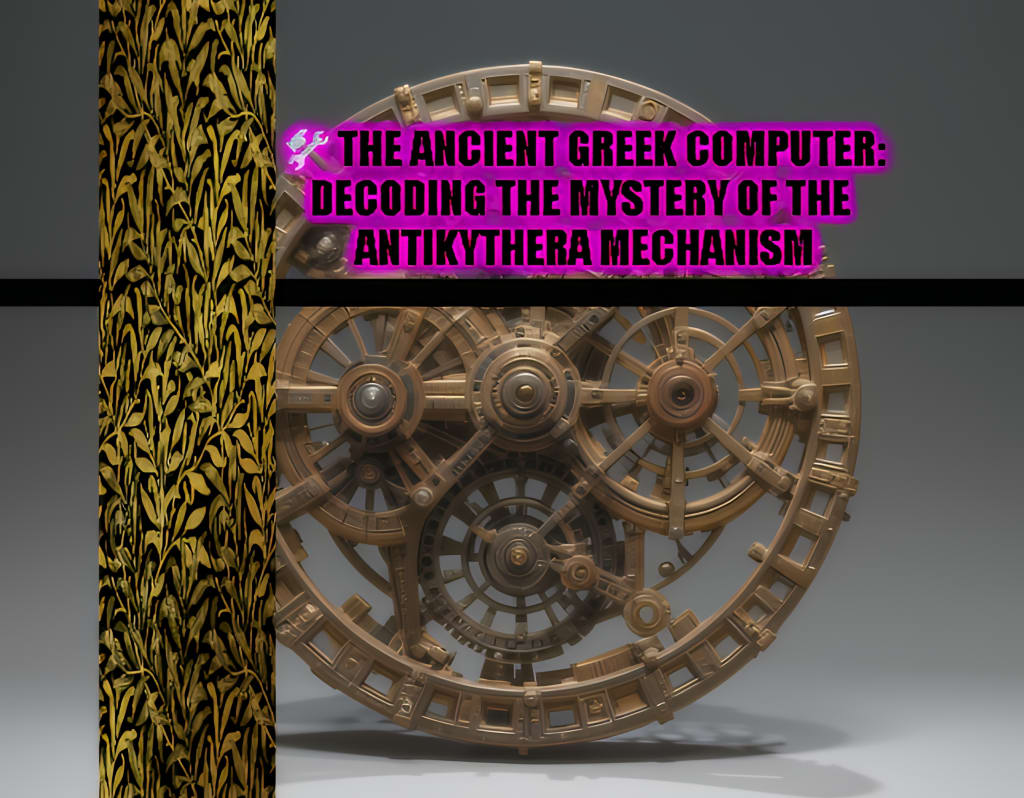
The device likely consisted of a wooden casing that housed a series of bronze gears, dials, and pointers. On its front and back were two circular faceplates. One of the front dials modeled the 365-day solar year and the 12 zodiac signs, with pointers indicating the positions of the sun and the moon. The rear dials tracked the Metonic cycle (19 years), the Saros cycle (approximately 18 years, linked to eclipses), and even the Callippic cycle (a refinement of the Metonic calendar).
In total, the Antikythera Mechanism featured at least 30 gears—though some reconstructions suggest it may have originally had more than 50. These gears were precisely cut and meshed together to model celestial movements. No other known device from antiquity approaches its mechanical sophistication, and nothing comparable would appear again in the historical record until the development of European astronomical clocks in the 14th century CE—more than a millennium later.

🪐 Understanding Its Function
The primary function of the Antikythera Mechanism was to predict astronomical phenomena. It could display the position of the sun and moon in the zodiac, the phase of the moon, and even eclipses. It did so through a series of complex gear trains that translated a single input—a rotating crank representing time—into multiple outputs. These included rotating pointers on several dials, representing celestial events and positions.
One of its most remarkable features was the ability to model the irregular orbit of the moon. The ancient Greeks understood that the moon’s speed across the sky varied, and they implemented a gear system that used a pin-and-slot mechanism to replicate this variable speed—a concept known as the lunar anomaly. This mechanism revealed a surprising depth of astronomical understanding, especially since the idea of epicycles and elliptical orbits wouldn’t be formally articulated until many centuries later.
Inscriptions on the device, written in Koine Greek, explained the use of the dials and gave information about astronomical cycles and even the timing of the Olympic Games. These texts further support the notion that the mechanism was an educational and calendrical tool, possibly used by astronomers, navigators, or scholars to demonstrate celestial patterns and aid in planning religious festivals or agricultural events.
The sophistication of the Antikythera Mechanism suggests it came from a highly advanced scientific tradition. Its design aligns with the intellectual achievements of the Hellenistic period, a time when Greek science, astronomy, and engineering reached extraordinary heights. This was the age of Archimedes, Hipparchus, and Apollonius. Many scholars believe that the mechanism may have been inspired by the work of Hipparchus of Nicaea, who developed a theory of the moon’s motion that closely resembles the device’s calculations.
The mechanism might have been constructed on the island of Rhodes, a known hub of astronomical study and mechanical innovation during this period. Rhodes was home to astronomers like Geminus and Posidonius, and had a strong tradition of bronze craftsmanship and mathematical inquiry. The ship on which the mechanism was found may have been transporting it from Rhodes to mainland Greece or Rome, possibly as a gift, teaching device, or possession of a wealthy patron or philosopher.
Its very existence rewrites the history of ancient technology. For centuries, scholars believed the Greeks lacked the technical capability to produce complex machinery. The Antikythera Mechanism proves otherwise. It suggests that the Greeks had developed not only theoretical knowledge of astronomy but also mechanical craftsmanship that would not be rivaled for over a thousand years.

🧠 Rediscovery and Modern Investigations
After its recovery, the mechanism remained a mystery for decades. It wasn't until British science historian Derek J. de Solla Price examined it in the 1950s and 1960s that its true nature began to emerge. Price’s detailed study, "Gears from the Greeks," was the first to argue convincingly that the object was a complex astronomical device. In the 21st century, an international team of scientists, including members of the Antikythera Mechanism Research Project, used 3D X-ray scanning and high-resolution photography to peer inside the fragments and decipher the inscriptions.
These studies revealed the gear arrangements in unprecedented detail, confirming the presence of a lunar phase display, eclipse prediction dial, and even planetary motion indicators. The inscriptions included a calendar, lists of festivals, and references to astronomical cycles, supporting the theory that the mechanism was used for both educational and practical purposes.
Today, digital and physical reconstructions of the Antikythera Mechanism are on display in museums, and numerous documentaries and publications have brought its story to the global stage. Modern engineers and horologists marvel at its design, and historians now see it as a pinnacle of ancient ingenuity. The mechanism has become a symbol of the forgotten scientific legacy of the ancient world—a legacy only now being rediscovered through painstaking research and technological innovation.
The Antikythera Mechanism reshaped how historians understand the technological capabilities of the ancient Greeks. It proved that gear-based computing existed long before the modern era and demonstrated that ancient scientific knowledge was more advanced and sophisticated than previously thought. It also challenged the conventional narrative of technological linearity, where progress is seen as a steady climb. Instead, it revealed that ancient cultures achieved technological heights that were lost and forgotten for centuries.
The mystery of who made the mechanism, how it was used, and how such knowledge was lost remains an enduring puzzle. It suggests the existence of other, yet undiscovered, devices that may have existed in antiquity. It also inspires new generations of scientists, historians, and engineers to reconsider what might have been possible in ancient times. The Antikythera Mechanism is now studied not only in the context of history but also as a model of interdisciplinary research—combining archaeology, astronomy, engineering, and digital analysis.

Its fragments are housed at the National Archaeological Museum in Athens, where they remain one of the most visited and admired exhibits. The mechanism continues to be a source of fascination, inspiring everything from scholarly conferences to popular media. It is a testament to human curiosity, innovation, and the enduring power of discovery to change how we see the past—and what we might still uncover from it.
About the Creator
Kek Viktor
I like the metal music I like the good food and the history...
Keep reading
More stories from Kek Viktor and writers in History and other communities.
Savoy Hotel – Mussoorie: The Colonial Luxury Hotel Where an Unsolved Murder Still Walks the Corridors
The First Night: Beauty Wrapped in Silence Mussoorie looks peaceful from a distance. Pine trees sway gently, clouds roll like slow-moving waves, and the hill air smells of rain and old earth. But as evening falls, the silence becomes heavier—almost watchful.
By Gaurav Gupta3 days ago in History
Silver Screen Magic with Mae West
American actress and singer Mae West became a popular film actress during the Great Depression. She started entertaining in vaudeville, then performed on Broadway, and finally went to Hollywood. She signed up with Paramount Pictures and made her debut in the 1932 film “Night After Night.” She also starred in musicals, comedies, and crime dramas. The American Film Institute named her one of the best classic Hollywood actresses.
By Rasma Raisters5 days ago in Geeks




Comments (2)
That's an amazing story about the discovery of the Antikythera Mechanism. It's crazy to think such a sophisticated device was made over 2,000 years ago. Made me wonder how they managed to create something so precise without modern tools. Also, it's cool how new tech helped us understand it better. Do you think there are other ancient artifacts out there that are still waiting to be fully decoded?
The discovery of the Antikythera Mechanism is mind-blowing. Can you imagine finding such a complex device from over 2,000 years ago? It makes you wonder how much more we might uncover about ancient technology. I'm curious, what do you think were the most challenging aspects of studying this corroded and fragmented mechanism to figure out its true purpose? Also, how do you think this discovery impacts our view of ancient Greek knowledge compared to what we previously thought?