
Silver Screen Magic with Mae West
Best films


American actress and singer Mae West became a popular film actress during the Great Depression. She started entertaining in vaudeville, then performed on Broadway, and finally went to Hollywood. She signed up with Paramount Pictures and made her debut in the 1932 film “Night After Night.” She also starred in musicals, comedies, and crime dramas. The American Film Institute named her one of the best classic Hollywood actresses.

In 1934, “Belle of the Nineties” was directed by the American film director, screenwriter, and producer Leo McCarey. This was a Western film based on the short story “I Ain’t No Sin” written by Mae West. It starred Mae West, Roger Pryor, John Miljan, John Mack Brown, Katherine DeMille, and Duke Ellington.
It was noted for being the premiere performance of the jazz standard “My Old Flame” performed by West with the Duke Ellington Orchestra.
The storyline is about nightclub queen Ruby Carter (West), who, trying to get away from her former beau and prize fighter, Tiger Kid (Roger Pryor), moves from St. Louis to New Orleans. Arriving in New Orleans, Ruby gets work at a popular club owned by Ace Lamont (John Miljan) and becomes the toast of the town. Tiger Kid comes to town and get chosen as a contender in a fight hosted by Lamont. He and Ruby will reconcile, and the ending is a happy one.

British-born film director and actor A. Edward Sutherland, directed the musical comedy “Every Day’s a Holiday” in 1937. The story was co-written by Mae West and was the last picture she made for Paramount Pictures. It starred Mae West, Edmund Lowe, Charles Winninger, and Charles Butterworth.
West portrayed the sultry con artist, Peaches O’Day, who runs into trouble with the law. However, the police captain Jim McCarey (Edmund Lowe) takes a liking to her. He lets her go as long as she gets out of town. Instead of leaving, Peaches disguises herself and with the help of a wealthy gentleman, Van Reighle Van Pelter Van Doon (Charles Winninger), and his butler, Larmadou Graves (Charles Butterworth), transforms herseld into a singer and performer named Fifi.
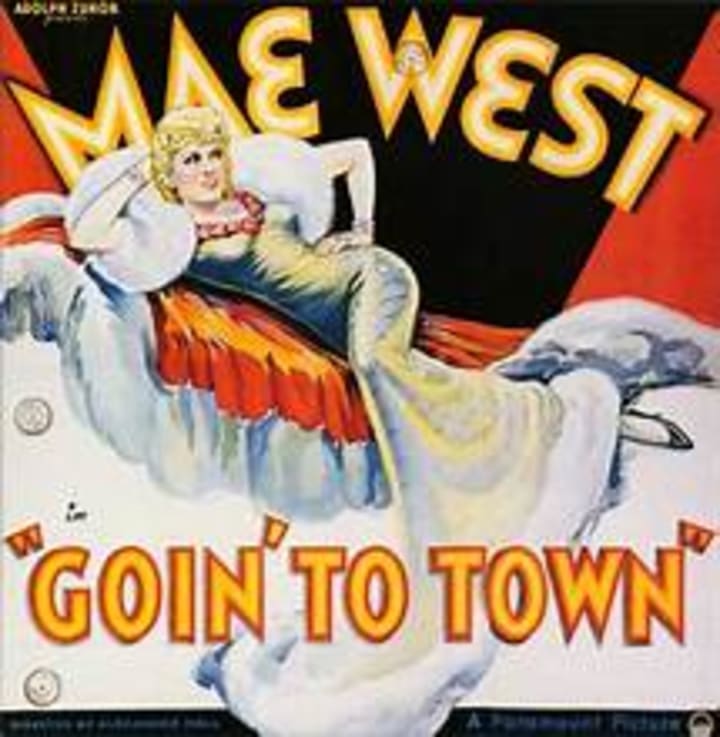
American director Alexander Hall directed the musical comedy “Goin’ to Town” in 1935. Today the film reigns as an essential pre-code film and is celebrated by many classic film fans and historians for its bold comedy and West's outstanding performance. It starred Mae West, Paul Cavanaugh, and Ivan Lebedeff.
West portrays saloon singer, Cleo Borden, who after her husband’s sudden death inherits all his wealth including his cattle ranch and several oil wells. She tries to win over wealthy British gentleman Edward Carrington (Paul Cavanaugh), who surveys the wells on her property. Then she meets Russian billionaire Ivan Valadov (Ivan Lebedeff) and must choose between the two men.

American film director and producer Henry Hathaway directed the comedy film “Go West Young Man” in 1936. The film starred Mae West, Lyle Talbot, Randolph Scott, and Warren William. The film is based on the 1934 play “Personal Appearance” by Lawrence Riley.
West portrays Mavis Arden, a movie star who is romantically involved with politician Francis X. Harrigan (Lyle Talbot). She plans to meet Francis at the next stop of her tour, but her Rolls-Royce breaks down, and she’s left stranded in a rural town. He manager Morgan (Warren William) arranges for her to stay at a local boarding house. Mavis sets her eyes on the young mechanic fixing her car, Bud Norton (Randolph Scott).
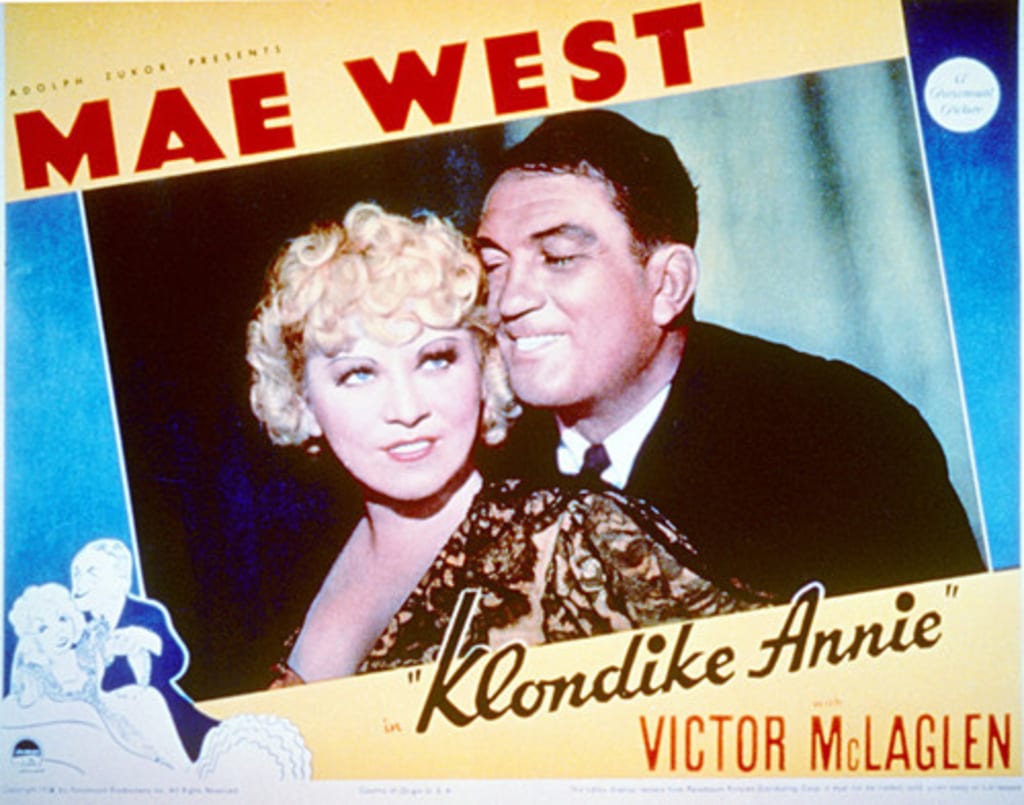
American film director and actor Raoul Walsh directed the western comedy “Klondike Annie” in 1936. The film was co-written by West and based on the 1921 stage play she wrote, “Frisco Kate.” It starred Mae West, Victor McLagen, Phillip Reed, and Helen Jerome Eddy.
West portrays Rosie Carlton, also known as The Frisco Doll. She has murdered a man in self-defense, is wanted for murder, and flees aboard a ship bound for Alaska. Onboard she meets Sister Annie Alden (Helen Jerome Eddy), who is on her way to save a mission in financial trouble. Unfortunately, Alden dies before reaching their destination and Carlton assumes her identity. She decides to save the mission.

Directed by the Russian-American actor, director and producer Gregory Ratoff Mae West starred in the musical comedy film “The Heat’s On” in 1943. After this film, West, who preferred the theater, did not make another film appearance for 27 years. The film starred West, William Gaxton, and Victor Moore. It was filmed by Columbia Pictures.
The film was about Broadway star Fay Lawrence (West) as a temperamental diva who is reluctantly persuaded by a Broadway producer to star in his latest production.
About the Creator
Rasma Raisters
My passions are writing and creating poetry. I write for several sites online and have four themed blogs on Wordpress. Please follow me on Twitter.
Keep reading
More stories from Rasma Raisters and writers in Geeks and other communities.
Silver Screen Magic with Marlene Dietrich
Marlene Dietrich came into this world on December 27, 1901, in Schöneberg, now Berlin, Germany. She was a beautiful German-American film actress who became on of the most glamorous film stars in the world. Dietrich was named the ninth-greatest screen icon from the Golden Age of Hollywood by the American Film Institute. She left this world on May 6, 1992, at the age of 90. She had one daughter, Maria Riva, who became an American actress and passed away on October 29, 2025, at the age of 100.
By Rasma Raisters2 months ago in Geeks
Spongebob Review
The episode “Hooky” opens with a bright, sun‑splashed morning in Bikini Bottom, and the camera glides lazily over the familiar pastel‑hued streets before settling on the Krusty Krabs. A perturbed Mr. Krabs warns everybody in the place that the hooks had returned and no one pays attention to him, especially Squidward. But Spongebob is interested in what Krabs has to say. He tells him once in every year, people go fishing to catch fish from up the surface and the worst part is being placed in gift shops. He delivers a stern admonition to his employee: “No fiddlin’ with hooks, lad—danger lurks in every gleam!” The warning, delivered in his trademark, gravelly drawl, is underscored by a subtle, low‑key musical cue that hints at impending mischief. SpongeBob, ever‑optimistic and perpetually gullible, immediately interprets the caution as a challenge rather than a safeguard, while Patrick, his dim‑witted yet endearing sidekick, brightens the scene with a series of delighted exclamations. He tells Spongebob that the carnival is in town and he should skip work to see it. The animation here is especially noteworthy, employing exaggerated, rubber‑like movements for the two friends as they bounce into the open sea, their eyes wide with childlike wonder—a visual language that instantly conveys both innocence and the looming sense of chaos that will soon ensnare them.
By Forest Greenabout 14 hours ago in Geeks


Comments (3)
Pretty sure I recall seeing her in many TCM
I’m curious as to why My Little Chickadee got no attention—she and WC Fields wrote their own dialogue for it, and it’s delightful. The train scene is my favorite.
There are ten men waiting to see me? Send one of them home. I’m tired.”—Mae West