Places
When Was World War 3 Started? The Date That Changed History.
It was January 12, 2031, when the first undeniable shot was fired — at least according to official records. That morning, an airstrike destroyed a major oil facility in the Persian Gulf, killing hundreds and crippling supplies for weeks. Governments around the world condemned it but blamed “unknown terrorists.” Yet intelligence agencies knew: it was a state-sponsored attack, planned and executed by one of the world’s largest armies.
By Hamd Ullah6 months ago in History
The History and Origin of Football (Soccer)
Football, or soccer as it is called in some parts of the world, is the most popular sport globally. With billions of fans and players, it commands unparalleled attention. Its history, however, is as fascinating as the game itself—rich in culture, conflict, and evolution over millennia.
By Engr. Mansoor Ahmad6 months ago in History
The Downfall of the Ottoman Empire: Causes and Consequences
The Ottoman Empire, once a vast and powerful dynasty spanning Europe, Asia, and Africa, existed for more than six centuries. At its height during the 16th and 17th centuries, it was one of the most formidable empires in history. However, by the early 20th century, it had disintegrated into political, economic, and military chaos, eventually collapsing after World War I. The fall of the Ottoman Empire was a gradual process, marked by both internal decay and external pressures. This article explores the key causes and consequences of the empire’s decline.
By Engr. Mansoor Ahmad6 months ago in History
There Is Beauty Even
When we hear the words “dark night”, a wave of fear, loneliness, and eerie silence often fills our hearts. For centuries, humans have associated the dark night with fear, danger, and uncertainty. Myths, ghost stories, and mysterious tales have painted the night as a symbol of terror.
By haider ali6 months ago in History
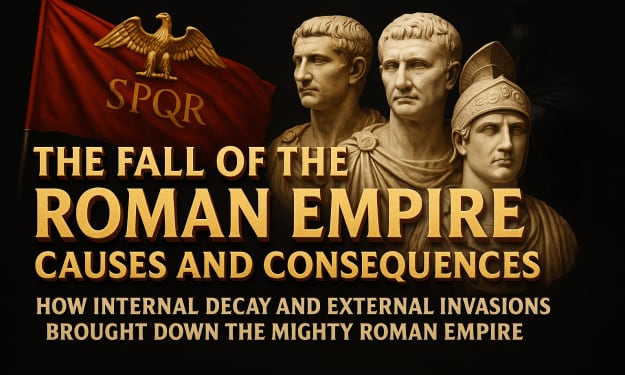
The Fall of the Roman Empire: Causes and Consequences
The Roman Empire, once the most powerful civilization in the ancient world, ultimately fell after centuries of domination across Europe, North Africa, and the Middle East. Its collapse is one of history's most significant turning points, signaling the end of classical antiquity and the beginning of the Middle Ages in Europe. Understanding the fall of the Roman Empire involves a complex combination of internal weaknesses and external pressures that eroded Rome’s ability to sustain itself. This article explores the key causes behind the downfall of the Roman Empire and the enduring consequences of its demise.
By Engr. Mansoor Ahmad6 months ago in History
How a Man Got Trapped Forever in Nutty Putty Cave
A man named John Edward Jones entered a cave near Utah Lake with the intention of exploring. During his adventure, he decided to reach the narrowest part of the cave to set a new record. But little did he know that this decision would turn out to be the last of his life. The cave was known as Nutty Putty Cave, famous for its tight and twisted passages. As John crawled deeper into the cave, he accidentally took a wrong turn and ended up in a part where no one had ever been before. It was as tight as a coffin, making it nearly impossible to move—even breathing was difficult. Unfortunately, John got stuck in this position—head down, feet up, in a space so narrow that even moving his arms was impossible.
By Jehanzeb Khan6 months ago in History
The Precambrian Eon: The Forgotten Era Where It All Began
Long before dinosaurs, trees, or even the oxygen we breathe existed, there was an era that marked the beginning of everything—the Precambrian Eon. Spanning from Earth's formation over 4.6 billion years ago to 540 million years ago, this colossal period represents a staggering 88% of our planet's history. Yet, it remains one of the least understood chapters in Earth’s story.
By denizan Lawyer6 months ago in History
Letters from the Empire
Prologue: The Ottoman Empire—spanning over six centuries, three continents, and countless souls—was not merely built on conquest or sultans’ decrees. It lived in the hands that planted its gardens, sailed its ships, marched in its armies, and whispered secrets in its palaces. These are the letters they left behind.
By Salah Uddin6 months ago in History
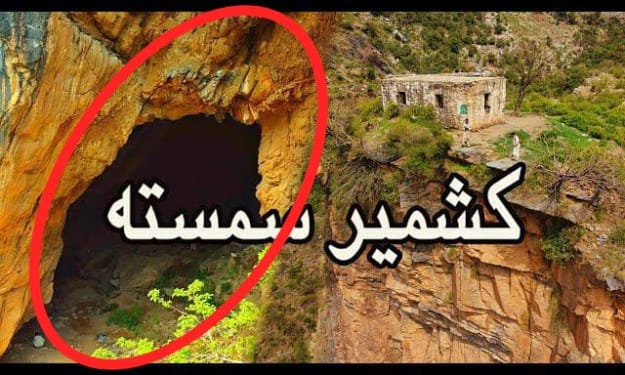
The Kashmir Smast. Secrets of the Buddhist Caves of Katlang, Mardan Pakistan.
Who Lived Here? The Kashmir Smast was once home to Buddhist monks, spiritual leaders, and scholars. The word Smast itself comes from the Sanskrit word Samasta, meaning “cave” or “temple”. It is believed that these caves were first occupied in the 4th century CE, at the height of the Gandhara civilization, which was famous for its art, learning, and devotion to Buddhism.
By Hamd Ullah6 months ago in History