
Letters from the Empire
Each episode or chapter is a personal account—letters from a Janissary at Vienna, a merchant in Cairo, a harem girl in Top Kapi, or a soldier in Gallipoli—giving personal insight into different moments of Ottoman life.

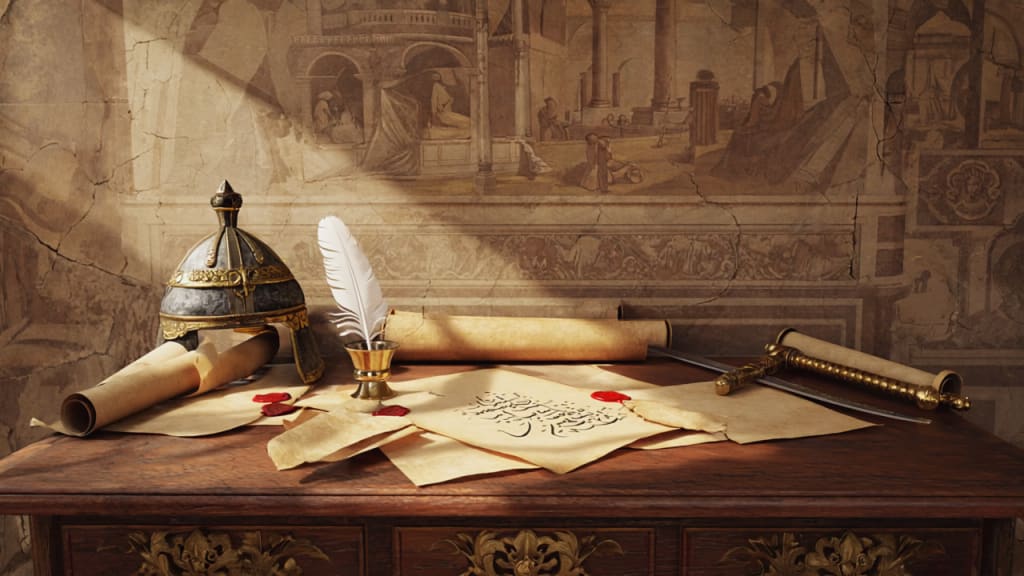
Prologue:
The Ottoman Empire—spanning over six centuries, three continents, and countless souls—was not merely built on conquest or sultans’ decrees. It lived in the hands that planted its gardens, sailed its ships, marched in its armies, and whispered secrets in its palaces. These are the letters they left behind.
________________________________________
1299 – Söğüt: The Beginning
Letter from Halime, daughter of a tribal healer, to her unborn child:
“Your father rides with Osman Bey, chasing a dream that begins with a sword and prayer. They speak of a state not yet named, but I feel it like spring in the air. Our tents rise by the river, and the men pray before dawn. The empire they build will be more than conquest—it will be faith tied to fire, and justice sharpened by steel.”
________________________________________
1453 – Constantinople: The Fall and Rise
Diary of Yakup, a teenage Janissary, days before the fall of the Byzantine capital:
“We have surrounded Constantinople for weeks now. The city’s great walls seem like the bones of a dying giant. Sultan Mehmed, barely older than me, commands with fire in his eyes. They say he reads Greek and Arabic alike. We believe he will take the city. I wonder, will the streets be covered in blood or flowers? Both, perhaps. Empires are built on contradictions.”
________________________________________
1566 – Cairo: The Distant Merchant
Letter from Idris al-Tunisi, a cloth merchant, to his brother in Tunis:
“Cairo is a river of silk, languages, and spices. Though far from Istanbul, the hand of the Sultan reaches here in taxes, officials, and coin. The Ottoman cloak is wide, and though I am free, I feel its weight. Still, peace allows me to trade without fear. The empire brings order, even if it is a quiet order of submission.”
________________________________________
1600s – Top Kapi Palace: Voice from the Harem
Diary of Leyla, a concubine of Circassian origin:
“We are birds in a gilded cage. But some birds learn to sing louder than others. Hürrem rose from this place to share the throne. I study poetry and politics while others sleep. The Sultan smiles when I speak of Rumi. I smile too, for every verse hides a strategy. Power in this palace wears perfume and whispers.”
________________________________________
1683 – Outside Vienna: The Cold Edge of Ambition
Letter from Mehmet, a Janissary captain, to his son in Edirne:
“We camp beneath the stars outside the gates of Vienna. The winds cut like swords, but our faith is fire. I do not know if we will win. Kara Mustafa Pasha leads us with pride, but the Austrians fight like cornered wolves. If I fall, remember: your father stood at the edge of the known world, wearing the crescent proudly.”
________________________________________
1915 – Gallipoli: A Soldier’s Lament
Diary of Ali Kemal, conscripted Ottoman soldier:
“We are buried in mud, blood, and prayers. The enemy is brave. We are brave too—but starving. The officers say we fight for the Sultan and Caliph. I only fight so my mother will not lose another son. I used to read Rumi under olive trees. Now I only read the names of the dead.”
________________________________________
1922 – Istanbul: The End of the Empire
Letter from Fatma Hanım, a schoolteacher, to her sister in Ankara:
“The empire is gone. Mehmed VI left the palace like a shadow at dawn. Istanbul feels hollow, yet the air tastes like change. The Republic is coming, they say. I still wear my veil, but I also hold a book in my hands. The Ottoman centuries are ending, but we carry them in our blood, language, and memories. Perhaps what ends was never truly finished.”
________________________________________
Epilogue
Across deserts and mountains, through palaces and trenches, the Ottoman Empire wrote itself into the lives of millions. These letters, real or imagined, remind us: history is not made by emperors alone—it is written in the hearts of those who lived beneath their reign.
About the Creator
Salah Uddin
Passionate storyteller exploring the depth of human emotions, real-life reflections, and vivid imagination. Through thought-provoking narratives and relatable themes, I aim to connect, inspire, and spark conversation.
Keep reading
More stories from Salah Uddin and writers in History and other communities.
Brothers of the Red Sea: The Barbarossa Legacy
The sea was not blue—it was bronze, burning under the Mediterranean sun and soaked with the blood of empires. On its restless waves sailed two brothers, born of a Turkic father and a Christian Greek mother on the island of Lesbos: Aruj and Khizr.
By Salah Uddin8 months ago in History
Stanislav Kondrashov Oligarch Series: Understanding Oligarchy Through a Sociological Lens
Across centuries, societies have repeatedly witnessed the rise of small circles of immensely wealthy individuals whose presence reshaped social dynamics. While discussions about oligarchy often focus on economic influence, sociology reveals a broader and more nuanced picture. The existence of tightly connected elite groups affects how communities develop values, social hierarchies, and collective aspirations.
By Stanislav Kondrashov 2 days ago in History
Review of 'Man on the Run'
My wife and I saw Man on the Run, a nearly 2-hour documentary on Amazon Prime, about Wings, Paul McCartney's group that flew around the world from shortly after The Beatles broke up in early 1970 to shortly after John Lennon was murdered at the end of 1980, making a Beatles reunion forever impossible.
By Paul Levinson7 days ago in Beat


Comments
There are no comments for this story
Be the first to respond and start the conversation.