Medieval
Ukraine says at least 40 Russian warplanes hit in massive drone strikes
**Ukraine asserts that over 40 Russian warplanes were hit by massive drone strikes** Ukraine has claimed responsibility for a massive drone strike that allegedly damaged or destroyed more than 40 Russian warplanes across several key airbases, escalating its military campaign dramatically. Officials in Ukraine say that the attack, which took place in the early morning hours of June 1, 2025, was one of the largest and most successful drone operations since the war with Russia began. The operation, codenamed "Spider Web," targeted several Russian airfields, including Olenya in Murmansk Oblast, Diaghilevo in Ryazan Oblast, Belaya in Irkutsk Oblast, and Ivanovo Severny in Ivanovo Oblast, according to Ukraine's Security Service (SBU). Strategic bombers like the Tu-95 and Tu-22M3 as well as the A-50 airborne early warning aircraft are known to be housed at these bases. Ukrainian sources shared footage that showed several aircraft clearly engulfed in flames as thick black smoke rose from some of the affected bases. While Russia has acknowledged that drone attacks have occurred in specific locations, the country has yet to provide an official count of the damage. Access restrictions and ongoing military activity limit independent verification. The fact that this operation was the result of more than a year of planning and development has been emphasized by the Ukrainian government. In order to circumvent radar detection and air defenses, the reportedly used drones were launched from concealed mobile platforms inside Russian territory. Considering the disparity in long-range missile capabilities between the two nations, this strategy represents a significant shift in Ukraine's military tactics. According to Ukrainian officials, the operation involved the simultaneous deployment of more than 70 drones. demonstrating Kyiv's growing reliance on domestically produced weapons, many of these were indigenously developed systems. This, according to analysts, is a direct response to Ukraine's urgent need to expand its strategic reach and restrictions on Western weapons deliveries. Russia used more than 470 drones and a number of missiles to launch its own massive assault on Ukrainian territory in response to the drone attack. A Ukrainian military training facility was hit by one of these missiles, killing at least 12 soldiers and injuring more than 60 others. The tit-for-tat strikes are a significant step up in drone warfare, a strategy that is increasingly defining this contemporary conflict. The drone operation is viewed as a strategic and symbolic success by the Ukrainian government. Ukraine intends to challenge the concept of safe havens far from the front lines and hinder Russia's ability to launch aerial attacks against Ukrainian infrastructure by striking deeply into Russian territory. In the near future, Russia's capacity for coordinated missile strikes and aerial intelligence gathering may be diminished by damaging strategic bombers and surveillance aircraft. In contrast, the strikes by drones occur just a few days prior to the planned international peace talks in Istanbul. The international community is keeping a close eye on the negotiations because Ukraine has confirmed its participation. The timing of such a well-publicized attack raises concerns regarding its potential to influence diplomatic discussions or international perceptions of Ukraine's military resolve. Experts warn that while the attack demonstrates Ukraine's inventiveness and tenacity, it may also elicit harsh Russian retaliation. Nevertheless, the operation highlights a significant shift in contemporary warfare, in which battlefield dynamics are increasingly altered by drones and asymmetric strategies. The skies over Ukraine and Russia may become even more tense as both nations invest in unmanned aerial capabilities. Long-range drone strike technologies could continue to advance, not just in Ukraine but around the world, if the operation in Ukraine is successful. Drone warfare may now be the central battleground in a war that has already reshaped the geopolitical landscape of Eastern Europe with no end in sight and both sides indicating firm military resolve.
By GLOBAL NEWS8 months ago in History
Alexander the Great and the Indian Subcontinent
In 327 BCE, Alexander the Great, already a legend across the known world, gazed eastward toward a land few Greeks had ever seen—India. Having conquered Persia and stood victorious over mighty kings, Alexander sought new horizons. His ambition was as vast as his empire, and beyond the towering Hindu Kush mountains lay the fabled riches of the Indian subcontinent.
By Muhammad Saeed8 months ago in History
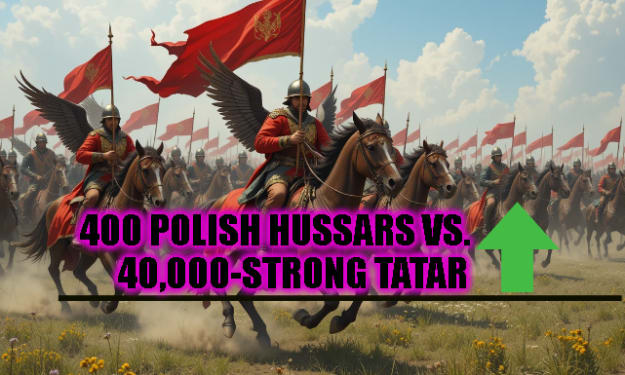
🛡️When 400 Polish hussars resisted a 40,000-strong Tatar force
The Battle of Hodów, fought in the summer of 1694, stands out as one of the most extraordinary confrontations in the history of the Polish-Lithuanian Commonwealth. This clash between a small detachment of approximately 400 Polish hussars and a massive Tatar raiding force, estimated at around 40,000 warriors, has become legendary as a symbol of valor, discipline, and tactical genius. Often called the “Polish Thermopylae,” the Battle of Hodów showcases how steadfast courage and military skill can defy overwhelming odds.
By Kek Viktor8 months ago in History
⚔️ The Lindisfarne Raid of 793: The Thunder Before the Storm of the Viking Age 🛡️
In the year 793 CE, a catastrophe unfolded on the eastern shores of Anglo-Saxon England that would echo across the continent and mark the beginning of one of the most transformative eras in European history: the Viking Age. This event, the violent raid on the monastic island of Lindisfarne, was not the first Scandinavian incursion into the British Isles, but it was the first to shock contemporary chroniclers so deeply that it made its way into the annals of medieval history as a moment of divine terror and political warning. It is now recognized by historians as the symbolic start of nearly three centuries of Norse expansion, violence, exploration, and cultural exchange.
By Kek Viktor8 months ago in History
The World’s Most Beautiful Bucket-List Castles, Ranked ...
The World’s Most Beautiful Bucket-List Castles, Ranked 1. Germany's Neuschwanstein Castle Perched high in the Bavarian Alps, Neuschwanstein Castle looks like something straight out of a fairy tale—because it literally inspired Disney’s Sleeping Beauty Castle. Built by the reclusive King Ludwig II in the 19th century, its soaring turrets and dramatic cliffs make it the most photographed castle in the world.
By parves mosharaf8 months ago in History
🛡️The Viking Shield Wall Which Changed The Viking Age
🛡️The Viking Shield Wall Which Changed The Viking Age The Viking shield wall stands as one of the most iconic military formations in medieval warfare, a symbol of Norse martial prowess and tactical discipline that played a crucial role in the Viking Age (c. late 8th to 11th centuries). More than just a static defensive line, the shield wall was a dynamic and adaptable formation that allowed Viking warriors to excel in varied combat scenarios—from brutal open-field battles and lightning raids to sieges, urban warfare, and even amphibious landings. This article explores the shield wall’s construction, tactical function, and its pivotal role in key Viking battles that shaped European history.
By Kek Viktor8 months ago in History
🛡️ The Greek Phalanx: The Shield Wall That Changed the Ancient World
The Greek phalanx stands as one of the most iconic and influential military formations in world history, epitomizing the unique fusion of military innovation and societal structure that defined classical Greece. Emerging from the gradual militarization and social development of Greek city-states (poleis) during the early Archaic period (circa 8th century BCE), the phalanx embodied a collective approach to warfare, based on discipline, unity, and the combined strength of heavily armed infantry known as hoplites. This formation was not merely a tactical arrangement but a reflection of the social and political dynamics of Greek society, where military service and citizenship were deeply intertwined.
By Kek Viktor8 months ago in History
Artifacts and Finds on Oak Island: Spanish Gold, Templar Clues, and Echoes From 700 Years Ago
The dirt on Oak Island doesn’t just cover soil and stone. It covers secrets. For more than two centuries, men and machines have clawed into this cursed ground, chasing whispers of treasure and truth. And while no vault has yet been fully opened, the earth has spoken in fragments.
By Rukka Nova8 months ago in History