
🪣 The War of the Bucket (1325) — Italy’s Most Absurd Battle Over a Wooden Pail
⚔️War for Nothing

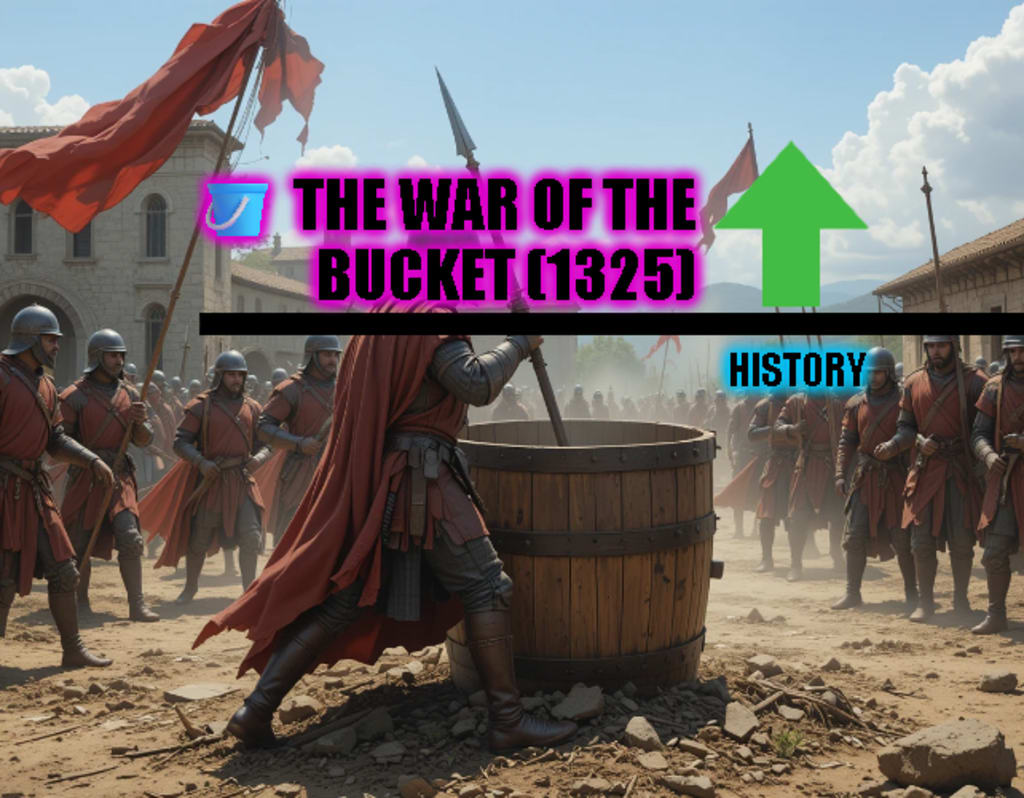
🪣 The War of the Bucket (1325) — Italy’s Most Absurd Battle Over a Wooden Pail
⚔️ Italy in the 14th Century – Guelphs, Ghibellines, and Growing Tensions
To understand the ridiculous conflict known as the War of the Bucket, one must first look at the political chaos that plagued medieval Italy. During the 13th and 14th centuries, Italy was a divided land, not by borders, but by loyalties. Two major factions dominated the political scene: the **Guelphs**, who supported the Pope, and the **Ghibellines**, who were loyal to the Holy Roman Emperor. These two sides had been fighting bloody conflicts across northern Italy for generations, with entire cities aligning with one faction or the other.
📍 Modena aligned with the Ghibellines. The city had a strong aristocratic structure and leaned toward imperial rule, valuing order, hierarchy, and central governance. Modena’s elites were often educated in classical law and military theory, fostering a class of civic leaders who prioritized structure and allegiance to the Emperor. This made Modena not just an ideological opponent to Guelph cities, but also a strategic bulwark for the Empire in northern Italy.
📍 Bologna, on the other hand, was staunchly Guelph. The city was a bastion of papal authority, republican ideals, and strong civic independence. It was also a wealthy and powerful center of trade and education, housing one of the oldest universities in Europe. Bologna prided itself on being a cultural beacon and a guardian of ecclesiastical law. Its alliance with the Pope wasn’t merely political—it was spiritual and deeply ingrained in its civic identity.
This political rivalry wasn’t just ideological—it often broke out into open warfare. City-states like Florence, Siena, Parma, and Pisa frequently took sides in local feuds that spiraled into large-scale military campaigns. Castles were built and destroyed. Towns changed hands repeatedly. Raiding parties and assassination plots were commonplace. Every diplomatic meeting carried the risk of a swordfight breaking out.
By the early 14th century, the hatred between Bologna and Modena had simmered for decades. Numerous skirmishes, raids, and sieges had already created a long-standing grudge. Feudal lords allied to either side fueled the rivalry with private vendettas. Mercenaries from France and Germany often joined the fray, adding to the chaos. The smallest provocation could tip the balance into full war—and that’s exactly what happened in 1325.

🪣The Bucket is Stolen – A Spark in the Powder Keg
The inciting incident that sparked the War of the Bucket was both comical and tragic. In 1325, a group of Modenese soldiers conducted a raid on Bologna. Such incursions were common—soldiers often looted livestock, destroyed crops, or kidnapped villagers. But this time, the raiders stole something different: a wooden bucket from a public well in Bologna.
This wasn’t just any bucket. It was a symbol of Bolognese municipal pride. Located in the city’s central square, the well and its bucket represented the communal life of Bologna. It was where townsfolk gathered, gossiped, and fetched water for their homes. Its theft wasn’t just petty—it was interpreted as a deep humiliation and insult. The Modenese paraded the bucket back to their city as a trophy.
📣 Bologna, enraged by the act, demanded the return of the bucket. Modena refused. What should have been resolved diplomatically escalated rapidly. For Bologna, the theft was a call to arms. To reclaim the bucket meant reclaiming their honor.
🪧 The bucket incident quickly became a rallying cry. Bolognese priests preached from pulpits about the dishonor done to the city. Street performers recited epic poems blaming Modena for their treachery. Blacksmiths forged weapons while merchants donated funds to raise an army. Soon, the conflict shifted from local outrage to a full-blown military mobilization.
Historians still debate whether the bucket was the true cause of war or just the excuse. It’s likely that Bologna had been waiting for a reason to attack Modena for years, and the stolen pail gave them the moral high ground to rally support. What is certain is that both cities mobilized thousands of troops in response.
🔔 Political alliances also came into play. Bologna called on its Guelph allies in Florence and Lucca, while Modena summoned Ghibelline support from Parma and Cremona. Within weeks, armies were on the move, banners flying, and knights sharpening their blades for a war that would be remembered for centuries—for all the wrong reasons.

The Battle of Zappolino – Where Honor Met Absurdity
On November 15, 1325, the armies of Bologna and Modena clashed at Zappolino, a small village in the rolling hills between the two cities. Bologna marched into battle with around 32,000 men, a coalition of Guelph allies, citizen militias, and mercenaries. Modena, outnumbered with 7,000 Ghibelline soldiers, prepared to defend their territory with cunning strategy.
🎖️ Despite being the smaller force, the Modenese army was better trained, more cohesive, and better led. Their commanders understood the terrain and used it to their advantage. The Bolognese army, large but disorganized, underestimated their opponents. Confidence turned into overconfidence, and overconfidence into tactical blunders.
Modena’s commander, Bonacolsi da Mantova, employed swift cavalry charges and baiting maneuvers to split the Bolognese line. Forested terrain and narrow valleys helped the Ghibellines hide their troops and launch ambushes. Archers fired from high ground while lancers cut through exposed infantry formations.
The Bolognese, confused and poorly coordinated, began to fall apart. Guelph knights became separated from infantry. Entire battalions lost contact with command. Rumors of betrayal began to spread within their ranks. What was intended to be a decisive blow in the name of honor turned into a disastrous rout. Over 2,000 Bolognese soldiers were killed or captured.
🏃 The rest fled back to the city in humiliation, many leaving behind their weapons and supplies. In the aftermath, Modenese troops advanced toward Bologna’s gates—but instead of continuing the siege, they did something unexpected: they planted a new well just outside the city and mocked the Bolognese by hanging another bucket on it.
🪣 The original bucket remained firmly in Modena’s possession, while the second served as a literal symbol of their mockery—rubbing salt in Bologna’s wounded pride.
Following the stunning victory at Zappolino, the war effectively ended in Modena’s favor. Though Bologna was not conquered, it suffered a deep blow to its military reputation and political standing among the Guelph cities. The loss of life, morale, and prestige made the defeat even harder to swallow—especially since the whole war had started over a bucket.
📦 As for the bucket, it was placed in Modena’s Torre della Ghirlandina, the city’s bell tower. There it remained, mounted on public display as a war trophy and symbol of Modena’s victory over its longtime rival. The bucket still hangs in the tower today, a testament to one of the strangest causes for war in European history.
🗣️ In Bologna, the war became a source of bitter memory and mockery. Poets and chroniclers in the decades that followed often mentioned the bucket war in jest. Some Bolognese officials tried to downplay the war’s significance or avoid discussing it altogether.
📜 Politically, the outcome solidified Ghibelline influence in the region for some time. Modena emerged stronger and more confident, while Bologna’s influence temporarily waned. Trade routes were disrupted, local nobles realigned allegiances, and papal emissaries were sent to patch up the fractured alliance.
Bologna spent years rebuilding its army and reputation. Citizens quietly grumbled about the folly of pride and politics. Artistic depictions of the war—often allegorical or satirical—began appearing in frescoes, manuscripts, and puppet plays, blending historical bitterness with comedic relief.
Despite its absurd origin, the War of the Bucket remains a powerful lesson in the politics and absurdities of medieval Europe. It is often cited in political science and history courses as an example of how minor disputes can escalate into major conflicts when pride and ideology are involved.
🎭 Writers and historians have never let go of the war’s comedic potential. In the 17th century, Italian poet Alessandro Tassoni wrote La Secchia Rapita (“The Stolen Bucket”), a mock-heroic epic that immortalized the war with satire and exaggeration. The poem was wildly popular and cemented the bucket as a symbol of Italian absurdism.
🎨 In museums and literature, the war remains a favorite anecdote. Historical reenactments and lectures often use the story to demonstrate the bizarre but very human causes of conflict. The bucket, now a museum artifact, draws curious tourists and history lovers alike. Schoolchildren in Italy often learn the tale as part of cultural heritage lessons.

🕊️ More broadly, the War of the Bucket reminds us that wars are not always fought over resources or survival. Sometimes, they’re fought over honor, symbols, and perceived slights—elements that continue to spark conflict in our world today.
🌍 As a symbol of both comedy and tragedy, the bucket has transcended its humble function to become an artifact of collective memory—a reminder that the smallest spark can ignite the largest blaze.
From a stolen pail to a battlefield of thousands, the War of the Bucket is a tale of pride, rivalry, and how far humans will go to defend even the most trivial things. 🪣💥
About the Creator
Kek Viktor
I like the metal music I like the good food and the history...
Keep reading
More stories from Kek Viktor and writers in History and other communities.
🪖Top 7 Submachine Guns of World War II
🪖Top 7 Submachine Guns of World War II MP40 — The Backbone of German Firepower The **MP40**, known as the Maschinenpistole 40, became one of the most iconic and widely used submachine guns of Nazi Germany during World War II. It was developed as a successor to the MP38, streamlining the design for mass production using stamped steel and bakelite, which made it cheaper and faster to manufacture. The MP40 was chambered in 9x19mm Parabellum and had a relatively low rate of fire at approximately 500–550 rounds per minute, allowing for better control in full-auto fire. It featured an open-bolt blowback action and a 32-round magazine, though the magazine was prone to jamming if not handled carefully.
By Kek Viktor8 months ago in History
A secret staircase found beneath a 1,500-year-old French church
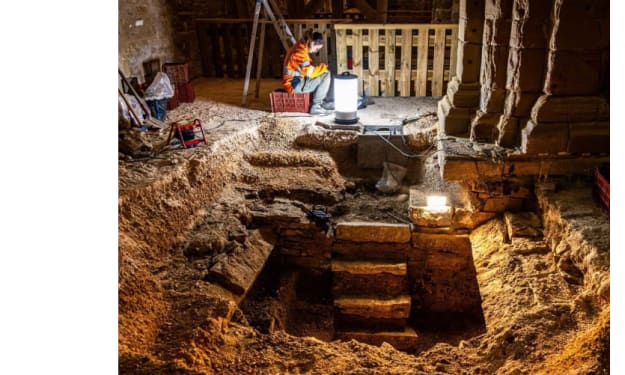
A subterranean staircase and burial strata dating back approximately 1,500 years were discovered during a project inside the Church of Saint Philibert in Dijon, France. The stairs were discovered by restoration workers inside the church when repairs were being made, and the excavation soon ensued.
By Francis Dami5 days ago in History
Martin Luther King's 'I Have a Dream' Speech: Things People Still Don't Know
Former President Ronald Reagan declared the third Monday in January to be Martin Luther King Jr. Day to celebrate the slain civil rights activist. Had he lived, he would be celebrating his birthday at age 97 on January 15, 2026, but he was assassinated at the young age of 39 on April 4, 1968.
By Margaret Minnicksa day ago in History



Comments
There are no comments for this story
Be the first to respond and start the conversation.