
Alexander the Great and the Indian Subcontinent
A Clash of Empires at the Edge of the Known World


In 327 BCE, Alexander the Great, already a legend across the known world, gazed eastward toward a land few Greeks had ever seen—India. Having conquered Persia and stood victorious over mighty kings, Alexander sought new horizons. His ambition was as vast as his empire, and beyond the towering Hindu Kush mountains lay the fabled riches of the Indian subcontinent.
Crossing into present-day Pakistan, Alexander and his army encountered rivers wider than any in Greece, forests teeming with strange beasts, and cities carved in stone. The first Indian ruler he met was King Ambhi of Taxila, who chose diplomacy over resistance. He welcomed Alexander with gifts and troops, seeking alliance rather than war. But not all Indian kings would kneel so easily.

News soon reached Alexander of a proud and powerful ruler named Porus (Purushottama), who reigned beyond the Hydaspes River. Unlike Ambhi, Porus had no intention of surrendering. He raised a formidable army, including chariots, cavalry, and the most feared of all—war elephants, massive beasts unknown to Greek warfare.
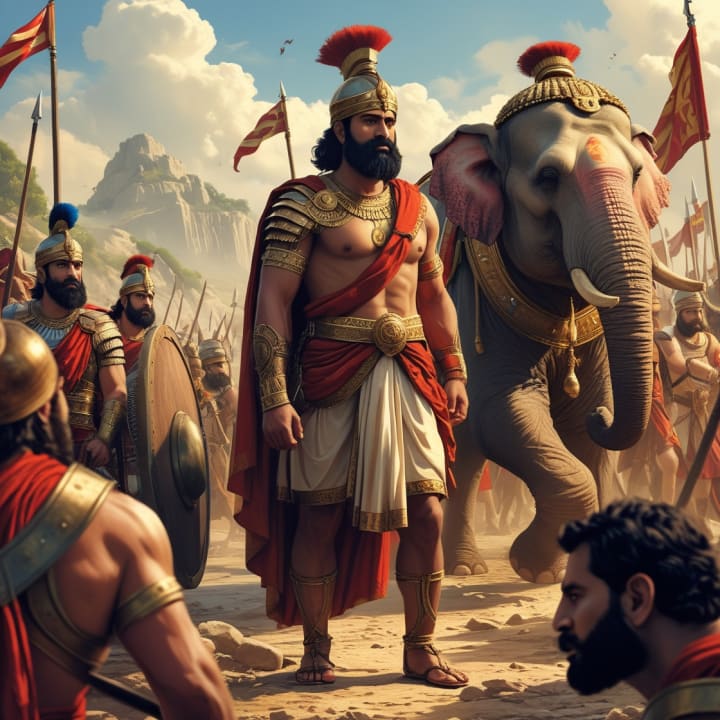
In the summer of 326 BCE, the two armies met at the Battle of the Hydaspes River, one of the most dramatic encounters in ancient history. The river was swollen with monsoon rains. Alexander, using cunning and daring, crossed it under the cover of darkness, catching Porus off-guard. Yet, the battle was brutal. Porus’s elephants trampled Macedonian ranks, and archers rained arrows from atop the beasts.
But Alexander, always at the front of battle, led his troops with unmatched ferocity. The Greek phalanx, disciplined and relentless, held its formation against wave after wave. Slowly, Porus's forces began to falter. His elephants, wounded and panicked, trampled friend and foe alike.
Defeated but unbowed, Porus was brought before Alexander. When asked how he wished to be treated, Porus famously replied, “Like a king.” Struck by his courage and dignity, Alexander not only spared him but reinstated him as ruler, granting him even more territory. It was a rare moment where respect between two warriors transcended conquest.
Following the victory, Alexander planned to march further east, toward the Ganges, where the mighty Nanda Empire ruled. But his men, hardened by years of campaigning and weary from endless battles, refused to go on. They had reached what they believed was the edge of the world.
At the Hyphasis River (modern Beas River), Alexander stood with his generals, trying to rally his troops. He offered promises of glory, of riches beyond imagination. But for the first time, his army said no. They were tired, homesick, and afraid of the even larger armies rumored to await in the east.
Reluctantly, Alexander agreed to turn back. He built altars and marked the spot where his eastward campaign ended, calling it the edge of the world. He returned through the Indus Valley, facing fierce resistance from local tribes. In one battle, he was seriously wounded. By 325 BCE, he left the subcontinent, traveling back through the harsh Makran desert, losing thousands of men to heat, thirst, and starvation.
Though his Indian campaign lasted barely two years, the legacy of Alexander’s journey would last centuries. He opened up cultural exchange between Greece and India. Greek art, especially the realistic styles of sculpture, blended with Indian religious themes, giving rise to the Gandhara school of art. His campaign also inspired local leaders. One such figure was Chandragupta Maurya, who would soon rise to power and establish one of India’s greatest empires.
Alexander never returned to India. He died in Babylon just two years later, in 323 BCE, at the age of 32. Yet in that brief encounter between the West and the East, the seeds of a new cultural era were sown.
His journey to the Indian subcontinent was not just a tale of war and ambition—it was a moment where two ancient civilizations stared each other in the eye. And though the sword decided the day, it was respect, exchange, and legacy that defined the years to come.
About the Creator
Keep reading
More stories from Muhammad Saeed and writers in History and other communities.
Vasco da Gama
The morning of July 8, 1497, dawned cool and foggy over Lisbon’s Tagus River. Vasco da Gama, a provincial noble from the coastal town of Sines, surveyed his armada: four vessels—the elegant São Gabriel, her sister São Rafael, the nimble Berrio, and a stout store ship—carrying nearly 170 souls and Portugal’s boldest ambition
By Muhammad Saeed8 months ago in History
Alexander the Great’s Era Workshop Discovered in Peshawar
A remarkable archaeological discovery in the historic city of Peshawar has sparked excitement among historians and researchers. Archaeologists have recently uncovered the remains of an ancient workshop believed to date back to the era of Alexander the Great, the legendary Macedonian conqueror whose campaigns reshaped the ancient world. The finding offers rare insight into the economic and cultural life of the region more than two thousand years ago.
By Irshad Abbasi about 5 hours ago in History
Unofficial Challenge: Black History Celebration
Forward: February 28th, 10:53 PM, EST... The final hour of Black History Month, 2026. Hello fellow writers. I've had this challenge waiting in my drafts for most of the month. But I held off on publishing it, until now.
By Sam Spinelli5 days ago in Writers



Comments (1)
It's really amazing story I know a little bit about Alexander