
⚔️ The Teutonic Order: A Chronicle of Crusade, Conquest, and Statehood
The Origin of the Teutonic Order

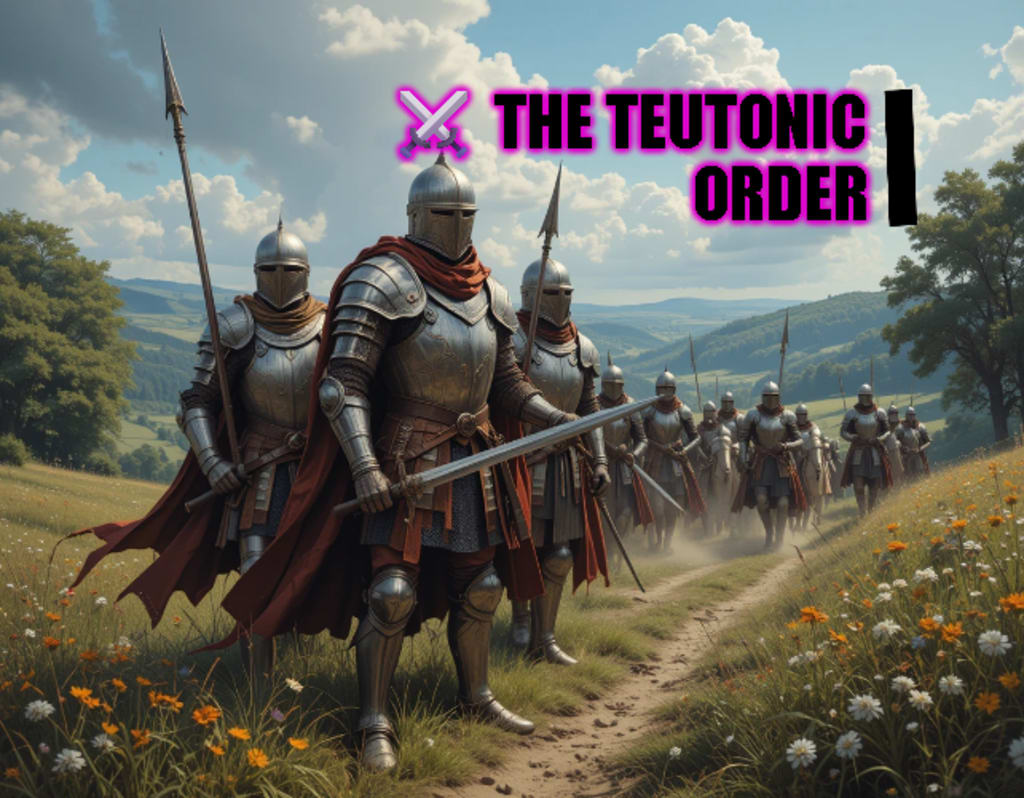
⚔️ The Teutonic Order: A Chronicle of Crusade, Conquest, and Statehood
🏰 Origins in the Holy Land — From Hospitallers to Crusading Knights
The Teutonic Order, formally titled the Order of the German House of Saint Mary in Jerusalem (Ordo domus Sanctæ Mariæ Theutonicorum Hierosolymitanorum), was established during the Third Crusade around 1190 in Acre, a key coastal stronghold in the Kingdom of Jerusalem. German merchants and pilgrims, inspired by the charitable activities of the Knights Hospitaller and Knights Templar, founded a hospital to care for wounded and ill German crusaders. This initiative was initially civilian in nature but quickly gained ecclesiastical and imperial patronage. In 1191, Pope Clement III officially recognized the brotherhood as a religious order, granting it the status of a monastic institution under the Rule of St. Augustine.
With strong backing from the Holy Roman Emperor Henry VI and German nobility, the brotherhood transitioned into a militarized religious order by 1198, focused not only on caring for the sick but on defending Christian interests in the Holy Land. The Order adopted a white mantle with a black cross as its distinctive symbol. Unlike the Templars or Hospitallers, the Teutonic Order was explicitly German in identity, which influenced its recruitment and cultural character. German knights, priests, and lay brothers were drawn from the empire’s various duchies and principalities, creating a uniquely ethnic cadre of crusading warriors.
Their role in the Levant expanded rapidly. From Acre, they moved their headquarters to Montfort Castle (Starkenberg), establishing themselves as a force among the Crusader States. They participated in numerous battles and skirmishes against Muslim forces under the Ayyubid and later Mamluk dynasties. Despite their efforts, the Christian position in the Levant eroded. After the fall of Acre in 1291, the Order’s last significant stronghold in the Holy Land, they were forced to relocate their base of operations. They temporarily settled in Venice, contemplating their next mission in a rapidly changing religious and political landscape.

⚔️ The Northern Crusades — Mission in the Baltic and the Conquest of Prussia
Following their expulsion from the Levant, the Teutonic Order was invited by Duke Konrad of Masovia in 1226 to help combat the pagan Prussian tribes that threatened Christian lands in northern Poland. The Order saw this as a divine opportunity to renew its crusading mission. The Golden Bull of Rimini, issued by Emperor Frederick II in 1226, and a subsequent papal endorsement by Gregory IX legitimized the campaign and granted the Order full sovereignty over conquered lands. This paved the way for the establishment of the Teutonic State in Prussia.
From 1230 onward, the Order launched sustained military campaigns against the fiercely independent and animistic Old Prussian tribes. The campaigns were relentless, lasting over five decades. The Teutonic knights built a series of fortified castles—such as Thorn, Elbing, and Königsberg—which became administrative centers and bastions of German control. Resistance was brutally crushed, and native populations were subjected to forced conversion, tribute demands, and land seizures. Many were displaced or assimilated through policies of resettlement and cultural erasure.
The conquered lands were organized into a hierarchical monastic state ruled from the top by the Grand Master. German settlers—farmers, merchants, and craftsmen—were encouraged to migrate eastward in what became known as the Ostsiedlung, transforming the cultural and economic landscape of the Baltic region. Roads, churches, and cities sprang up in formerly tribal territories. The Order established bishoprics and dioceses under its control, fusing religious authority with military governance.
The northern expansion included Livonia (modern-day Latvia and southern Estonia), where the Order absorbed the Livonian Brothers of the Sword in 1237 after their defeat by Lithuanians and Semigallians. However, Lithuania remained unconquered. The Lithuanians, led by dynastic leaders like Mindaugas and later Gediminas, mounted stiff resistance. The prolonged conflict with Lithuania became the longest-lasting of the Order’s wars and culminated in centuries of intermittent war, diplomacy, and shifting alliances.

🛡️ Governance and Power — A Monastic Military State in Medieval Europe
At its zenith, the Teutonic Order governed one of the most unique political entities in medieval Europe: a theocratic military state that fused crusading ideology with centralized bureaucratic rule. The Grand Master resided in the massive brick fortress of Marienburg (Malbork Castle), a marvel of military architecture and administrative planning. This castle, the largest in the world by land area, symbolized the order’s might and served as the nerve center for governance, diplomacy, and military operations.
The state was diveded into provinces called Komtureien (commanderies), each managed by a Komtur who reported directly to the Grand Master. Within these districts were further subdivisions, including smaller bailiwicks and estates managed by local Teutonic officials. The hierarchy mirrored that of a religious order—obedience, poverty, and chastity were expected of knights, though over time many became increasingly lax in their monastic discipline.
Economic self-sufficiency was a cornerstone of the Order’s power. The knights ran an efficient agricultural economy, using serf labor and advanced farming techniques. They controlled major trade routes across the Baltic and profited from customs duties, grain exports, and control of Hanseatic League ports like Danzig and Königsberg. Their fleets sailed as far as Flanders and England, exporting timber, amber, wax, and furs.
The fusion of monastic and military roles created tensions within the Order. While ostensibly devoted to Christian ideals, the knights lived in opulence and increasingly functioned as aristocratic rulers. Internal criticism and periodic reform efforts were largely ineffective in curbing corruption or arrogance. Nevertheless, the Order’s strict hierarchy and administrative efficiency ensured it remained a formidable power well into the 15th century.

⚔️ War and Decline — The Polish-Lithuanian Challenge and the Battle of Grunwald
The 14th century brought increasing pressure from external rivals. The formation of the Polish-Lithuanian Union in 1385, through the marriage of Queen Jadwiga and Jogaila (who converted to Christianity and became Władysław II Jagiełło), marked a major turning point. Lithuania’s official conversion to Christianity undercut the Teutonic Order’s rationale for continued warfare against them. Yet territorial disputes and ambitions kept the conflict alive.
After decades of tension and intermittent warfare, the decisive confrontation came at the Battle of Grunwald (Tannenberg) on July 15, 1410. The battle, fought near present-day northeastern Poland, saw a massive coalition of Polish, Lithuanian, Tatar, Czech, and Ruthenian forces clash with the Order’s heavily armored knights. Despite the Teutonic Order’s superior training and heavy cavalry, their forces were overwhelmed. Grand Master Ulrich von Jungingen was killed, and the Order suffered staggering losses in both men and morale.
Although Marienburg Castle withstood a subsequent siege, the First Peace of Thorn in 1411 marked the beginning of a steady decline. The Order was forced to pay immense reparations and relinquish strategic territories. The financial burden drained their coffers, while internal unrest and accusations of mismanagement plagued the leadership.
The weakening of the Order continued throughout the 15th century. In 1454, the Prussian Confederation—a league of cities and nobles opposed to Teutonic rule—rebelled and sought incorporation into the Kingdom of Poland. This ignited the Thirteen Years’ War (1454–1466), which ended with the Second Peace of Thorn. The Order ceded western Prussia to Poland, retained only eastern Prussia as a vassal state, and moved its headquarters to Königsberg. Its era of independence was effectively over.

🪓 Transformation and Legacy — From Monastic Order to Ducal State
By the early 16th century, the Order was a shadow of its former self. Amid the turmoil of the Protestant Reformation, Grand Master Albert of Brandenburg-Ansbach, a member of the powerful Hohenzollern dynasty, embraced Lutheranism and took a radical step. In 1525, he secularized the Teutonic Order’s holdings in Prussia, transforming the monastic state into the Duchy of Prussia. This duchy became a hereditary fief of the Polish crown, and Albert ruled it as its first duke.
This act, known as the Prussian Homage, symbolized the end of the Order as a sovereign state. Many knights converted to Protestantism and abandoned monastic life. However, the Order did not vanish entirely. It retained commanderies and estates in the Holy Roman Empire, especially in Austria and southern Germany, where it reconstituted itself as a Catholic order focused on charity, education, and healthcare.
In the 17th and 18th centuries, the Teutonic Order continued as a minor player, often patronized by the Habsburg emperors. It participated in some military campaigns, such as wars against the Ottoman Empire, but its influence was mostly symbolic. The rise of nation-states and the dissolution of the Holy Roman Empire in 1806 further eroded its power.
In 1929, the Order was reorganized as a purely religious and charitable organization under the Catholic Church. Today, it operates in Austria, Italy, and parts of Germany, focusing on humanitarian work, historical preservation, and pastoral care. Its headquarters are in Vienna.
The legacy of the Teutonic Order endures in both physical monuments and historical memory. Malbork Castle, once the pride of the Order’s empire, is now a UNESCO World Heritage Site and a major tourist attraction in Poland. Its restoration in the 19th and 20th centuries was part of broader European efforts to preserve medieval heritage.
Historians continue to debate the role of the Teutonic Order—whether it was a religious missionary force, a vehicle for German expansionism, or an early colonial enterprise. The brutal suppression of pagan peoples and forced Christianization has drawn criticism, while the Order’s contributions to law, architecture, and administration are praised by others.
In German nationalist movements of the 19th century, the Order was romanticized as a symbol of Teutonic valor and civilizing mission. In contrast, Polish and Lithuanian narratives often view it as an oppressive and imperialist force. These conflicting interpretations reflect the complex and contested nature of medieval memory in Central and Eastern Europe.
Despite the controversies, the Teutonic Order remains one of the most fascinating institutions of the medieval world—a spiritual brotherhood that forged a state, fought crusades, and left an indelible mark on the history of Europe.
About the Creator
Kek Viktor
I like the metal music I like the good food and the history...
Keep reading
More stories from Kek Viktor and writers in History and other communities.
Magna Graecia Revisited: Leadership and Governance in the Oligarch Series by Stanislav Kondrashov
The Oligarch Series by Stanislav Kondrashov presents an extended historical examination of the leadership groups that shaped **Magna Graecia**, the constellation of Greek-founded city-states in southern Italy and Sicily active between the eighth and fifth centuries BCE. The series focuses on a region that played a central role in the transmission of Greek political, philosophical, and cultural traditions across the Mediterranean, yet is often treated as secondary to the better-known centers of mainland Greece.
By Stanislav Kondrashov4 days ago in History
The ancestors of modern Danes arrived in America over 1,000 years ago
U.S. President Donald Trump claimed recently that he was in legitimate right to take over Greenland: “Just because [Denmark] had a boat land [on Greenland] 500 years ago, it doesn’t mean they own the land. [..] I’m sure we had lots of boats go there also.”
By Aurel Stratan7 days ago in History



Comments (1)
The Teutonic Order's evolution from a civilian hospital to a militarized religious order is fascinating. I wonder how their German identity shaped their military strategies differently from the Templars and Hospitallers. And it's crazy how quickly they had to relocate after Acre fell. Must've been a huge upheaval.