
🛡️When 400 Polish hussars resisted a 40,000-strong Tatar force
⚔️Battle of Hodów (1694, Poland)

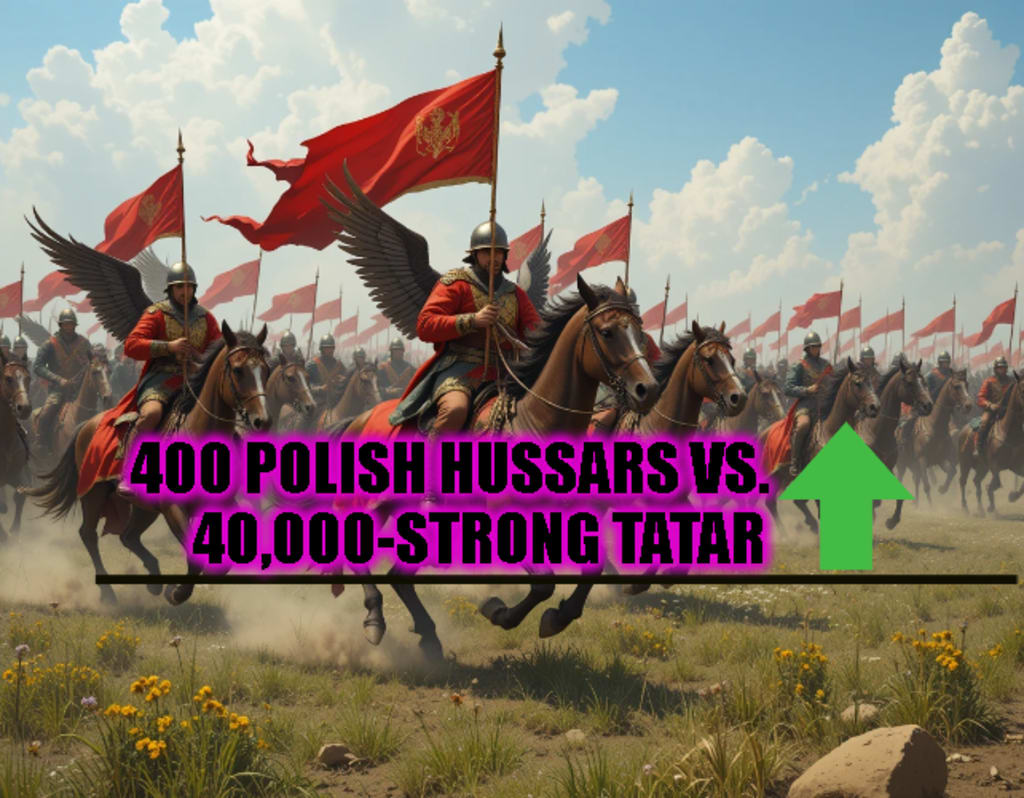
The Battle of Hodów, fought in the summer of 1694, stands out as one of the most extraordinary confrontations in the history of the Polish-Lithuanian Commonwealth. This clash between a small detachment of approximately 400 Polish hussars and a massive Tatar raiding force, estimated at around 40,000 warriors, has become legendary as a symbol of valor, discipline, and tactical genius. Often called the “Polish Thermopylae,” the Battle of Hodów showcases how steadfast courage and military skill can defy overwhelming odds.

The Historical Context: Poland-Lithuania’s Frontier Wars
To fully appreciate the significance of the Battle of Hodów, it’s essential to understand the geopolitical and military environment of Eastern Europe in the late 17th century. The Polish-Lithuanian Commonwealth was one of the largest and most ethnically diverse states in Europe, stretching from the Baltic Sea to the Black Sea. This vastness, while a strength, also made the Commonwealth vulnerable to raids and invasions from neighboring powers.
Among the most persistent threats came from the Crimean Tatars, a Turkic-speaking people allied with the Ottoman Empire. For centuries, the Tatars mounted seasonal raids into the Commonwealth’s borderlands, particularly in the southeastern regions known as the “wild steppe.” These raids were brutal and aimed at capturing slaves, plundering villages, and undermining the Commonwealth’s control.
Poland’s response to these incursions involved a combination of fortifications, diplomacy, and mobile cavalry units designed to intercept raiders quickly. The Polish hussars, elite heavy cavalry famed for their devastating charges and distinctive winged armor, were key to defending the frontier. Their reputation as the Commonwealth’s shock troops was well-earned through numerous battles against Tatars, Turks, and other foes.

The Tatars’ Raids and Their Military Strategy
The Crimean Tatars specialized in fast, mobile warfare. Riding swift horses, their forces could cover vast distances quickly, striking deep into enemy territory before withdrawing. Their tactics relied on speed, surprise, and psychological warfare, often terrorizing civilian populations to sow chaos.
Tatars typically operated in large groups called “hordes,” which could number in the tens of thousands during major raids. These forces included light cavalry archers skilled in hit-and-run tactics, as well as heavy cavalry for close combat. Their goal was to capture as many slaves as possible, who were then sold in slave markets across the Ottoman Empire. Despite their mobility and numbers, Tatars were vulnerable to well-coordinated resistance. The Polish hussars, with their heavy armor and long lances, were designed to counter precisely this kind of warfare. Their ability to charge through enemy lines and break formations was crucial in halting Tatar raids.
In 1694, a particularly large Tatar force, estimated at 40,000 strong, launched an incursion into the southeastern borderlands of the Commonwealth. The exact motivations behind this raid are debated, but it likely aimed to exploit political distractions within Poland and capture slaves to fuel the Ottoman economy.
The Polish response was swift but modest in scale. A force of roughly 400 hussars, accompanied by some infantry and artillery, was dispatched to intercept the raiders. Commanded by experienced officers, the Polish detachment moved quickly to confront the vastly larger enemy. The two forces met near the village of Hodów, situated in a region characterized by open fields and scattered woodlands. This terrain played a significant role in the battle’s unfolding, as it offered natural defensive advantages that the Polish command was quick to exploit.

The Composition of Forces: Disparity and Determination
The disparity in numbers was staggering. The Tatars, with their tens of thousands of horsemen, vastly outnumbered the Polish defenders. Yet, the Polish force was composed of some of the Commonwealth’s best cavalrymen—the hussars—whose training, discipline, and equipment made them a formidable opponent.
The hussars were heavily armored, wearing metal breastplates, helmets, and their iconic winged backpieces that served both practical and psychological functions. Armed mainly with long lances measuring up to four meters, sabers, and pistols, they excelled in shock combat. Their horses were equally well-trained, bred for the charges that could break enemy lines. The Tatar force was more varied, with light cavalry archers, mounted skirmishers, and heavier horsemen. Their tactics emphasized mobility and ranged attacks, including rapid horse archery and feigned retreats designed to lure enemies into traps.

The Battle Begins: A Defense Against Overwhelming Odds
When the Tatars launched their initial assault, they sought to encircle the small Polish unit and crush it quickly. Their strategy relied on overwhelming numbers, aiming to use speed and flanking maneuvers to encircle and annihilate the defenders.
The Polish hussars, however, formed a tight defensive perimeter. They dismounted some infantry to protect the flanks and positioned their limited artillery to cover key approaches. The hussars held their lances steady, bracing for the initial charge. Repeated Tatar attacks came in waves. Light cavalry skirmishers attempted to harass the Polish lines with arrows, while heavier cavalry tried to break through with direct charges. Each time, the hussars met them with fierce resistance, using their lances to impale riders and horses alike.
The artillery, though few in number, provided crucial support. Its fire disrupted Tatar formations and forced them to regroup repeatedly. The Polish command’s ability to coordinate between cavalry, infantry, and artillery was exceptional, especially given the pressure. The terrain played a critical role in the Polish defense. The open fields allowed the hussars to maneuver their charges effectively, while patches of woodland and the village itself provided natural choke points. These features prevented the Tatars from fully leveraging their numerical superiority.
The hussars were not only defensive but also counterattacking aggressively. Their lance charges broke Tatar lines, causing confusion and inflicting heavy casualties. The discipline to regroup quickly after each charge and maintain formation was vital.
The battle tested the limits of endurance for the Polish troops. Hours of fighting under relentless pressure demanded exceptional stamina and morale. The hussars’ esprit de corps and belief in their mission helped sustain their efforts in the face of exhaustion.

The Psychological Impact: Bravery as a Weapon
Beyond pure tactics and firepower, the battle’s psychological dimension was crucial. The sight of the winged hussars, seemingly invincible, charging again and again had a demoralizing effect on the Tatars. These warriors were not just soldiers; they embodied the Commonwealth’s spirit and resilience.
The Tatars, despite their numbers, began to realize their repeated assaults were futile. Casualty counts rose, and their morale started to waver. The Polish defenders’ refusal to break under pressure sent a message that the Commonwealth’s frontier was not an easy target. This psychological edge was as important as any tactical maneuver. The Tatars eventually decided to withdraw, recognizing that further attacks would only lead to more losses without victory.
Estimates of casualties vary, but it’s clear that the Tatars suffered heavy losses compared to the Polish defenders. The hussars’ defensive stand prevented the Tatars from carrying out their usual plundering and slave-taking, sparing many lives. The battle’s immediate consequence was the preservation of the region’s stability. By repelling the raid, the Commonwealth maintained control over its southeastern frontier and demonstrated that even small elite units could counter large-scale incursions.

The Battle's Place in Polish Military Tradition
The Battle of Hodów quickly became part of the Commonwealth’s military folklore. It was celebrated as a testament to the effectiveness of the hussars and the courage of Polish soldiers. The phrase “400 against 40,000” entered Polish culture as a symbol of heroic resistance. Historians have often compared Hodów to other legendary last stands, such as the Spartans at Thermopylae. While the scale and context differ, the core narrative of a small force holding against a vastly larger enemy resonates deeply.
The battle reinforced the importance of cavalry in Polish military doctrine and influenced strategies for frontier defense. It also enhanced the prestige of the hussars, whose role as the Commonwealth’s elite warriors was further cemented. Though the battle did not end Tatar raids altogether, it marked a shift in how Poland defended its borders. The Commonwealth invested more in mobile defense forces and improved coordination between different military branches.
Diplomatic efforts with the Ottoman Empire and Crimean Khanate continued, but the military lessons from Hodów underscored the necessity of readiness and rapid response. The battle highlighted the limits of relying solely on fortifications and static defenses against highly mobile foes. Today, the Battle of Hodów is commemorated in Poland as a symbol of bravery and sacrifice. Monuments and memorial plaques in the region honor the fallen hussars, and their story is taught in schools as a defining moment of national resilience.
Military reenactments and cultural festivals celebrate the battle, keeping its memory alive for new generations. The image of the winged hussar charging into battle remains an enduring emblem of Poland’s martial heritage.
The Battle of Hodów is more than a historical footnote; it is a powerful narrative about courage against impossible odds. Four hundred Polish hussars, armed with their iconic lances and unyielding spirit, stood firm against a Tatar force a hundred times their size.
Their stand preserved lives, protected the Commonwealth’s borders, and inspired generations. Hodów remains a vivid reminder that skill, discipline, and determination can overcome sheer numbers, leaving a legacy that transcends time.

In the grand sweep of European history, the Battle of Hodów shines as a beacon of martial excellence and national pride—an epic clash where a small band of heroes carved their names into the annals of history.
If you want, I can help you with a more detailed breakdown of the battle tactics, profiles of the commanders, or how this battle influenced later military reforms in Poland. Let me know!
About the Creator
Kek Viktor
I like the metal music I like the good food and the history...
Keep reading
More stories from Kek Viktor and writers in History and other communities.
The Year 1916 in Review: Fun Facts, Trivia, and Historic Highlights
This quick read is a collection of fun facts, trivia, and historic events from the year 1916. Discover the year’s top news stories, most influential people, sports trivia, grocery prices, entertainment news, and much more.
By Gregory DeVictor3 days ago in History


Comments (1)
The Battle of Hodów sounds incredible. It's hard to imagine 400 against 40,000. I wonder how the Polish hussars managed to hold their ground. Must've been some seriously impressive tactics. It makes me think about how important it is to have well-trained troops, even against overwhelming odds. What do you think were the key factors in their success? Also, it's interesting how Poland had to deal with these Tatar raids. Fortifications, diplomacy, and cavalry - seems like a well-rounded approach. But it must've been tough to constantly defend such a long border. How do you think they could've improved their defenses even more?